
Category Archives: Market Intelligence

Big Data = Big Mistake

FT.com recently published a great article on Big Data that asked Are We Making a Big Mistake which contains the best description SI has seen yet for Big Data: Big Mistake!

Why? Because, even though there are times we might want correlation to be causation (because then we could put an end to IE once and for all), it is not, never was, and never will be. never, Ever, EVER!* And, as pointed out in the article, just because a correlation algorithm works great for predicting trends, such as the spread of influenza, three years in a row, this doesn’t mean it’s going to work well the fourth year. Randomly identified statistical patterns in data are just that — randomly identified statistical patterns in data.

The Google example in the article is a huge example of how big data can fail in a massive, embarrassing way. In Nature 457, published 19 February 2009, Google published a paper entitled detecting influenza epidemics using search engine query data that detailed how they were able to track the spread of influenza across the US more quickly than the Centers for Disease Control and Prevention (CDC). Using a big data algorithm that detected a correlation between what people searched for and and whether they had flu systems, Google was apparently able to track the spread of influenza with only a day’s delay, compared to the week or more it took the CDC to assemble a picture based on reports from doctors’. This theory free approach worked for four years, and then failed spectacularly in 2013 when it drastically over-estimated peak flu levels, as chronicled in this article on When Google Got Flu Wrong over on Nature.com.

To put the issue of correlation vs causation into terms everyone can understand, if correlation was causation, Microsoft would be on trial as an accomplice to felony murder in every state in the United States, since the declining usage of internet explorer directly correlates with the declining murder rate in the US:
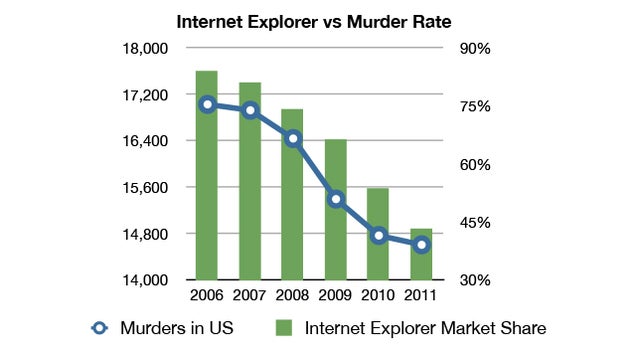
In other words, if correlation was causation, then using Internet Explorer invokes violent tendencies which leads to murder, and its continued existence is criminal.**

This is the problem with big data today. Everyone is using it to try and detect potentially useful correlations, instead of trying to support or disprove useful, actionable, theories. Why? Because, as the FT.com article states, figuring out what causes what is hard, and some would even claim it to be impossible.

Correlation might work in the short term, as it did for Google that was able to predict the spread of influenza for a few years, but it always fails in the long term. And if you have no idea what is behind a correlation, you have no idea what might cause that correlation to break down. Just like a stock market trading algorithm, it might work for a year, a month, a week, a day, or a minute. You just don’t know.

That’s why relying on correlation-based big-data algorithms is a big mistake. While they will give you interesting patterns to examine, relying on them will lead you down a dark and winding road that leads to the edge of a deep canyon (that you are aren’t going to see until you fall in). Unless you can come up with a reasonable theory and support it with the data, it’s just an interesting pattern — and you should continue on your merry way until you find an interesting pattern you can actually explain unless you too want to end up with egg on your face.

That’s why Sourcing Innovation Still Prefers Big Brains to Big Data, and likely always will. We might be slaves to the corporations in the continuum, but that doesn’t mean we have to be slaves to stupidity.

* Everyone should know by now that correlation is not causation given that Pinky and the Brain gave you all a great Lesson in Statistics six years ago (when they were still in the employ of a certain Burlington sourcing provider …)

** It’s distribution was criminal for a while when Microsoft tried to create a browser monopoly by embedding it in the Operating System in a way that led Windows users to believe there was no other choice, as monopolies are illegal in many countries, but, I’m sorry to say, the continued existence of IE is not criminal, just sad and frustrating.

Too Many Marketing Fingers in the Procurement Pie? And if You Need Help, Get It.

Let’s face it. If Marketing hasn’t let you put your fingers in the Marketing Procurement Pie, then you don’t have any experience executing and managing Marketing and Agency projects in your organization. Furthermore, given the more traditional role of Procurement and Supply Management, all of the training and expertise that has been imparted to you has probably focussed on direct and indirect materials management, and not ephemeral creative services.

If you want to be taken seriously, you have to not only be an expert in your function, but very knowledgeable in the Marketing function as well. You have to know their process, KPIs, and lingo and speak it like a pro. Otherwise, you look like a n00b in a l33tsp34k forum, and you won’t be taken seriously.

If you don’t make the cut, then you better bring in help, get up to snuff, and make sure you are putting your best foot forward before taking on your first Marketing Procurement project. As per our previous post in this series, you will be put on probation and likely only get one chance to succeed. Fail on even one task, and you’ll be blamed for everything and not allowed back in until there is a change in leadership. (It’s harsh, but you need to remember where the biggest concentration of egos typically are outside of the C-Suite.)

A third-party experienced in marketing procurement can not only help you understand the lingo, the relevant KPIs from a Marketing viewpoint, and the process customizations that are likely to get Marketing’s attention, but can also help you with:

  • Analysis & Benchmarking
    Chances are you are struggling getting enough clean and current data just to analyze and breakdown Marketing’s current spending — how are you going to benchmark the industry when Marketing never bothered to save bids and quotes from agencies that didn’t win the bid?
  • Subject Matter Expertise
    In addition to helping you with lingo, KPI definition, and process customization, they can also help you prepare the SoWs (Statements of Work), MSAs (Master Services Agreements), and Rate Card templates that make sense for your organization.
  • Time Bank
    Chances are that your team is already “time bankrupt” and barely has the time to do it’s job, yet alone learn another function. Bringing in the appropriate expertise not only minimizes the amount of time you need to identify the relevant subject matter, but to run the first project successfully as you will have an expert guiding you each step along the way. In addition, an outside third party can help you with the time-intensive data collection, cleansing, and benchmarking, freeing your team up to focus on what is important.

For more information on what a third party can bring to the table, check out Source One Management Services’ new white-paper on “Fueling Effective Collaboration: How Strategic Sourcing Delivers Results for Marketing Groups”. There aren’t many resources out there on Strategic Sourcing for Procurement (and SI knows this as it’s been talking about the importance thereof since it started back in 2006), so take advantage of what there is when something comes your way.

Too Many Marketing Fingers in the Procurement Pie? Then You Need To Run a Successful Event.

Once you get Marketing’s attention, you’ll probably be put on probation. Just because the CFO views you positively because you are helping the organization identify 5% to 20% savings annually in every category you touch, this doesn’t mean Marketing does — even if Marketing acknowledges that they need to get their spend under control and deliver more value. So you’ll be given permission to help with one or two “pilot” projects, and if you want to get on Marketing’s good side and take back the Procurement Pie, you will have to succeed and impress. This sounds easy enough, since you already have a standard five/six/seven step sourcing process which is generic enough to be applied everywhere, but, as always, the devil is in the details! Unlike most indirect purchases, it’s not as easy as searching a database or sending out a Request for Interest. Different agencies have different strengths, and different capabilities. Some can manage third party production houses, some can’t, for example. You need to have a firm understanding of what Marketing needs to help identify the right agencies. Second, evaluating an agency pitch is not like evaluating a physical product or manufacturing plant. What are you looking for, and what aren’t you looking for. Again, you need to have a firm understanding of what Marketing needs and a solid understanding of the lingo used by the Agencies as well as Marketing.

And you need to present Marketing with a clear picture of the process you are going to follow up-front and make sure that Marketing understands the process you are using and the critical importance of not circumventing the process, no matter how many times the incumbent Agency representative uses his direct-dial rolodex and asks someone in Marketing to let a requirement slide or just skip straight to the pitch. To get Marketing’s commitment, the process should look like it has been customized to them and use terminology they understand. If you need a good starting point, a recent paper by Source One Management Services, LLC. has a great process graphic you can use in their recent Marketing Insight Report on “Fueling Effective Collaboration: How Strategic Sourcing Delivers Results for Marketing Groups”.

Be sure to pay special attention to the following tasks:

  • Scope of Work (SoW) Definition
    This is what the agencies respond to and will determine not only whether or not the right agencies respond but how accurate their responses are.
  • Agency Identification
    You don’t want to send the SoW to an agency that you know is not appropriate or that would present a conflict of interest (especially if they are working with your direct competitor).
  • Market Assessment
    You have the RFI/RFP process down pat, but you are not necessarily experts in the Agency Marketplace or in what the standard rates are (or should be). This is where your benchmarking skills are really going to come into play.
  • Pitch Evaluation
    You have to make evaluations a qualitative and deliberative process on your terms, not a seat-of-the-pants decision in the Agency’s boardroom, which is what The Crazy Ones want you to do. You have to work with Marketing to build a quantitative scorecard that will be consistently applied to all pitches and select your finalist(s) based on the scorecard.
  • Negotiation, SoW, and Contract
    You know better than everyone that the way to avoid a contract dispute is to address and negotiate the issue up front because, as the saying goes, if you have to reach for the contract, then you’ve already lost the argument. This means leaving no “i” undotted, no “t” uncrossed, and no potential risk, no matter how small, unaddressed. This is your forte. You can make sure no stone remains uncovered, which greatly increases the chances of unblemished project success. (Which, to be honest, is often all Marketing really cares about.)You also know that you have to move Marketing away from just handing over the account and letting the agency run with the account to specifying detailed contracts, statement of work, budgets, and rate-cards as well as processes for selecting and managing third party vendors. You have to help Marketing make the agencies understand that while they can run free on creative within the boundaries specified by Marketing, print, production, etc. has to be managed according to guidelines and budgets.

While you won’t be thanked for your many successes, even though proper benchmarking and reporting will have you recognized by the CFO and CEO, you will get all the blame for any and all failures if you screw up just once.

Too Many Marketing Fingers in the Procurement Pie? First You Need To Get Their Attention.

Does this sound familiar? The CFO has mandated a 10% across the board spend reduction, and it’s Supply Management’s time to shine. You want to help, but, as expected, Legal and Marketing are refusing your help because, when it comes to litigation, you need the rain maker and when it comes to creative, you can’t put a process behind it and get results. As a result, Legal and Marketing costs are still spiralling out of control while you watch millions being wasted on e-Discovery, cookie cutter legal services, print, basic media production services, and unmanaged third party spend. Getting this spend under control could save Legal and Marketing so much that they could afford to pay even more for the rain-makers and creative geniuses they so covet, but still deliver savings and ROI to the business. But how do you get your point across?

The process is two-fold. First, find out who in the C-Suite wants you to get your message across and help the Marketing organization save money and have them strong-arm the Marketing leaders into a meeting with you in a wireless-signal free zone where these Marketing leaders will be forced to give you their undivided attention. Second, have a firm grasp of what you can bring to the table to help Marketing enhance their organizational performance and make sure you can convey it to Marketing in a crisp, clean, clear, and concise presentation.

Specifically, make it clear that you don’t just bring cost-cutting to the table — you also bring value generation support services which include, but are not limited to:

  • Decision Support
    Your expertise in supplier identification, profiling, and evaluation can help Marketing evaluate current relationships and identify new agencies that might more closely align with Marketing needs.
  • Benchmarking
    Your expertise in spend analysis and visibility can help Marketing get a grip on what it is spending compared to what it should be spending (according to existing contracts and rate cards) as well as a breakdown on how much is being spent on each category (print, media production, creative, etc.) and what opportunities there are for consolidation and spend reduction by leveraging volume and disassociating physical product-based spend from creative spend. (Since Marketing generates value based upon the power of the campaign they deliver, it makes sense to pay Phillippe or Eduardo the $500 an hour he wants for his creative genius if it generates a campaign that gets you noticed more than the competition. After all, he’s just one guy and even if he works 3 months on the campaign, that’s only $240K on what could be a 10M campaign. However, it doesn’t make sense to pay $50 an hour to a guy running the printer at Kinkos, especially since you probably are producing so much paper over the year that you are paying the equivalent of 5 guys at Kinkos to sit there full time and run printers, who should be paid $15 an hour. Net result, you’re overspending $350,000 for copy services — way more than the $140,000 you might save by hiring a second-rate creative genius who might end up generating a second rate campaign that actually hurts your brand and costs Sales $1,000,000 by cutting the wrong corner.)
  • Contracting
    You deal with negotiations and contracts day-in and day-out. As a result, you have the methodology to keep the process moving nailed down, the knowledge to know what needs to be addressed, the ability to work with Legal to create a standard Master Services Agreement template to streamline every negotiation, and the skills to put together an all inclusive Statement of Work that protects both parties and includes rate cards that are fair and beneficial to both parties.
  • Strategic Focus
    Marketing’s strength is in campaign management and strategic brand and product positioning, not in the tactical Procurement process, contract negotiation pitfalls, or the back-end project management, that is often left up to the agency. Your presence lets Marketing focus on it’s strength and not waste time on areas that don’t increase its value to the organization.

Of course, this is just the first step.

Is Supply Chain Finance the new Prisoner’s Dilemma?

In the classic logic problem known as the prisoner’s dilemma, there are two prisoners, being held on a minor charge (such as breaking and entering) which comes with a 1 year prison term, suspected of conspiring together to commit a serious crime (such as grand larceny). There is little actual evidence to convict either of them and the police are relying on a confession by one or both prisoners to convict at least one of them of the more serious crime. In an effort to get this confession, the two prisoners are separated and each is offered an identical deal. The deal is that if one prisoner confesses, he’ll be set free, instead of spending 1 year in jail, and the other prisoner will get a 3 year sentence. If neither prisoner confesses, they each do 1 year, and if both prisoners confess, they will both serve time, but only 2 years each for coming forth. What should the prisoners do?

When the dilemma is analyzed using game theory, each party is most likely to betray the other and spend 2 years in jail rather than remain silent and enjoy the best possible outcome of only 1 year in jail. This is because, regardless of what the other prisoner chooses to do, each prisoner believes they improve their likely outcome by confessing, even though an analysis of the possibilities …


P1 Confess? P2 Confess? P1 Sentence P2 Sentence
N N 1 1
N Y 3 0
Y N 0 3
Y Y 2 2


… indicates that each Prisoner is expected to do an average of only 1.5 years, and betrayal increases time served. Why? It has to do with something called the Nash equilibrium, which is a solution concept of a non-cooperative game where no player has anything to gain by changing only their own strategy (which is often the case when both players have to choose their strategy in secret) and results from the fact that the payoff relationships from each prisoner’s perspective make confession the only case where each player would do worse by unilaterally changing strategy. In simple terms, this means that if prisoner 1 chose confession and prisoner 2 chose confession, then either prisoner changing their choice on their own would result in that prisoner serving more time. In psychological terms, if you don’t confess, and your colleague does, you serve an extra two years while he walks free.

So what does this have to do with Supply Chain Finance (SCF)? Peter Loughlin does a great job making the comparison in his new Purchasing Insight paper on “Demystifying Supply Chain Finance”, sponsored by Taulia. Simply put, even though the best situation for many buyer-supplier relationships (where a SCF solution that would help both parties is not available) is the status-quo (of no supply chain finance), there is often an incentive for one party to choose a solution that benefits them, even though, as in the case of the prisoner’s dilemma, the choice of that solution often damages the other party considerably (by adding cost to the other party, just like the prisoner’s dilemma adds time).

The reason for this is that each primary SCF solution, for reasons that are clearly explained in the white-paper, has a sweet-spot and any relationship that falls outside of that sweet-spot isn’t helped by the solution, and may even be hurt by it. In a very cramped nutshell:

  • Supplier Finance only helps large volume/dollar suppliers of large buyers because banks aren’t willing to bear the cost of on-boarding the long tail of the supply chain
  • Dynamic Discounting only helps favoured suppliers because most buyers typically don’t’ have the liquidity to pay the entire supply chain early and not all suppliers have e- solutions that integrate with the buyers’ dynamic discounting solutions (assuming that the buyer will extend or negotiate terms across the entire supply base)
  • Pre-Shipment Finance doesn’t help the buyer or give the supplier access to borrowing at the buyer’s creditworthiness

For more details, download Purchasing Insight’s new white paper on “Demystifying Supply Chain Finance”. It’s worth it.