Unlike rock and roll, RFPs are noise pollution, but RFPs ain’t gonna die.
Today we’re tackling a different type of graphic. In this case it’s not one that oversimplifies, but one that misses the core issue — an utter lack of Procurement maturity in the average organization.
This is a case where we don’t have any real problems with the graphic, it’s theoretically correct, but problems with the underlying assumptions, which ignore the fact that most Procurement departments are not ready.
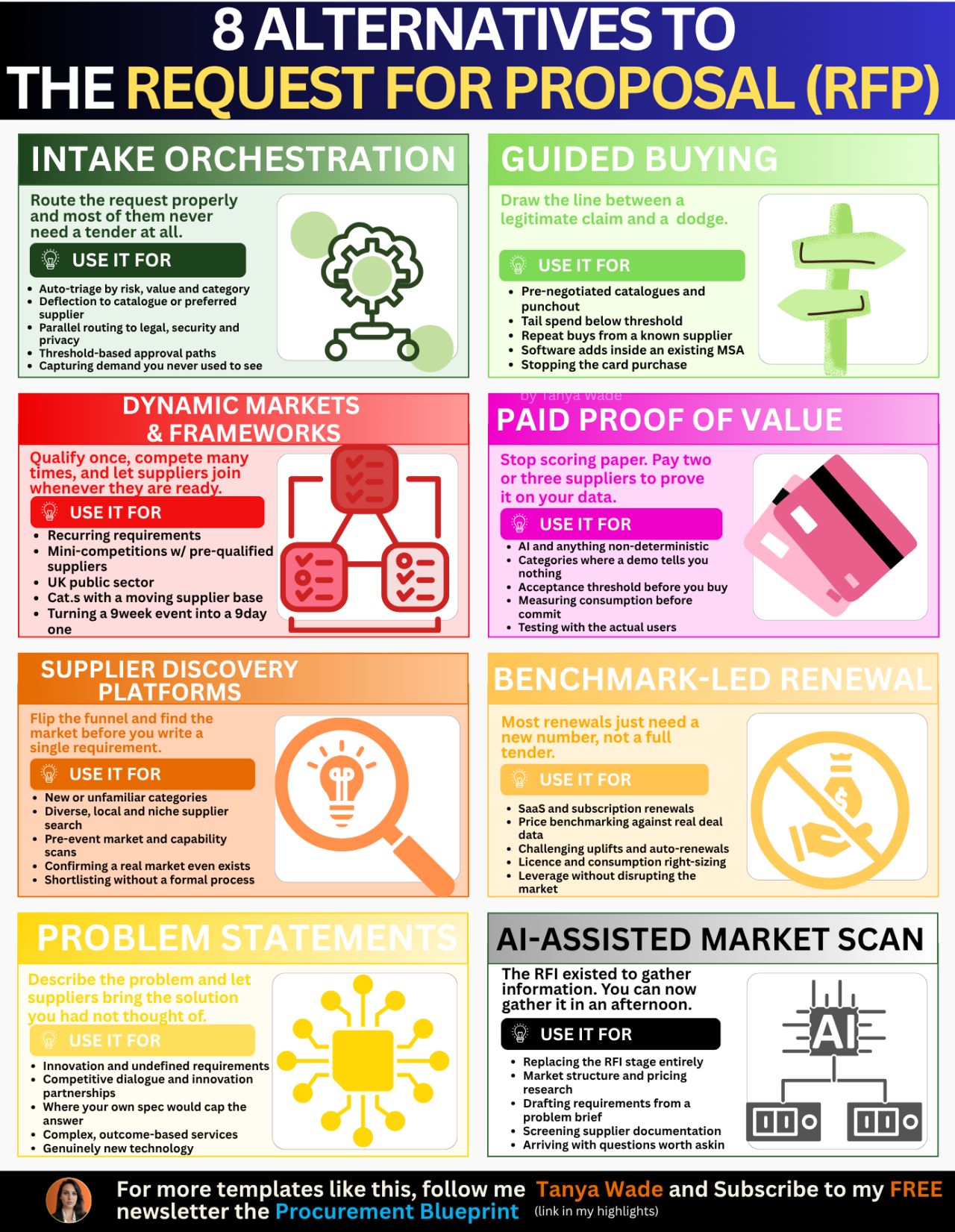
In the graphic in question, Tanya Wade presents 8 valid alternatives to the RFP which all organizations should be aware of.
But here’s the thing, most Procurement departments, to this day, are immature and can barely do basic RFPs and e-Auctions. They have primitive, last generation (if not first generation) sourcing and procurement platforms, and their knowledge puts them on par with the Island of Misfit Toys. They aren’t ready for anything else.
Let’s take Tanya’s suggestions one-by-one.
- Intake-Orchestration (I2O): few organizations have this, and those that claim to just have a software solution from a third party and accept the third party’s definition blindly don’t understand what true I2O really is — because intake isn’t just software, it’s process — and without a good understanding of the process the organization needs and an effort to incorporate that process into the acquired software, I20 doesn’t work (at all)
- Guided Buying: you not only need solutions that support it, but the knowledge to configure them properly so that the end users can self-serve
- Dynamic Markets and Frameworks: the majority of Procurement organizations are not sophisticated enough to handle dynamic markets and frameworks, this has to be done by a third party which requires the use of a Consortium, and while once popular, many of those have disappeared over the last two decades
- Paid Proof of Value: this is great in theory, but not many vendors will do this in practice — they want a sale, not a cost-neutral pilot — and if you won’t guarantee a sale upon success, even those that will consider it won’t do it
- Supplier Discovery Platforms: this is about the only platform the average organization is more-or-less able to use, and the -less part is that while they can use it, they can’t always do the verifications that the platform can’t and will sometimes invite inappropriate suppliers to the RFP and won’t realize it until they go through a full detailed RFP and a product verification, which could waste weeks or months of their time
- Benchmark-Led Renewal: Procurement organizations need external data and external guidance to create benchmarks, and then need guidance on how to interpret them and negotiate on them; and they don’t know where to get this data and how to identify the experts to guide them or negotiate on their behalf (or even find potential help in the first place)
- Problem Statements: i.e. CrowdSourcing — this was supposed to change Procurement two decades ago, and that was the last time we really heard of it …
- AI-Assisted Market Scan: for most procurement departments, this is asking chat, j’ai pété or clod to identify products, services, and suppliers; match to requirements; and make a recommendation — which will result in the procurement regularly getting a quote for the perfect product from a fake supplier that doesn’t exist because these tools hallucinate regularly
In other words, even when the simplified graphic is right, it’s still wrong when the typical Procurement department is not mature enough to implement any of it. Without an understanding of readiness, even the right path is not one an organization can walk down.
Follow Tanya Wade over on The Procurement Blueprint.