
Yesterday, in part 3, we provided an example where a graphic could get everything right, but still miss a core issue, and that issue was that while they might be a good half a dozen alternatives to the RFP, most procurement departments and professionals just aren’t ready for them. That makes the graphic totally useless for most Procurement practitioners in average Procurement departments.
Yesterday we discussed the alternatives presented by Tanya Wade. But Tom Mills also discussed the issue, and even though we already discussed one of his graphics this week, we like him so much we can’t leave him out of this important issue.
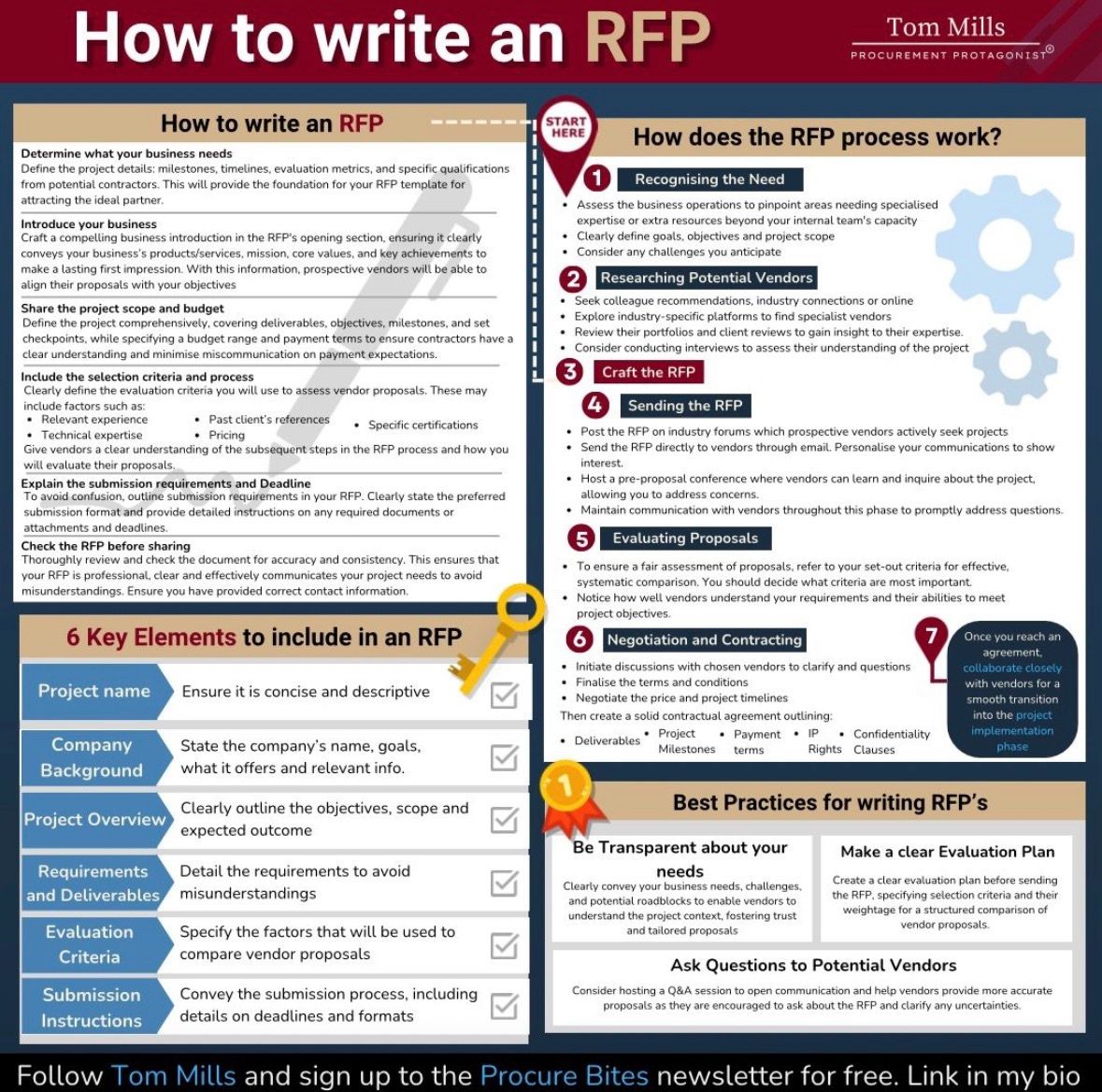
Tom’s graphic was about how to write an RFP. And it is great. Actually, like Tanya’s graphic, it’s truly fantastic. But it has the same problem as Tanya’s … it ignores the underlying issue … that Procurement departments often aren’t capable even with step-by-step instructions.
Let’s take Tom’s 6 steps:
- determine the business needs: it’s not just determining what the business needs, but what fulfills that need … what the core requirements are, the detailed specifications that are required, the utilization requirements, etc. … all of which requires extremely deep technical or process knowledge that Procurement doesn’t possess
- introduce your business: long winded introductions don’t always provide clarity, especially since most companies will puff up their business description, mission, and values with marketing puff that will distract from the core goals and objectives … which is where the RFP needs to start to get the organization on the right track
- project scope and budget: the scope is critical, but you should allow the suppliers to suggest the phases because if you lock them into an inappropriate or inefficient plan you created due to your lack of expertise, you won’t get the best quote; also, it’s not appropriate to suggest a budget on the first contact; the best approach is to precede the RFP with an RFI where you collect basic information on the supplier, their capabilities, and their typical proposal range so you can invite the right suppliers to the full RFP in a budget range that is both appropriate and that you are prepared to pay
- selection criteria: this is dead on … but it has to be right, which means the Procurement department has to be on the same page as the organizational end-user because they can’t shift the criteria and process later or they’ll risk losing credibility
- submission requirements and deadline: this needs to be super clear and the requirements should be well thought out and set in stone because, if you change them, you’ll lose credibility — but if you are looking for a custom solution, you need to be willing to extend the deadline for all parties if a supplier can make a reasonably grounded request (where they clearly explain why they need more time and educate you in the process)
- check the RFP: more specifically, have key stakeholders check … overlooking key requirements will waste everyone’s time …
The reality is that while many Procurement departments don’t know any methods beyond the RFP and e-Auction, they don’t know the process they should be following … and that’s why they can’t write a good RFP, even when they get a great template like Tom’s that tells them what to do step by step — they don’t always have the core knowledge to execute — and that goes beyond Procurement knowledge into deep organizational product and service knowledge and an understanding of who needs to be involved.
n other words, even when the simplified graphic is right, it’s still wrong when the typical Procurement department is not mature enough to implement any of it.
And remember to follow Tom Mills and his Procure Bites for practical procurement proverbs (unless you prefer the pompous pontifications of LinkedIn).