Category Archives: Economics

It’s Good That Asia Is Rising

A lot of people are scared about the rise of China to the 2nd largest producer of GDP and the expected rise of India to be the 3rd largest producer of GDP by mid-century, but I’m not. It’s a good thing. The truth of the matter is that, for the last decade or two, the US share of Global GDP was too high. If a single country controls more than 25% of the GDP, than any significant changes to its economy are going to have drastic ripple effects across the globe.

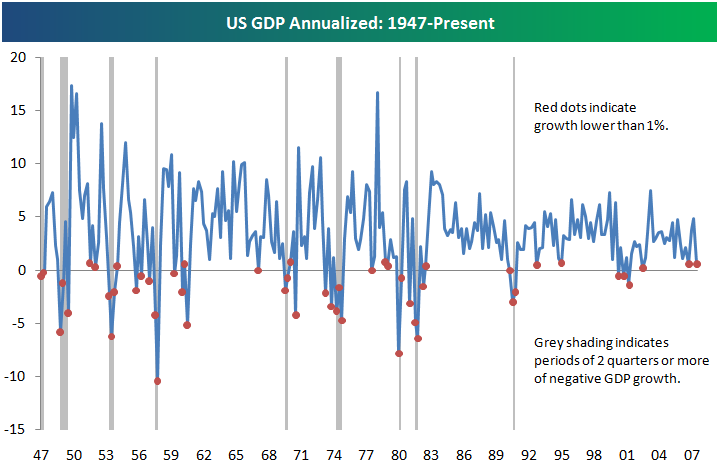
Look at the recent recession. It’s not only the US that was affected — it was all of North America. Then it rippled across the pond to Europe (as most big multinationals have a big US and European presence). And even New Zealand and Australia felt the tail end of the shockwaves. Only Asia survived relatively unscathed, and only because they had a growing economy that resulted from over a decade of heavy investment by the US (and Europe) before the US recession.

So, needless to say, I was annoyed when I saw a recent article in Atlantic Business that asked if if “the Canadian Economy [is] Weakened by its Southern Neighbor” because only someone with their head in the sand for the last 20 years would think otherwise. Every time the US goes down, it takes us with them. They are both our next-door neighbour and biggest trading partner, with 10 times our population and 10 times our GDP. Canada might be the 10th largest economy in the world, but since 70% of our exports go to the US, if we lose 10% of that because of a major US recession, 7% of our GDP is at risk overnight — as it is for any small economy that is dependent on the economy with the largest GDP in the world — an economy that is roughly 3 times that of the next largest economy.

As Asia rises, not only will it minimize the impact of any one economy on global GDP, but it will start buying from us as well as selling to us, and redistribute the wealth back home. If China was going to control the US share of the economy in the near future, then maybe there’d be cause for concern, but right now, the rise of Asia is a good thing. The balance is going to eventually minimize the risks of a meltdown due to a recession in any one economy, and that is going to provide more stability (and predictability) to our supply chains.

Capital Costs are Going Up. Can Your Supply Chain Handle It?

The McKinsey Quarterly just published a great article on “how the growth of emerging markets will strain global finance” (registration required) that should be read by every CPO who doesn’t work for a mega-corporation with a large cash balance. The article will help them understand what’s keeping the CFO up at night and why the CFO, who already has to deal with Basel III, might be afraid to invest in long-term capital projects (or, at the very least, have difficulty committing the capital).

The article points out that when you combine low savings rates in developed economies, decreasing savings rates in the more mature emerging economies, the increasing expenditures required to support the aging population in developed countries (that will further reduce savings), and the growing need for capital-intensive investments in infrastructure in the new emerging economies, in less than 20 years there will be a significantly greater need for investment in the global marketplace than there will be investment dollars available. When you combine this increasing demand for capital with the looming threat of increased inflation, and factor in the increased risks associated with short-term funding, it quickly becomes clear that interest rates have no where to go but up, especially since these rates are now at their 30-year lows. At the very least they will return to their 40-year average (which is about 150 basis points above current rates), but they could rise even higher.

As a result, capital for supply chain infrastructure investments could soon be in short supply. This means that if your supply chain is aging and needs significant infrastructure upgrades in terms of facilities or vehicles, the last thing you want to do right now is extend end-of-life (planning) too far into the future if a costly upgrade is inevitable. At the very least you want to start planning and analyzing different upgrade cost scenarios that factor in different (potential) costs of capital so that you’ll know how much capital the supply chain upgrades are going to require and at what point it becomes too expensive. Then you will be in a good position to work on securing the capital before it’s too late.

Share This on Linked In

Time to Stop Worrying About China

Yes they’re the number two economy and yes they will reclaim their spot as the number one economy in thirty (30) to forty (40) years, but they’re not worth all the attention they’re getting. As per this recent article in The Economist on Chinese Acquisitions, China owns a mere 6% of global investment in international business. That’s less than 1/15th. Compare that to Britian’s stake in international business in 1914 or America’s stake in international business in 1967 when they both held about 50%, or 1/2, of global investment in international business, and you see that there’s really nothing to worry about.

Since most developed world markets have rules in place that insure that no global investor can divert business away from the home country or export trade secrets or compete in a monopolistic way, the rules we have in place for foreign investors right now are good enough. There’s no point wasting time and money developing special rules for China, especially when most of our economies need our attention as it is. And as far as our supply chain is concerned, how about we spend the time and effort making sure they are adhering to our regulations and safety protocols instead? After all, even when they become the dominant economy, they’re not likely to be more than 20% of global GDP (especially since the rest of the BRIC countries are expected to increase significantly in GDP as well) or control more than 20% of global investment. And while 20% is significant, it’s far from majority control. Time to stop the much ado about nothing and get back to business.

Is Your Supply Chain Future In India?

As per this recent article in Digit Chanel Connect on “Moving Up the Supply Chain”, IDC India estimates the total Indian SCM solutions market will reach $132.6 Million in 2011. This might not sound like much, but, in relative terms, it’s the equivalent of a $1.6 Billion dollar market! (In 2009, the GDP of India was one twelfth of the GDP of the US.) And it’s still growing!

India’s Big 6 Consultancies are already making massive inroads into the global market. Many companies are making the SWITCH — Satyam, Wipro, Infosys, Tata Consultancy Services, Cognizant Technology Solutions, and HCL — and the current Big 6 Providers are being PACKED (PriceWaterhouseCoopers, Accenture, CapGemini, KPMG, Ernst & Young, and Deloitte & Touche) in. The major players might be SAP, Oracle, and Aspen today, but it won’t be long before the ABC Procure’s, Algorhythm’s, eBiz Global’s, Griha Software Technologies’, and Zycus‘s become the next major players in the Indian SCM space, and not much longer before those companies, and the next generation, make an even bigger impact on the global e-Sorucing and e-Procurement marketplace.

Furthermore, as Ravindra Sharma, General Manager of Ariba India, says: “With India poised for decent growth, many of the firms are proactively setting up [a] supply chain infrastructure which can help them grow rapidly and profitably. Many of these firms have global business aspirations and are benchmarking themselves with global organizations in various aspects including business processes, practices and technology“. As a result, deployment of SCM solutions is definitely increasing — and Indian companies are working hard to fill the surging demand now that Indian corporates have ‘tasted’ the efficiency of SCM solutions and now believe it to be a vital component of their business readiness plans.

In other words, while most of your technology options today will likely be US companies, or European offices with a strong US presence, it might not be long before many of the options on the table are Indian operations. But with the cloud and 24/7/365 service levels, will it really matter?

Share This on Linked In