
Category Archives: Market Intelligence

There’s More to Cost than Cost Analysis

While it was exceptionally well written, I was a little disappointed with this article on “uncovering hidden costs” over on SupplyManagement.com.

The article, which made the acute observation that there is no fixed arithmetic formula between the cost of producing the goods and services sold to us and the price charged for them: sellers charge what the market will bear and that to break down a suppliers’ figures, we need to know the proportion of each area of cost that the goods or services are likely to attract, did a great job of describing the different types of analysis one could bring to bear on costs, but a poor job of actually indicating how to reduce the “hidden” costs once found. The advice boiled down to “collaboration is key” which, while correct, doesn’t help you answer the important questions that will arise during the collaboration.

While questions like:

  • Can we give our suppliers access to our contracts to reduce cost?
  • Does our supplier have contracts we could access to cut cost?

are theoretically easy to answer (but not always easy to answer in practice due to the poor state of contract management in many organizations)

questions like:

  • What is the thing made of and what is happening in the market for that material?
  • Where are the cost drivers in these goods or services?
  • How can you buy that material most effectively?

are a little harder to answer.

You need to understand how to perform market intelligence, you need to understand how the goods are assembled (using virtual modelling environments like those offered by Apriori) or the services delivered, and you need to understand what innovative new technologies or processes could be applied to reduce those costs. And that’s more than you’re going to get from a purchase-price, open-book, or total absorption cost analysis. You have to start with a true Total Cost of Ownership and then dive in on each cost.
Share This on Linked In

Invoice and Asset Based Lending Goes Mainstream

Venture Finance, the UK’s premiere independent Invoice Finance and Asset Based Lender with 20 years of helping thousands of businesses under their belt, just released a white paper on “the evolution of invoice and asset based lending” that is definitely worth a read. The white-paper, which resulted from a roundtable discussion among UK industry leaders in London late this summer, addressed the evolution of invoice and asset based lending and how it addresses today’s business needs in times of recession and growth.

Today, the UK Invoice and Asset Based Lending (ABL) Industry stakes a strong claim for a place at the commercial finance executive table, growing from £ 7.3B and 13,669 clients at the end of 1995 to £ 46.7B and over 46,000 clients halfway through 2009. This represents a strong, and consistent, growth in an industry which provides security and flexibility when compared with more traditional funding choices, which have proven to be quite fragile over the past 18 months as many banks called in loans and lines of credit with little, if any, notice as a result of the failure of the traditional banking system that started with the collapse of Lehman Brothers. According to research done by Venture Finance across 1,000 UK accounts, in the last year, 58% have had their clients refused credit from banks. As a result, payment times have increased to horrendous levels. Over a third of accountants are now suffering an average payment delay of 14 extra days, and over a quarter are now having to suffer an average payment delay of 30 extra days, which puts a tremendous strain on cash flow when you’re waiting an average of 60 to 75 days to have an invoice paid.

It’s important to note that ABL is not a new concept, having been around in some form or another for centuries, with a history that can be traced back to the glory days of Rome. A few centuries ago, in colonial times, it was common for British merchants to make use of factors to sell goods in the Americas. The industry has evolved significantly in the last 40 years. Whereas its modern beginnings consisted solely of basic factoring and invoice discounting forty years ago, in the 1990’s, we saw the introduction of true ABL that leveraged against stock and plant.

ABL is important because it provides value above and beyond traditional financing. This value includes:

  • direct link to business performance
    if your invoices are strong, so is your credit availability
  • flexible and responsive
    you can decide how many of your receivables you want to leverage, how much funding you want to ask for, and if your business improves, so does your credit availability
  • superior service levels
    in ABL, it is the norm to ensure face-to-face visits occur at least every six months in order to establish a productive and lasting relationship; this allows a relationship manager to pre-empt any upcoming issues in conjunction with the client and ensure that capital remains available; compare this to the banking industry where visits can be yearly at best from a manager with a large client portfolio

When you consider that ABL has grown during the recession, and that it can take as many as 13 quarters for a full recovery if we use previous recessions as a guide, it quickly becomes clear that, for many firms, ABL is a much better financing option than the local bank. In other words, if you’re not doing it, maybe you should. If you’re in the UK, you can start with Venture Finance and if you’re in the US, you can start with The Receivables Exchange.

Share This on Linked In

You Can Compare Apples to Oranges!

And they’re not that different after all!

All you have to do is gently desiccate them in a convection oven at low temperatures over the course of several days, mix the dried samples with potassium bromide, grind them in a small ball-bearing mill for two minutes, press 100 mg of each of the resulting powders into circular pellets having a diameter of 1 cm and a thickness of approximately 1mm, and record their spectra at a resolution of 1cm-1 using a Nicolet 740 FTIR spectrometer.

And when you’re all done, as per the above graph, you’ll find out that apples and oranges are very similar!

So, for those of you who are still claiming your solution can’t be compared to your competition because they’re “apples and oranges”, for e.g., I guess your bubble has been burst.

Source: Apples and Oranges — A Comparison, “Annals of Improbable Research”, May/June 1995.

Share This on Linked In

There’s No New Normal — And There’s Definitely No New New Normal Either!

I was very, very, very disappointed to come across this recent article on ‘The “New Normal” and Its Effects on Supply Chain Management’ in the Supply Chain Management Review because it’s one of the few publications in the place I hold in high regard and, as I pointed out in a recent post, there is no new normal. This means that there is definitely no new new normal either.

The author, who pointed out that senior managers in many businesses are using the catchphrase “The New Normal” as if it were a prescient view of the way things will be from now on, suggested that — since most decisions today are driven by economic conditions — we should consider a New New Normal, defined as a frame of mind where we choose to take the risk of utilizing practices that always work whatever the conditions are. Huh? And double Huh?

First of all, as I said in my last post on the topic, there is no new normal. We’re just in a transitory state on the way to the old normal … coming back after an extended hiatus. Secondly, no practice will always work. Markets always evolve, and practices that work regardless of economic state need to evolve with them. Third, smart companies are already using flexible practices that can adapt with the markets. In short, kill this new normal and new new normal BS and kill the new new new normal BS before it starts. Dust off those old business and economic texts from 20 years ago and start remembering how things in stable economies work — and if you need a reminder, look at the European economies which have been around longer. Then we can get back to the business of running the supply chain.

Share This on Linked In

There is NO New Normal … Just the Old Normal Coming Back

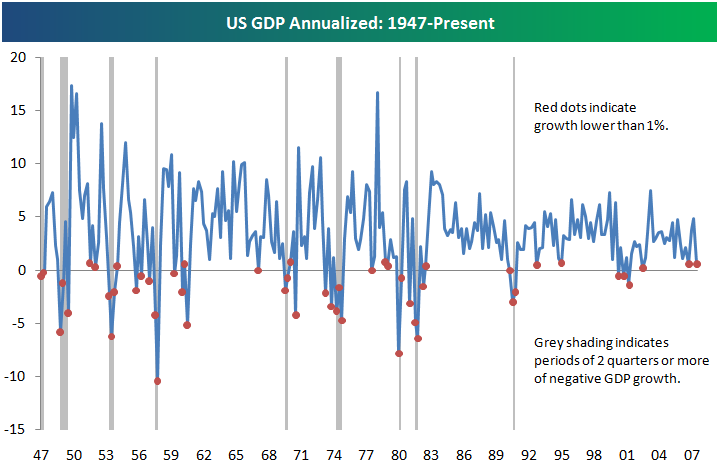
I have to be honest … I get sicker and sicker of “the new normal” each time I hear about it … even though I must admit that upon reflection I did find the recent article from McKinsey Quarterly’s Strategy Practice on “Navigating the New Normal” to be hilarious. For a while I couldn’t put my finger on why I couldn’t stand hearing about “the new normal”, but then it hit me. There’s no such thing as a new normal … just the old normal coming back after an extended 15 year hiatus. After all, if you think back to before 1995 and before the leading edge of the first tech boom, you see a slow, steady growth in the year-over year stock indices going back to 1975*1. And if you look at the annualized GDP data in the same time frame, you see that growth went up and down, usually between -7% and 7%, over time*2, but averaged out to slow, steady growth*3.

Not only does this mean, as the McKinsey Quarterly article pointed out, that (continual) market growth of 5% to 7% is a thing of the past, but that you have to go back to the good old days where your growth is going to be at the expense of your competitor’s loss. That means that you are going to have to buckle down and build better products, create better services, and offer them at a better price point than your competitors. In other words, the days of new markets and free growth are over.

And while I agree with the leading “strategists” that you are going to have to limit growth plans to “growth above market” and adapt to changing conditions on a quarterly basis, I am fed up about this bullshit about having to go to shorter and shorter planning cycles. That’s why the economy is in the gutter. No more long term thinking. No more research labs. No more support for long term research projects in academia (where it’s now “publish another paper, no matter how trivial, tomorrow or perish”). It’s one thing to be on short production cycles … as that lets you adapt to changing market conditions. But it’s another thing to not be planning beyond three years. It’s just crazy. We need to get back to the days where companies not only had five year plans, but ten year plans … and even longer term plans where innovation roadmaps were concerned. Until we do, I don’t see things getting much better. But in the meantime we’ll get lots of five page articles on discussions with “leading” Chief Strategy Officers who, in long winded diatribes, essentially tell us that they don’t know where things are going … which is exactly what you get when you stop planning for the future.

*1 Comparison of the Dow Jones Industrial Average, NASDAQ Composite, and S&P 500 after 1975

*2 Annualized US GDP Growth from 1947-Present

*3 US Gross Domestic Product 1947-Present

Share This on Linked In