Category Archives: Market Intelligence

Business Intelligence is More than Data Mapping and Cleansing!

BI, more BI, and even more BI. Every time I check a supply management or technology publication, I see yet another article on BI, like this recent article from Inside Supply Management on “getting smart at business intelligence”. Now, you think I’d be pleased at this as I’m always promoting advanced sourcing applications like decision optimization and spend analysis because good technology can help you do good analysis which helps you to make decisions which make you efficient and cost effective, but I’m not. Because every frickin’ BI article, just like every spend analysis article, always starts with mapping and cleansing, and then dwells on it like it’s the be-all and end-all.

Now, I probably shouldn’t complain because what is your average journalist supposed to think is important when even the high-and-mighty analysts — who are supposed to know that “It’s the Analysis, Stupid” — write long-winded thirty-five (35) question spend analysis surveys where twenty-nine (29) questions are about mapping, cleansing and categorization and only one (1) question is about analysis, but I am going to complain, because it’s not helping any of us. It’s not helping those of us trying to teach you what real high-end technology should, and can, do for you and it’s not helping you find the best tools for the job.

You see, real Business Intelligence, when you get right down to it, is not mapping and cleansing, not business unit involvement (because all you really need is the data), not rapid prototyping (because any solution you use should already be built as there are already lots of tools out there), not integration (because modern middleware platforms do that for you with point-and-click interfaces), and not canned reporting (which only tells you what you’re doing, not what you should be doing). Real business intelligence is making smart decisions based on insights gleamed from real data analysis … and real data analysis requires a tool that can cube, slice, and dice data any way you can think of looking at it. Face it, just like there’s no such thing as (a) spend intelligence solution, there’s no such thing as a business intelligence solution — because half of the “solution” is the brains in your head. Brains which won’t get to realize their full potential without a real data analysis tool to provide answers to their inquiries. So what is the definition of a real data analysis tool? I think I’ll let Eric answer that in his forthcoming series. (See the recent Spend Rappin’ repost for quick links to his previous ground-breaking and forward-thinking series on spend analysis.)

Share This on Linked In

Supply Chain Risks: Barriers to Manufacturing in Emerging and Developing Markets

Recently, The Center for Supply Chain Research at the Penn State SMEAL College of Business published a report on “Supply Chain Risks: Barriers to Manufacturing in Emerging and Developing Markets”
that reiterated what we’ve known for a while; that 73% of U.S. companies with revenue exceeding $1 Billion experienced supply chain disruptions in the past five years, that 70,000 companies went bankrupt in China in 2008, and that the average American company operating procurement in Asia found that the average company lost 8.2 Million over a three year time span due to illegal bribes and kickbacks.

It also told us that the five main categories of risk are trade, political, geophysical, economic indicator, and operational — and that all of these risks are prominent in emerging and developing markets, which we already knew. It also re-iterated the common mitigation strategies of:

  • Building Mitigation into the System via
    • Better Network Design
    • Supplier Financing
    • Multiple Manufacturing Locations
    • Monitoring of Public Source Risk Data
    • Contingency Plans
  • Use Technology Solutions such as
    • Scenario Planning
    • Visibility and RFID
    • Early Warning & Event Monitoring
  • Contract Outside Risk Experts

However, in addition to providing a detailed risk analysis of Africa, Asia and the Middle East, China, Latin America, and Eastern Europe, with risk scores for almost 40 individual countries that you should definitely review if you are sourcing from, or planning to source from, any of these areas, it made two very good points that I rarely see in discussions of risk and mitigation.

1. Rank your Risk on probability and significance of the loss.

Face it, unless a low probability risk is associated with a very significant loss, it’s not worth addressing if there are higher probability risks that are more likely to happen.

2. Dollarize the Risk.

Not only will associated hard dollar losses bring about the severity of relative risks, but if you know a risk is pretty much guaranteed to happen in a certain time-frame (for example, a hurricane or earthquake has a 95% probability of affecting your operations in a given 25 year period), you can amortize the cost associated with the impending loss and build a business case for investing in contingency planning and more expensive mitigations that, while costly up front, are guaranteed to significantly reduce your losses over the long term. And, while this is a topic for another post, if you dollarize the risks, the mitigation costs, and the expected loss reductions from the mitigations, you can optimize the application of your limited risk management budget.

Share This on Linked In

There are Analysts and There are Analyst Firms … Guess Which One You Really Need to Understand?

Recently Dan Gilmore, Editor of Supply Chain Digest, published a “first thoughts” piece on Understanding Supply Chain Analysts. In it he made a number of valid points, including:

  • Analysts can provide useful information and insight
  • Analyst research / opinions can have a significant impact on how a company views specific technology vendors and options.
  • Technology vendors often change product roadmaps and messaging to match what they think the analysts want to hear.
  • Some analysts are primarily vendor focussed on their client base while others are “consumer” focussed and others still sit somewhere in the middle.
  • Most analysts today will not write any “negative” research/opinions on a specific vendor for fear of the fire and brimstone it would bring.

The last point is both scary and true. Printed negative opinions in the analyst community are going extinct. However, negative opinions are still strong in many of the top analysts in our space. So what gives?

What gives is the analyst firm. Today, most of the top analyst firms frown seriously on quoting or printing any negative opinions and, in some case, have steadfast policies banning the public iteration of a negative opinion about any past, present, or potential client in fear of the fire and brimstone wrath that could result in the termination of funds or, where some of the more successful analyst firms are concerned, a frivolous lawsuit against their flush bank account.

Before you engage an analyst you need to understand, at a minimum, the following about their firm:

  • Revenue Model: Vendor-Driven, Enterprise Buyer Driven, Consumer Driven, or some combination thereof
  • Management Team: Primarily Former Analysts or MBAs
  • Ownership: Management &/| Employees, Private Equity, or Public Equity
  • Clients: Who are they?

Why? Each of these will have an impact on organizational policy and, as such, on the analyst focus and their freedom of speech. For example:

  • Vendor Driven Revenue Model
    The analyst firm will likely be very careful in what it allows to be conveyed about any of its clients.
  • MBA Management Team
    The analyst firm will likely be more focussed on profitability metrics than on quality research.
  • Private Equity Ownership
    The bottom line will likely be the most important success metric the analyst firm is judged against.
  • Vendor X is a Client
    Any “research” produced will likely echo the importance of whatever the vendor says in its marketing and positioning, regardless of what is said.

In comparison:

  • Consumer Driven
    Since none of the vendors being reviewed are clients, and since the analyst firm’s revenue will likely be linked to the credibility of their research, the analyst firm will be less likely to censor itself.
  • Former Analyst Management Team
    The analyst firm will be more focussed on quality research than on profitability metrics.
  • Employee Owned
    The analyst firm does not have to meet external success metrics and can set their own agenda.
  • Vendor Y is not a Client
    The analyst firm does not have to worry about subscription renewal fees.

Essentially, if you understand the firm, you understand the level of trust can you put into an analyst report and, more importantly, the level of openness you can expect if you engage the analyst in a one-on-one conversation. In the second case, a good analyst will likely give you the full monty.

Share This on Linked In

Why You Need Visibility

The simple act of placing data in front of people changes their behaviour.

For example, as per this recent blog post from Andrew Winston’s Harvard Business Blog on “5 Ways to Use Green Data”, if you put an energy meter inside a home and show people total usage in real time, a miraculous thing happens: they use about 10% less energy. This is because data makes people smarter and inspires them to make small changes to save money.

So get yourself a real data analysis solution. And by this, I don’t mean a “spend visibility” system that gives you a high-level spend report once a day that isn’t useful to anyone. Nor do I mean a “spend analysis” system that doesn’t allow you to drill down and re-dimensionalize your data on the fly to find out not only which departments are spending more money on telecommunications or energy than they should, but why. Knowing that marketing is driving up your phone bill is useless if you can’t find out it’s because they never switched to your new long distance carrier. Knowing that a particular manufacturing plant has a 30% higher than average energy bill isn’t very useful if you can’t pinpoint when they are using the energy and who they are buying the energy from at that time. Maybe they are buying too much energy from the back-up supplier at a higher rate, maybe one of their machines is drawing too much power, or maybe they are just inefficient. You’ll never know if you can’t drill into the data and provide the plant manager with the information he needs to track down the reason.

You need a solution that lets you do analysis … anything else is just flash without substance. And, as David Bush astutely notes in this dead reckoning post over on e-Sourcing Forum, unless you’re shopping for lemons, beware the Purchasing Magazine list. At least half of the “solutions” on this list are not spend analysis solutions as far as the doctor is concerned.

Share This on Linked In

Chris Jacob Abraham on “The C-Shaped Recovery”

Today’s post is from Chris Jacob Abraham of IBM and blogmaster of @ Supply Chain Management.

Are you pat down with the “V” shaped recovery or perhaps the “U” shaped recovery? Or perhaps, you’re attuned to stair stepping model of recovery that is headed to the dungeon of doom (nefarious toothless grin on my face)?

As you might gather from the dates between the last post and this one, I’ve been so long in the dungeon of doom, it is so dark there, that I’ve made only the slightest efforts to surface albeit with a severe case of decompression. I am decompressing actively now and hopefully I don’t get an acute case of the bends.

I still maintain my bearish bias but in the dark corners of the dungeon, one doesn’t really know whether one is amongst many or accompanying the few that remain. The last two months have been a veritable siege on my sensibility and not to mention stability. In retrospect, this was to be expected as I was well aware that there is no end to the machinations of an administration (any administration) hell bent on righting a sinking ship. While the previous administration might have protested that the ship was not sinking but it was that the storm was raging, this administration notes that while the storm has passed, there are so many tropical paradises nearby that you’d do well to use this straw to get from here to there. The more articulate ones have even begun to say that getting wet is the point of sailing. Meanwhile, “Full steam ahead”.

This is no critique of this administration because no administration save a brazen one could create sensibility when it has been jettisoned wholesale (or as a serving of humble pie a moi — offer sensibility where it is lacking. My sensibility, I confess, was lacking because I didn’t recognize the true extent of the power of government but I’m young and can be forgiven my insistence on comeuppance — well, that’s my “cop out” apology sort of thing). And this administration, like those before it, are brazen dispensers of promises and promissory notes — a brazenness more banal than breathtaking, partly because it is so predictable. While uncertainty is a staple, even necessary, when it comes to the machinations of countless parties, second parties and third parties in a web of agreements, only the steadfastness of that nameless bureaucrat and his ilk can save our world — for obvious reason: in that his chief means — power, is balanced by his chief virtues — ignorance and stability. The bureaucrat is ignorant because he was never a party to nameless and faceless agreements and his career is a glorious hymn beginning “Don’t rock the boat, baby..”.

It must come a sigh of fresh air to a bureaucrat when a cursory sampling of the latest uproar on his table reads, “Extravagant bonuses at bailed out banks, unemployment and regulatory loopholes”. These are the bread and butter of a bureaucracy — incompetence, corruption, ad hoc rules, fly by night consultations and visitations — what bureaucrat is unfamiliar with those, these can be dealt with, even swiftly if the overlords in the political world so desired it. What a bureaucrat cannot deal with is “Value”.

To illustrate, chain a man to a treadmill with rules and regulations — now, that is an easy thing in and of itself. The cheery bureaucrat will write himself a bonus for this task and no doubt countless pages of regulation that no one other than his cousin the lawyer would ever read. Why a man would run on a treadmill of his own accord — that is a secret that a bureaucrat cannot ever hope to fathom? So what does he do in the face of the latest tumult, order more treadmills and more importantly, more chains.

But this is not a question of sensibility (there’s that bearishness creeping right back in). When the agents of the government go on offense, even in a haphazard way as is their wont, even style, you’d better take note. My pocketbook took a lot of hits because I insisted on reason — governments, as I have been educated, insist on a different kind of reason.

So how have our fearless bureaucrats sought to return us to health? “Get on into more debt, young man,” blares every program in some form or the other. Take a look:

  1. The stimulus (and all others to come) — borrow against future tax receipts but spend it today.
  2. Cash for clunkers — Destroy a working (polluting?) car and go into debt for a new one with a little help from us — save the earth, save on oil but tie this chain around your neck.
  3. Homebuyer’s credit — The first $8000 is on us, the next sum of an order 100 times our bait is on you — go into debt for the sake of cycling those homes through the market, er, no better time to buy a house.
  4. FDIC is broke — This program which operates through the fees collected from the participating banks is floating a plan to have its members pre-pay up to three years of future dues in order to resume its mission of finding, taking control and then reopening failing and failed banks.

And the list goes on and on… Which of these spell restraint, awareness of the system or something wise? If we were reckless getting to this point, the administration responds with another form of recklessness getting out. The constant is a yearning for the halcyon days of but a few years ago (which having lived through were anything but) and the method of madness is to get into debt. Draw me a fine distinction, if you will, between

(a) the worry free days of getting into debt during the housing bubble that has just revealed a chain of corruption, wheeling and dealing all the way from the mortgage officers right through Wall Street and into the books of government backed institutions such as Fannie Mae and Freddie Mac

(b) government enticing homebuyers with a credit and saddling them with homes the value of which they are certain would crater if they didn’t endeavor this way to get their citizenry into debt. Of course, if the home prices still declined, though at a lesser pace, we would revisit this same issue a few years later.

In an insane world, if a bunch of guys were determinedly pouring water into a sinking ship, they would be keelhauled without delay. However, in this sane world, determined guys can pour more water into a sinking ship by pointing out that only then would the ship’s pumps be fully utilized. Furthermore, this is widely praised as distinguished public service.

So what then of the recovery, “V”, “U”, “L”, “W”… twenty two letters to go? To me, this is a “C” shaped recovery i.e. “Consumer” shaped recovery. I’m in the least concerned about the shape of the recovery. I’m more concerned about the consumer, the customer — the true end point of every supply chain. From my vantage point, talk about the shape of the recovery treats the consumer as the animal that he is (as in the repository of the animal spirit) — to be whipped onto the next treadmill of consumption and debt until he collapses.

And this is my contribution to the masters of the supply chain universe — if you can, for a minute, get away from the forecasts of recovery, and the talk of priming the supply chain pump, long lead times, weak dollar and what have you, and ask yourself — how is my customer dealing with a drawdown in credit lines, loss of equity in his home, chopped liver in his 401K…? In looking at the coverage of the consumer and businesses, we have gone from “Things are terrible” to “Things are bad”. However, now, I note an impatience to getting to “Things are great” while I’m expecting a “Things are not so bad” followed by “Things are Ok” followed by “Things are not so bad” followed by “Things are Ok”. The policy actions of this administration and the next would set the direction of that cycle in motion and there is every evidence that we’re gearing up for more spending, more debt, pressure from creditor nations and so on.

So is there any evidence of a consumer recovery? Yes, there is some but it is by no means something that presages significant improvement and the petering out of some of the extant stimulus programs should impact consumer confidence negatively going forward. As it stands now, note the rebound from the all too widespread feeling that went along the lines of “The world is ending”:
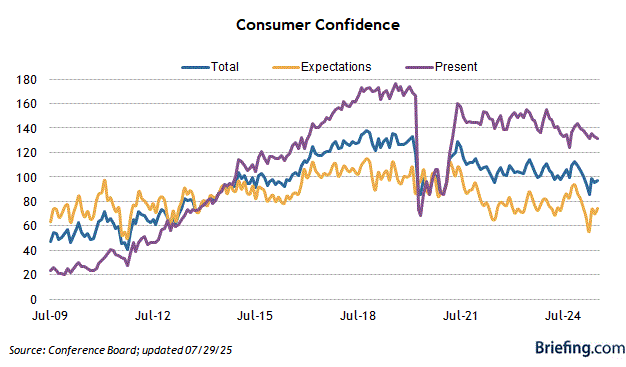
Consumer Confidence from 1993 to 2008
There was a slight decline in September 2009 and as they note,

Consumer sentiment indices get way too much attention. The simple fact is that sentiment does not correlate strongly with consumer spending and thus has little predictive value. Consumer spending correlates more closely with income. Sentiment tends to reflect well known factors such as unemployment rates and gas prices more than it predicts future spending patterns.

Meanwhile, “Romer: Impact of stimulus will wear off” (Christian Romer is a top White House economist) notes,

A top White House economist says spending from the $787 billion economic stimulus has already had its biggest impact on economic growth and will likely not contribute to significant expansion next year.

But I thought the bulk of the stimulus effect would be felt in 2010 and not in 2009 — What’s the deuce here? As this CNN story notes from January 2009: “Stimulus will take a while to work” (CNN Money, Jan 12, 2009).

All in all, the legitimate infrastructure spending, which in its expanded form would include Obama’s ambitious plans to invest heavily in renewable energy sources, will most likely not start coming on line until the fourth quarter of the year and its full effect is at least 12 to 18 months away. In other words, the fiscal stimulus measures that the incoming Administration will be pushing through are more a 2010 story.

And as for numbers of jobs created, A look at the effect of stimulus on States notes

Economists on both sides of the debate agree that the actual number of jobs created by the stimulus package will likely never be known. Large swaths of stimulus money went to provide tax relief, extend unemployment benefits and provide fiscal relief to beleaguered state government budgets. These programs have largely indirect effects on employment.

Only about a third of the stimulus funds — some $275 billion — are going to grants, contracts and loans that will be tracked on Recovery.gov. The 30,000 jobs reported so far cover only direct contracts, which represent $16 billion of that total.

So what can one conclude from this sorry state of affairs? What can one say about the “C” in the “C” shaped recovery? In a post a little while back, I had noted that there will be many more stimulii in the pipeline and one can already see the trial balloons being floated for them.

However, there is another “C” in the “C” shaped recovery — the Corporation. That will be next.

Thanks, Chris!

Share This on Linked In
