
Category Archives: Miscellaneous
How Do You Identify Tomorrow’s Supply Chain Paupers? (Repost)
SI posted this last September. It’s posting it again because, after speaking to a number of e-Procurement and e-Invoice providers over the summer, it seems the situation hasn’t changed much in the past year and the point of the post needs to be reiterated. Plus, as you’re just getting back to work from a summer vacation, a slightly familiar post is a nice way to ease back into a routine.
They still use paper today.
Although I don’t understand how any supply chain focussed business, and a logistics carrier in particular, could still be paper-based. It blows my mind that the WT 100, in their recent article on “Rounding the Optimization Curve”, reports that there are still a significant number of carriers that keep their records on paper. How can you survive in today’s cost-competitive, just-in-time, value-conscious supply management landscape and work on paper?
And while we’re at it, let’s talk about how you can identify the dead men walking of the day after. They use Excel. We’ve known for years that errors in spreadsheets are pandemic. Needless to say that it boggles my mind that Microsoft Excel continues to be the application of choice for supply chain and logistics management around the world. Fidelity lost 2.6 Billion as a result of a spreadsheet error, Fannie Mae made a 1.13 Billion honest mistake, and RedEnvelope lost more than a quarter of their value in a single day after they warned of a fourth-quarter loss due to a budgeting error that resulted in an overestimate of gross margins. How long is it going to be before someone accidentally uses a plus sign instead of a minus sign in a profit formula and forgets to uncap an inventory calculation and instead of ordering 100,000 units of a profitable product, instead orders 1,000,000 units of a product that actually results in significant losses at the target sale price, for which the market demand is weak, ties up all of the organization’s working capital, and essentially bankrupts the company? My guess, with the steadily increasing complexity of S&OP, JIT inventory management models, and supply chains, not much longer. But, maybe after a few companies are brought to their knees from spreadsheet errors, we’ll see the day when Excel is sh!tcanned along with the dinosaurs who still think it has any more use than a HP or TI calculator.
It’s time for anyone still on paper or Excel to wake up and realize we don’t live in Walt Disneyland and that the story of the prince and the pauper is a fairytale. A pauper is not going to become the benefactor of princely riches just by looking like a bigger, richer, company. In today’s uber-connected world, appearances don’t account for much. It’s not long before someone digs deep and uncovers the truth.
There’s a reason why customers are demanding end-to-end visibility of their supply chains, including those of their supply chains logistics’ partners. And a reason customers ow expect all of their suppliers and business partners on the supply chain (including logistics providers) to participate in a supply chain social network. It’s because they know that the only way they can accurately manage their supply chain is to keep on top of it, that the only way they can build accurate models is with accurate data gathered from partners, and that the best reports they are going to get are going to come from supply chain visibility and planning software plugged into these “social networks” (where, in reality, these are “enterprise communities” that allow the necessary collaboration, not “consumer networks” where you can poke, prod, and shake your buddy for no apparent reason).
In other words, paper is dead, and Excel will be the new paper, and then, someday, it too will be dead. So if you don’t want to be the pauper, move off of these technologies and onto solutions designed for your supply management needs. With a plethora of Best-of-Breed solutions on the market, designed for large and small providers, it’s extremely likely that there’s at least one solution that meets your needs almost exactly with minimal tweaking. If you look hard enough, the doctor would bet that there’s at least three, or will be before you can look twice.
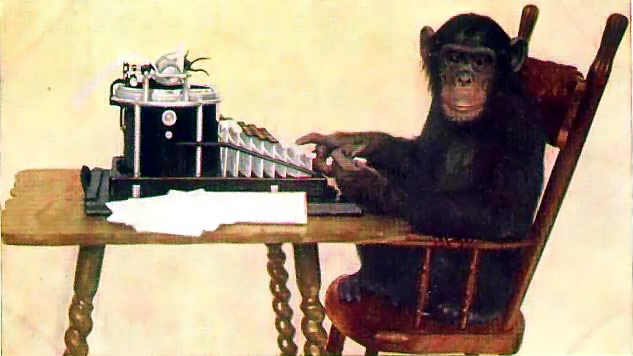
The Infinite Monkey Theorem
The Infinite Monkey Theorem, which states that a monkey hitting keys at random on a typewriter keyboard for an infinite amount of time will almost surely type a given text, such as the complete works of William Shakespeare, is 100 years old this year. The theorem first appeared in Emile Borel‘s 1913 article “Mecanique Statistique et Irreversibilite which was published in J. Phys. 5e serie, vol 3, pp. 189-196. And thus began The Parable of the Monkeys.
But since you have the doctor, you don’t have to wait an infinite amount of time for your supply management blog posts, which will resume on regular schedule after the holiday weekend!
Sometimes, there just isn’t enough time in the day …