
Monthly Archives: December 2015

State of Flux Has the Treatment for Your SRM Ailments: Part IV The Business of Supplier Relationships

At the State of Flux Chicago and London Events, State of Flux released their 2015 Global SRM Research Report: The Business of Supplier Relationships. This report, which is their 7th annual research report that analyzes detailed survey data from over 500 global companies, provides deep input into the state of supplier relationship management and the benefits that it can bring.

The importance of good SRM cannot be underestimated. As the report clearly states in its introduction, the nature of business is changing, with many companies becoming both flatter and more reliant on third parties to delivery everything from customer support through to research and development … in other words, businesses are putting more and more of their brands’ reputations into the hands of other companies. In such a scenario, a business can only be as good as its worst supplier.

On the other hand, becoming a key supplier’s customer of choice will bring access to a range of benefits, from price advantages to innovation — and that failing to do so will mean such benefits accruing to competitors instead. However, this is no longer as easy said as done as changing business dynamics are giving suppliers more power and choice about who they partner with, and how.

More than 40% of survey respondents have achieved a positive, quantifiable post-contract benefit from their SRM activities, with 31% reporting a benefit of 4% or more. Moreover, 60% report cost reductions, 52% report cost avoidance, and 39% report preferential pricing. These are substantial across-the-board benefits. While a strategic sourcing decision optimization event on a category might save 10% or 12%, that savings is limited to the handful of categories that the organization has time to strategically source. If the average organization has 60% of spend under management, only has time to strategically source 1/3rd of that in a given year, then the organization only saves 10% on 20% of spend, for a grand savings of 2%. But a great SRM program can save 4%. Across the board. Year over year. This is substantial.

This is not unrealistic. As per our previous posts, research demonstrates that good SRM contributes to as much as 70% of a company’s gross profit. No other business function can make this claim. And, most importantly, State of Flux‘s seven years of research has demonstrated that the benefits, both ‘soft’ and ‘hard’, that have been secured by the companies leading the way in SRM have continued to increase. The gap between the leaders and the laggards is getting bigger and bigger.

Supplier relationships are big business, but improving them requires more than a will. It requires knowing the way. That will be the subject of our next post.
The Marketing Spend RFP – Everyone is debating over the death of it — I think it needs to be improved Part II


Today’s guest post is from Mat Langley, a Strategic Advisor and Procurement Executive with 14 years experience in leadership roles in strategic sourcing and category management in Europe, Africa and Asia across Finance, IT Outsourcing and Oil & Gas industries who is currently associated with Shortlist.co.

In this post I am suggesting three areas the tools we’re implementing need to change to give Marketing what they need and then I’d love to hear any more ideas/suggestions that you have.

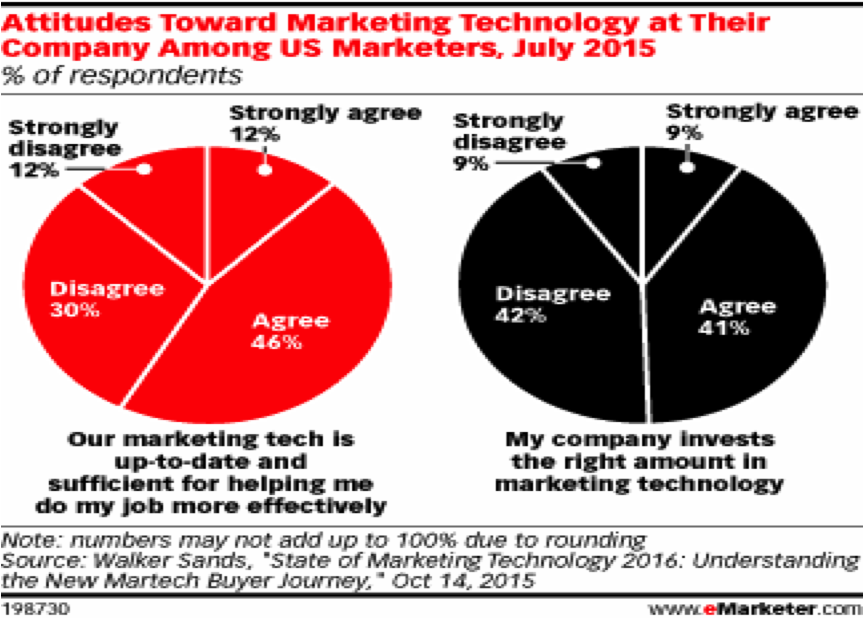
The ideas below are based upon the fact that a significant percentage of marketers (greater than 50% according to a July study by Walker Sands2) believe that we’re not investing enough in the right amount or the right type of solutions for them.


eMarketer.com Marketing Attitudes
1. The tools we’re providing need to improve usability – day 1

A recent international survey of Procurement Executives by Ivalua shows that we are focused on transforming the toolsets we’re using today — 80% of us consider Digital Transformation an opportunity3. That’s fantastic – now our focus needs to continue finding tools that are simple for marketers to use — on day 1 — not year 1. Preferably they should have modern interfaces and be SaaS so Marketers don’t have to use one brain at home and another at work.

2. The tools we’re providing need to improve access to qualified agencies

With the significant increase in channels and the number of content components that need to be created – access to a broader set of qualified specialist agencies to meet campaign needs is required. We need to provide tools that let marketers find, engage and then partner with agencies big and small across the specialist spectrum regardless of whether they are across the street or across the globe. And no, I’m not recommending that long-term relationships or that strategic and broad partnerships aren’t important — I’m simply pointing out that Marketing needs an agile toolset to deliver against compelling (and evolving) challenges — and they need access to partners ‘on demand’. This needs to be done in a way that meets our obligations to protect the organization commercially while bringing in the best and brightest vendors.

3. The tools we’re providing need to improve the creation of Request for Partnerships (RFPs) – perhaps they could even be user friendly?

Everyone in the organization has too much work… We need to provide tools that allow Marketers to find and share best practice workflows, templates for briefs, easy access to current best practice questions and that have the maximum amount of automation built-in for comparisons, approval workflows, agreement signatures, and so on. And our tools need to integrate with other tools marketers are using to get the job done – whether that’s Dropbox for file storage, Slack for communication, Office365 for email and yes, even your ERP system! And most of all the tools we choose need to help engage agencies and build long-term partnerships – not drive them all into a single box as described by Kirk Cheyfitz in his piece on ‘6 New Reasons to Kill the RFP4:

I think the fact that you put your RFP out only to agencies you really like is a demonstration that it wasn’t too closely allied to the mass, mindless cattle calls that I rail against. Then you actually seem to ask open-ended questions that invite the respondents to define or re-define the conversation. And that puts you completely outside classic RFP territory. Even I would respond to an RFP like that.

I believe that with a renewed or for many an on-going focus on the above 3 items we can align with Marketing and let them take control of their Request for Partnerships which will, hopefully with the right tools, lead to RFPs being done in days and weeks – not months and with less frustration and pain for all stakeholders involved: Marketing, Procurement and Agencies. This should lead to more of the Marketing spend being influenceable and competitive, thereby addressing both obligations of procurement to the marketing team and the broader organization.

Thanks, Mat.

2 Walker Sands State of Marketing Technology 2016 Understanding The New Martech Buyer Journey
3 Ivalua. (2015, 3 November). “International Survey Procurement Executives”, PROCUREMENT IN THE DIGITAL AGE: Measuring the impact of Digital on Procurement Departments.
4 Kirk Cheyfitz. (2015, April 02). 6 New Reasons to Kill the RFP: Find Innovators, Not Commodities.

State of Flux Has the Treatment for Your SRM Ailments: Part III Tips and Tricks

In Part I we noted that while State of Flux had the treatment, before we could talk about the treatment, we had to talk about the ailments, but before we did that we needed to give a bit of background on the recent State of Flux SRM event in Chicago which was the US launch for their most recent Global SRM Research Report, The Business of Supplier Relationships (which is their 7th annual research report on the subject). But before we could talk about either the event or the research, we needed to start with the need — which we nicely summarized using the research from Planning Perspectives who have independently found that not only does gross profit increase as working relations improve, but that 71% of the positive change is contributable to changes in the supplier relationship.

Then, in Part II, we gave additional examples of the value that can be obtained from good supplier relationship management (SRM), noting that a major oil and gas company extracts almost 1 Billion a year from its advanced SRM program while a major global electronics giant also extracts hundreds of millions from its SRM program. After this, we told you that while we don’t have permission to release specifics, we can share the general advice on how to structure a program and when you combine the basics covered in both presentations, which are quite similar, you can easily outline the foundations of a good SRM program.

Find opportunities.
Identify methods to capitalize on them.
Do it. Select the best method and go.
Overse the process. Don’t just set and forget.

Measure progress.
Accelerate implementation as circumstances permit.
Rsward success through recognition and remuneration.
Cooperate and collaborate at all times.

However, just knowing the basics is not enough. One needs to know how to put them into action and how to best capitalize on the opportunities available. In this post, we’ll present some of the best tips and tricks. Some will seem obvious, some not as obvious, but all are easy to implement and capitalize on.

Involve Suppliers From the Get Go

Don’t wait until after your supplier relationship management program is fully formed to reach out to your first supplier. Reach out to your strategic suppliers during formation of the program and ask for their input and help in creating the program. This will hasten your suppliers’ acceptance of the SRM program once it goes live and possibly give you some great insights that you can use to get a jump start on results from day one.

Align with Key Stakeholders

Success requires a unified front on the buyer’s side. This requires buy in from all key stakeholders, so align with key stakeholders before finalizing the SRM program and going live. Get buy-in and, more importantly, use these stakeholders to help get executive approval.

Start with a Pilot

Select a small group of key, willing, suppliers — preferably including some you engaged from the get go — and work-out the kinks before trying to go broad on a supplier relationship management endeavour. The last thing you want is to expand an inefficient program or replicate practices that have unexpected adverse or side effects. Get it right. Get it smooth. Then take it broad.

Challenge Suppliers to Solve Stakeholder Pain Points

It’s not just about savings, it’s also about value. If the stakeholders want new functionality in that electronics product, a more sustainable production method, a leaner production method that will allow for faster design (and line) changes, or the introduction of more environmentally friendly materials, challenge the supplier to come up with solutions that support this. This will help Procurement to not only secure the support of key stakeholders but to report wins early on in the initiative.

Regular, Positive, Supplier Feedback

Regular feedback is key to maintaining a good relationship. However, it’s important to make sure that the feedback is not just negative, what the supplier is doing wrong, but also positive, and what the supplier is doing right, and how they can build on this to do even better. It’s the old saying — you catch more flies with honey than vinegar.

Instill Relationship Management in the Supply Base

Make sure they understand that relationship management is about relationships, relationships are a two way street, and that it is up to them to manage their side of the effort. Moreover, they should take what they learn and use it in their supplier relationship management efforts to get better results from their suppliers, and push value further into the supply base.

These simple techniques, discussed at the State of Flux Chicago event, will go a long way to making your SRM efforts a great success.

The Marketing Spend RFP – Everyone is debating over the death of it — I think it needs to be improved Part I


Today’s guest post is from Mat Langley, a Strategic Advisor and Procurement Executive with 14 years experience in leadership roles in strategic sourcing and category management in Europe, Africa and Asia across Finance, IT Outsourcing and Oil & Gas industries who is currently associated with Shortlist.co.

I want to start with a bold statement — in Procurement, the most challenging group to work with is most often Marketing. Almost every other function in the organization easily identifies the value we aim to deliver. When it comes to who’s really leading, the RFP there shouldn’t be a ‘hot potato scenario’ — we guide, as Procurement experts, and collaborate in a mutual partnership. Marketing, by comparison is still evolving their views on how to collaborate with Procurement. In a late 2014 study conducted by the ANA (Association of National Advertisers), nearly half of all Marketing and Procurement respondents stated that the relationship between them needed to be more collaborative. Nearly 50% of Marketing and Procurement professionals admit that they aren’t collaborating the way they need to in order to deliver maximum value to their brands.

Now, on the flip side, my experience with Marketing colleagues is that they are passionate, energetic and constantly focused on being creative. For Procurement (or Marketing) people reading — I’m guessing you’ve had more than a few debates and I’m sure that debate often centers on how Marketing feels like they’re wearing an RFP straightjacket designed, fitting and sewn by Procurement!

With agencies currently rebelling against RFP’s and even some very high profile CMOs like Linda Boff from GE calling for the ‘death of RFPs’1 — organizations can quickly get themselves in a downward spiral, ‘hot potato scenario’. It’s a relatively simple problem at its root: when Marketers don’t fully collaborate and provide the necessary support at the beginning of the RFP process, someone has to jump in and grab the ball (find the agencies, write the brief and RFP questions, and run the process) — that often ends up being Procurement — which doesn’t always lead to the best results for anyone involved: Marketing, Procurement, Agencies … everyone.

Hot Potato Was Fun as Kids — Not Today

To be clear, no one is at fault here. Marketing hates RFPs because they feel they are old and outdated; in stepping in to assist Marketing with their agency selection, Procurement ends up writing more of the RFP than they should, often using out of date questions; then it gets sent to more Agencies (just in case) because Marketing doesn’t have a short list or have time to find a strong and competitive agency panel; and finally, Agencies are overloaded responding to bloated RFPs and remember above – they’re also hoping that RFPs die. In the end, we’ve all played our part in proving exactly why RFPs are so terrible and ‘out of date’ – and the easy answer is just to kill them — and the tremendous value they can provide to everyone involved.

Now is not the time to kill the RFP (nor is that what we are suggesting) — it’s time to enhance our focus on improving communication, collaboration and building great internal and external partnerships. The marketing industry is changing so rapidly, with new channels and divisions, new technology, broader yet flatter reach requiring even more agility and calls for more focus on driving value out of every dollar spent. It’s an exciting time but also daunting and we need to ask ourselves, if the CMO is struggling to keep pace with this change, how are we going to support and bring value?

Time for more focus on what’s working and less ‘tossing blame around’ — Time to give Marketing the tools they want

Ok, I know that there is no perfect world where Marketing loves Procurement, Agencies love Procurement and Procurement loves procurement workloads… But there are things we’re doing really successfully that we can build upon. In Part II, I’ll suggest three areas the tools we’re implementing need to change to give Marketing what they need.

Thanks, Mat.

1 Marketers: It’s Time to Say RIP to the Media RFP

State of Flux Has the Treatment for Your SRM Ailments: Part II Chicago

In Part I we noted that while State of Flux had the treatment, before we could talk about the treatment, we had to talk about the ailments, but before we did that we needed to give a bit of background on State of Flux’s recent SRM event in Chicago which was the US launch for their most recent Global SRM Research Report, The Business of Supplier Relationships (which is their 7th annual research report on the subject). But before we could talk about either the event or the research, we needed to start with the need — which we nicely summarized using the research from Planning Perspectives which have been doing detailed research in the automotive sector for the last fourteen (14) years, and who found that not only does gross profit per vehicle increase as working relations improve, but that 71% of the positive change is contributeable to changes in the supplier relationship. Let’s repeat that yet again: 71% of profit increase in the automotive sector can be directly correlated to improvement in supplier relations.

The impact of good supplier relations is not restricted to the automotive sector. A major oil and gas company, which also invests heavily in supplier relationship management and innovation, identifies over 100 innovations a year working with their suppliers and realizes an average return of over 750,000 per innovation. Some innovations return millions of dollars to the bottom line. The company realizes almost a billion dollars a year in value from better supplier relations. That’s a damn big number.

How does it do this? It has a good supplier relationship management program. What is this program? While we can’t give specifics, as permission has not been granted for deep coverage, we can give an overview of the solid foundations. Moreover, in addition to a presentation by the major oil and gas company that realizes almost a billion dollars a year in value from better supplier relations, there was also a presentation by a major electronics corporation which also realizes hundreds of millions of dollars a year in returns from their advanced supplier relationship management program. By combining the best advice and insights from both presentations, we can provide a great foundation for your SRM efforts.

FIDO MARC.

Find

Find an opportunity where the organization would benefit from an improved supplier relationship — either through performance analysis, need identification, brainstorming, or even open submissions from employees and suppliers for potential value chain improvements.

Identify

Identify the different ways to take advantage of the opportunity. For example, if on time delivery is poor — does the supplier work with the supplier to lean production, take over shipping (possibly through a 3PL), or work with the supplier on better demand projection so orders can be placed earlier. If production costs are high, does the buyer lead a lean initiative or challenge the current supply base to find a better, cheaper, method with the promise of additional award, or award shift, to the best supplier.

Do

Once the different options are identified, select the best one for implementation and implement it.

Oversee

Manage the process from kick-off through major deliverables, performance improvements, and other milestones. Don’t just set-it-and-forget-it, that never works.

Measure

Measure improvements on a continual basis against an appropriate scorecard identified upon initiative implementation.

Accelerate

Once all of the key stakeholders are on board and everything is going smoothly, accelerate implementation or, if appropriate, replicate (a variation of) the initiative with another supplier that could also benefit.

Reward

Reward suppliers for their success, either with an increased margin or additional business and publicly recognize them either at annual supplier recognition events, publications, or on the company website.

Collaborate

Continually collaborate with the supplier to look for additional improvements that can be made to tweak the process and additional opportunities that can be pursued in the future.

SRM is really a simple process. However, as with every other initiative that can bring great value to an organization, the devil is in the details. In our next post, we are going to discuss some of the tips and tricks that these, and other, organizations have used to accelerate their SRM programs and achieve great results, including some of the tips and tricks outlined in State of Flux‘s publications.