
Category Archives: eSourcing Forum

Don’t Swing the Wrecking Ball Unless You’re Prepared For the Falling Debris

Originally posted on on the e-Sourcing Forum [WayBackMachine] in April, 2008.

I enjoyed the recent article over on Global Services by the title of “Wrecking Ball” that noted that “implementation of new operating models requires the corporate equivalent of wrecking an old building in order to build anew, yet few corporate managers are trained to swing the wrecking ball carefully, communicate in the most effective way to employees, and prepare for the fallout”.

As the author notes, “for many corporate change managers, preparing to communicate with employees is the last tick in the box”. Too many managers assume that the responsibility can be offloaded to HR or the internal communications department when the reality is that only the managers who understand the scope – the work, employees, internal customers and potential impacts – can effectively swing the wrecking ball and manage the inevitable issues that are going to arise from a major change.

Furthermore, communication preparation should begin at the strategic planning stage, not at the beginning of implementation. This is the best time to prepare the right message – which must be clear, factual, and consistently communicated. Employees need to understand the reasons for change if they are to embrace them. As the article notes, “simple oblique statements such as ‘we need to be competitive’ can sound like corporate code for increase executive compensation” – and is not going to be very inspirational.

Once the core message is drafted, it’s time to list all the affected stake-holders, determine who realizes the rewards and who pays for the gains, and develop a plan to address their specific concerns. This will require targeted messaging to them on top of the basic message. Be sure to plan for the inevitable backlash, and craft appropriate responses as well.

Once the messaging is worked out, you can work out the roadmap and implementation plan as you know you will be able to start delivering the right messaging to the right stakeholders at the right time. This plan should include performance incentives as productively tends to decline precipitously immediately after a major change is announced. It should also include a plan for dealing with voluntary attrition, as some people will get nervous, fear for their jobs, and seek new employment elsewhere. And, of course, constant communication that addresses all of the concerns as they arise.
Discovering Your Leverage Points

Originally posted on on the e-Sourcing Forum [WayBackMachine] on January 29th, 2008

Purchasing B2B had a good article over the summer called “Suppliers Like You Because? Discovering All Your Leverage Points” by Terence Lillew that had a list of nine discussion points that should be considered in the development of a cost management strategy for a category.

1. Dollar Volume

Dollar volume is generally the primary leverage point. When a regular order over a period of time is locked in, suppliers can budget resources, plan appropriately and rein in their costs. Thus, you can insist that some of that savings is passed on to you.

2. Size

After dollar volume comes organization size. The larger the organization, and the greater the potential for future business, the greater the discount structure that the supplier can offer.

3. Leadership

The organization’s leader sets the tone for business value. If the leader is respected, and has demonstrated long-term effectiveness, the company can leverage itself into a better position.

4. Business Philosophy

A fair and ethical business philosophy that looks for solutions instead of attaching blame and that continually improves and a philosophy that supports creativity will give the organization a competitive edge in all negotiations.

5. Policies and Process

The company’s purchasing department must be responsible for the policies and processes if they are to leverage their position, and they must be sure to make sure the policies and processes are fair and up-to-date.

6. Early Influencer

A company known as an innovator gains a certain amount of prestige that can be leveraged to improve their position in a negotiation because they will be seen as a company you want to do business with.

7. Benchmarking

A leading organization constantly benchmarks its performance against peers and competitors. Suppliers know that a benchmarking company is often a successful company and may be more inclined to do business with such a company.

8. Buy Locally

Organization’s that buy locally have a natural advantage over those that don’t. A supplier wants to service a local buyer.

9. Payment Cycles

In an industry where most buyers are trying to extend payment cycles, any buyer that can reduce payment cycles is in a strong position to negotiate for additional discounts.

These are all great points. Be sure to think each and every one through before finalizing your negotiation strategy and starting an e-RFX or an e-Auction.

Design for Supply

Originally posted on on the e-Sourcing Forum [WayBackMachine] on Friday, 19 January 2007

Back in November, the Supply Chain Management Review ran a great article on “Design for Supply: An Evolutionary Path” which noted that design for supply involves more than just part and supplier re-use and that leading companies are achieving benefits from simulation and modeling before and during product launch. I agree completely. (I also wrote about Design for Supply, which is also known as Design For Sourcing, in my multi-part Procurement Innovation series over the summer in the post “Transforming New Product Development”).

A recent AMR Research study quoted by the article found that New Product Introduction (NPI) is the number-one influencer of supply chain demand and a National Science Foundation and Michigan State University study also quoted by the article found that material costs could be cut by 10% by applying design for supply and total cost of ownership analysis at the concept and assessment phases of NPI. Therefore, it is worth pursuing Design For Supply (DFS) as it can avoid design practices that drive supply chain complexity such as part number proliferation and supply base expansion.

Design for supply is not a new concept, and many manufacturers have been applying fundamental DFS strategies such as part reuse and cross-functional collaborative product design for a while. Furthermore, the manufacturers with the most successful DFS initiatives are those that have applied standardization.

However, it can be argued that current initiatives are only first generation and the future of Design for Supply is optimization and simulation of DFS trade-offs. Reuse reduces variability and improves volume pricing, but places a constraint on innovation when applied too rigidly. To truly design for supply while also developing new and exciting products, companies need to look at the trade-off between the benefit of a new innovation versus the cost of supply.

You need to look at the business and cost impact of every decision. One example is the analysis of the cost-benefit trade-offs associated with different product options to optimize customer revenue, time-to-market, and supply cost. Another example is product-cost modeling using a virtual production environment and what-if analyses based on alternative design decisions to accurately predict cost before product launch. (And this is more-or-less exactly what aPriori does, whom I just blogged about over on Sourcing Innovation.)

Supply chain modeling during NPI can move a company beyond first generation reuse and product-cost analysis to understanding the product’s potential impact on the entire supply chain network, allowing procurement to design the optimal network and, when good forecasts are available, predict required inventory levels up front.

The article concludes with some suggestions for DFS improvement:

  • Identify the person or team that will enforce accountability.
  • Understand product segments and global distribution methods.
  • Define the metrics to measure a design’s impact on inventory, reuse, lead time, and other cost drivers.
  • Understand the organization’s position on the DFS maturity curve before defining the next evolutionary step.

Collaborative Negotiation

Originally posted on on the e-Sourcing Forum [WayBackMachine] on Monday, 16 July 2007

It should be simple, but yet, according to different sources, including “The Road To Collaborative Negotiation” by Tim Cummins, collaboration or “win-win” is still not very widespread. The question is, considering the benefits that result when you Collaborate, Collaborate, Collaborate, Collaborate, what are the inhibitors?

According to the article, the issues are often culture, time, timing, and power. Whereas Japanese approaches to business are generally patient and trusting, US approaches tend to be impatient and focused on “fidelity”. Add in the desire for solid frameworks and rules and this results in lengthy contracts covering not only all eventualities but all possibilities which only results in a greater inclination to trust the other side and an assumption of “infidelity”.

In addition, too many negotiations are undertaken under (unreasonably) tight time pressures, which is problematic since US businesses almost always believe that collaboration takes more time than they have. Furthermore, negotiators are usually “involved too late” and the more powerful party often takes the heavy-handed approach of “Here are my terms. Trust me, we will collaborate later.”

This is problematic since, as the author points out, collaborative negotiations often take less time than confrontation if you can just get past the all-too-common viewpoint that it is a high-risk approach, simply because it is unfamiliar and might take more time than the traditional heavy-handed sales approach. However, the author is right in that the only way it is going to take hold is that if the more powerful organizations, like the Hondas of the world adopt it as an organizational strategy and methodology, allowing the weaker organizations to step up to the plate. Thus, the time to adopt a more collaborative approach in your strategic sourcing initiatives is now.

A Case for E-Sourcing and E-Procurement Integration

Originally posted on on the e-Sourcing Forum [WayBackMachine] on Monday, 5 November 2007

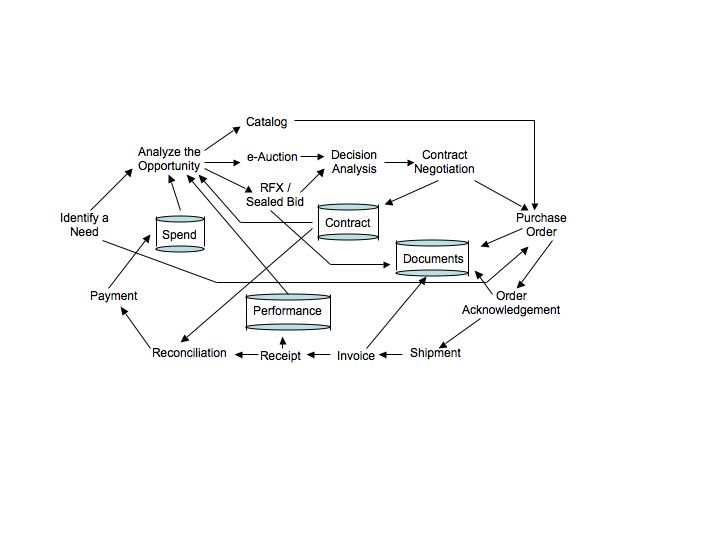
Even though some may argue that the two platforms should remain separate, especially since most providers today either excel in one platform or the other, I believe there is a strong case for the integration of the two platforms. Let’s start by considering a basic procurement process, pictured below. Even though it looks like there is a clean separation between e-Sourcing and e-Procurement between the “Contract Negotiation” and “Purchase Order” steps, and that one should be able to just slice the process down the middle, doing so comes with its disadvantages.

Three major reasons for this are as follows.

1. The processes require the same data to be truly effective.

Take a good look at the process. You’ll notice a number of steps that depend on data created and obtained in other steps and vice versa. For example:

  • Spend Analysis is heavily dependent on actual spend culled from the AP systems, performance metrics culled from actual shipments, and contracts that resulted from prior contract negotiations.
  • Although not shown, the supplier identification phase of the RFX process requires supplier information culled from previous e-Sourcing rounds and performance data gathered during previous relationships and procurement cycles.
  • Purchase Orders require contract data and terms introduced in the RFX phase.
  • Invoice Reconciliation requires contract data, quality and lot size data on the shipment received.
  • Payment requires contract (or catalog) data to determine the payment terms.

2. Supplier Management and Risk Management cannot be cleaved in half.

Critical to any successful e-Sourcing and e-Procurement effort is good supplier management and good risk management, but these processes must be handled holistically to be truly effective. Not only is a supplier not
going to want to deal with Rep A for sourcing issues, Rep B for procurement issues, and Rep C for delivery issues, etc., but neither sourcing, procurement, or logistics will be able to make the right decisions under
pressure with at most 1/3rd of the relevant information at their fingertips. Furthermore, all of the risk mitigation planning that goes into an award decision is useless if the individuals responsible for actually procuring the goods as they are needed are not aware of the planning, and more importantly, what could go wrong and what to look for. For risk mitigation efforts to truly succeed, I would argue that everyone needs access to all relevant information at all times.

3. Decisions in one part of the cycle impact the other half of the cycle.

One area in particular where this is true is finance. For example, if an organization’s normal payment terms are 45 days, but a sourcing manager cuts a deal for 30 days to get a really great price, it’s critical that the procurement and accounting team know about it. Otherwise, the invoice might sit on the shelf until day 44, at which point a large penalty clause might click in, costing the organization more than the sourcing manager managed to save in the special deal.

Furthermore, there are more reasons why the processes, and the platforms, should be integrated, but since I’m sure that the other guest authors lined up for this week will want something original to blog about, I’ll stop here.