
Just like every analyst firm wants to give you a 2 * 2 matrix (which is fundamentally broken, which is why the Busch-Lamoureux Exact Purchasing Model isn’t 2D — it’s a 3D pocket cube), every consultant wants to give you a simple table or chart to solve your spend.
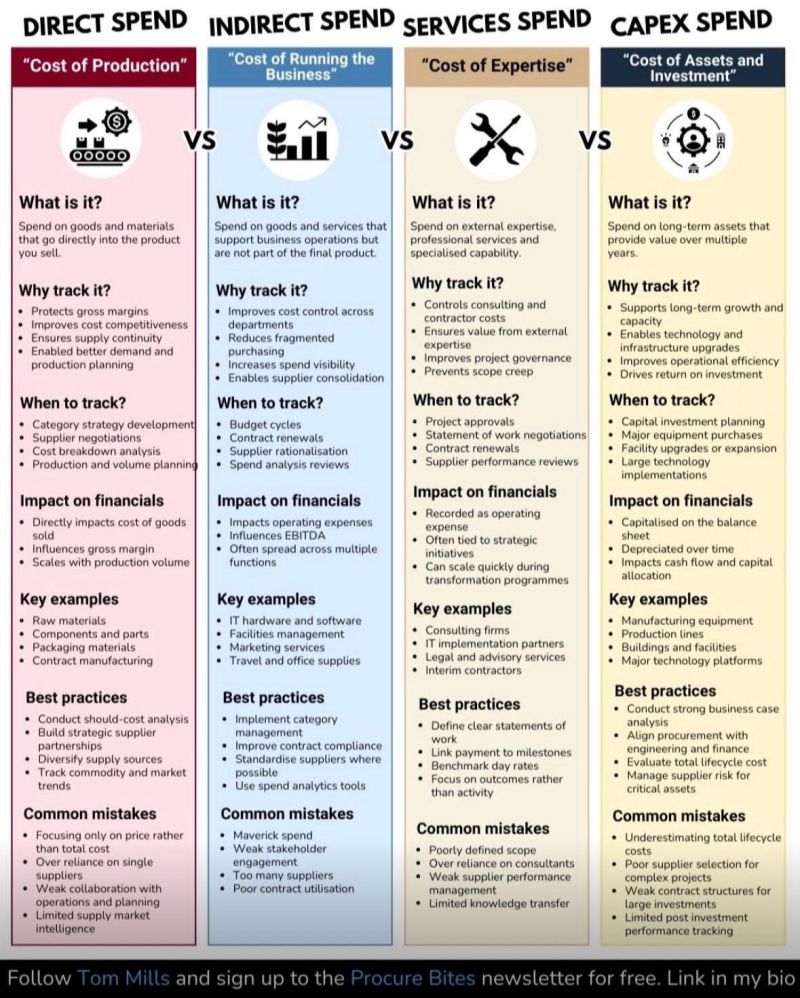
Take this recent example from Tom Mills where he decides that all spend falls into four buckets.
At a high level, it sounds correct. You either have:
- Direct Spend: Cost of Production
- Indirect Spend: Cost of Operations
- Services Spend: Cost of Expertise
- CapEx Spend: Cost of Assets and Investment
Except:
- cost of production can also include MRO (which is typically indirect spend in Procurement) as you have to keep the machines running, and you should also amortize the appropriate personnel spend (which is also cost of operations and maybe even cost of expertise)
- cost of operations is broad, and can include external spend for products and services as well as internal spend for personnel
- cost of expertise is not just services, it’s also hiring contractors direct, buying reports, and funding research
- CapEx is not just assets and investments, but rental — and then there are blurs around assets that can be fully expenses vs depreciated even though they will be in use for multiple years
Now, to be fair, Tom does a great job of explaining his view on what each of these categories is, why to track them, when to track them, how they impact financials, and key (crystal clear cut) examples. And Tom does a decent job of covering best practices and common mistakes, but here’s where the issues start to show:
- direct only requires strategic partnerships for custom manufactured products, materials or components in short supply;
- category management isn’t just for indirect, it applies across the board; same goes for contract compliance — negotiated “savings” is BS — if it doesn’t materialize due to non-contract compliance, it’s not there; over-standardization increases cost, risk, and decreases innovation; and spend analytics has to be applied everywhere
- cost of expertise isn’t just about day rates, it’s about return on investment — you need the right expertise, and that’s not just day rate
- capex is the most accurate by far, but the analyses has to include supplier managed vs lease vs buy for more asset types than most organizations are used to in this changing economy
In every case, the magnitude, risk, and complexity of the spend determines the specific sourcing and procurement methodology as well as the degree of analysis and effort that is required.
In other words, a simple bucketing strategy can get you going, and this one will get you much further than the useless 2*2s from the big analyst firms, but just remember that it will only get you so far as the real world is a lot more complex than 2 * 2 buckets and once you have the basics down, you have to step up.
We know you like flashy graphics, and we especially know that LinkedIn likes serving them up (and is 10 times as likely to serve up a flashy graphics post than a plain text post), but the end result is that you don’t get the deep knowledge you need. So don’t stop with the flashy graphic and dig deeper if you want to truly solve all your problems.
And remember to follow Tom Mills and his Procure Bites for practical procurement proverbs (unless you prefer the pompous pontifications of LinkedIn).