
Every consultancy and consultant has their own version of the Procurement funnel, and they all look great because they show you the shiny front side that they clean and rinse every day and not the rusted back side that is full of holes.
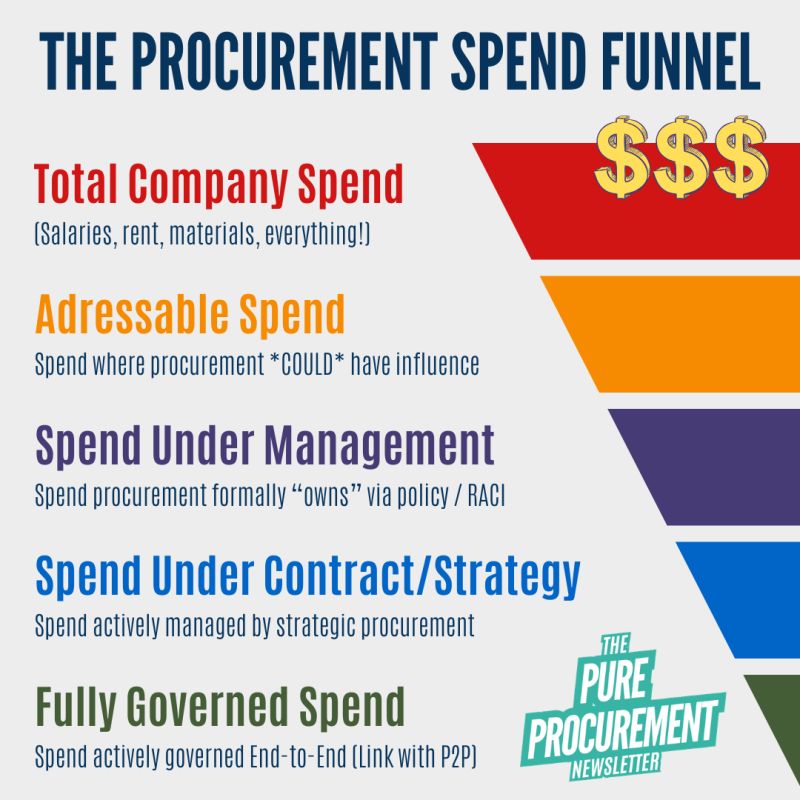
Today I’m going to pick on Joël Collin-Demers and his procurement funnel. Before we continue, we should admit that we like Joël’s funnel more than others, which is why we chose it to exemplify the problem with funnels.
Let’s take the levels one by one.
- Total Company Spend: well, this is the same for every funnel and the only level that’s ever 100% right
- Addressable Spend: this is defined differently by every consultancy and never matches reality — because, in theory ALL company spend is addressable spend if Procurement is allowed to have influence (even salaries — Procurement can help benchmark ranges and define what top talent looks like), but the reality is that addressable spend is ONLY what the C-Suite will allow Procurement to touch (or mandate they have access to such spend)
- Spend Under Management: in theory this is what procurement “owns” but in reality, it is only what they are both allowed, and able, to manage
- Spend Under Contract / Strategy: this is the one level Joel gets right that most get wrong — it’s not contract, it’s strategy … some spend should be contract, some should be spot-buy, etc. it all depends on the buy
- Fully Governed Spend: this is the missing layer in most funnels — under contract is not enough, it has to be managed
It’s a good funnel, which is why it’s the one we like the most — but here’s the problems with all the funnels:
- Addressable Spend: Procurement rarely looks beyond the spend they’ve been assigned to determine what might be addressable and how they should be advising the departments they are there to help
- Spend Under Management: “owning” is meaningless if it’s not being actively managed; a policy is useless when the end users are allowed to buy whatever they want when Procurement is supposed to own the spend; putting a catalog in place is nothing if the employees still buy what they want with the P-card; having an RFQ for spot-buys is useless if the employees ask for e-mail quotes and select the first one they get or just ask their favourite vendor to send them what they want — this happens all the time in “tail spend”, including spend that should not be in the tail
- Spend Under Strategy: a “contract” is useless if it’s not being adhered to; the classic example to this day is telco/cell phone — Procurement, with the help of an expert, negotiates a new national contract expected to save 30%, but a few departments refuse to switch, and keep paying the higher rates; since it doesn’t go through the P2P systems (as it’s a regularly recurring utility bill paid by finance), there’s no detection that 30% of spend hasn’t switched and the spend doesn’t get governed; and just following a strategy (contract, spot-buy, catalog, etc.) doesn’t mean the spend is being managed — who is contracting, spot-buying, cataloging and how are the policies being enforced
- Fully Governed Spend: this is the ideal, but the reality is that this bucket is empty in the vast majority of organizations — even if an organization has sourcing and procurement systems, the reality is that they are usually not connected and not configured properly and the spend the organization thinks is governed actually isn’t
The reality is that when
- organization’s don’t admit that what they are allowing to be “addressable” doesn’t address the problem
- owning on (the policy) paper is meaningless if ownership is not taken
- a contract or strategy is a foundation, but you still need to build upon it
The funnel gives them a false sense of security while performance continues to degrade.
That’s why you have to be careful when fancy graphics are involved. They can point to a path, but you need deeper insight to follow it.
Follow Joël Collin-Demers over on Pure Procurement.