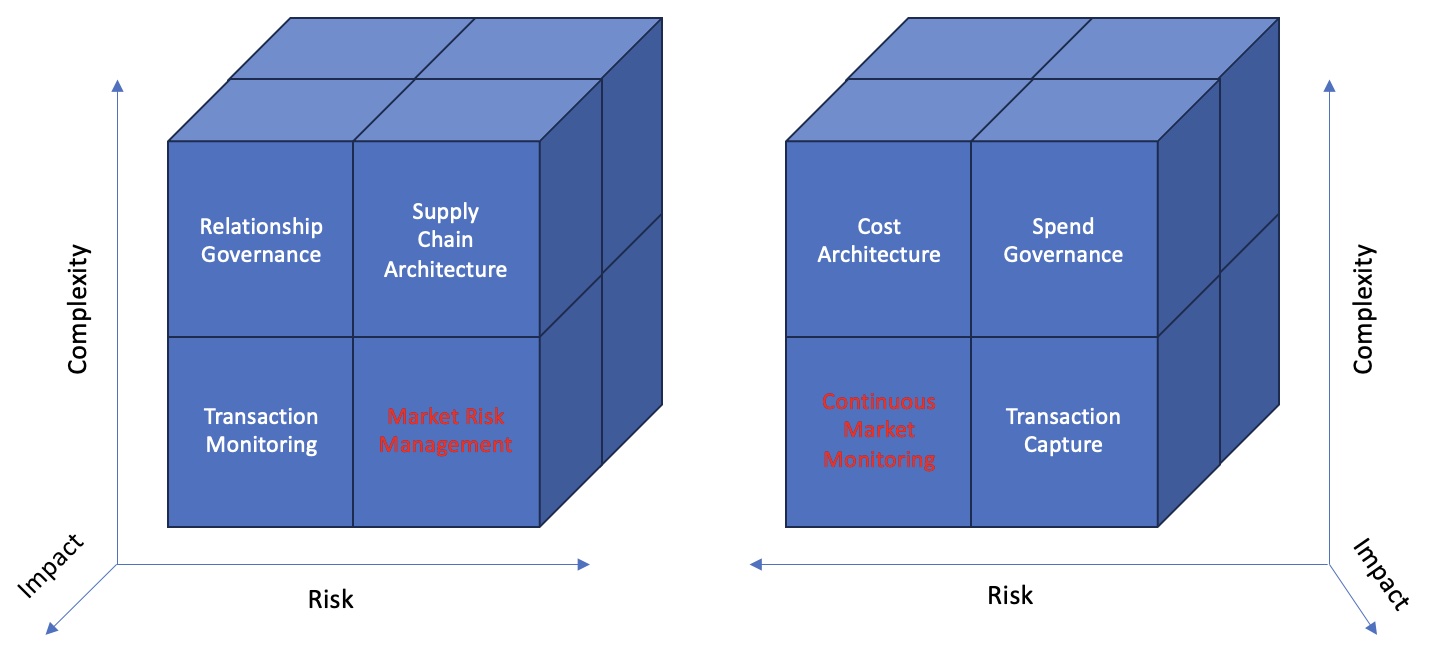
Today we continue our discussion of the pocket cube for exact purchasing, focusing on the high risk, but low complexity categories.
Low Complexity, High Risk, Low Impact: Continuous Market Monitoring
In this situation, which Kraljic would likely classify as a “bottleneck” and where Busch would likely say the answer is “relationship monitoring”, market risk starts to take central focus. But the answer isn’t really relationship governance, because you don’t govern a relationship for an easily replaceable item (low complexity) that has limited organizational impact, you quickly replace it. You do that by continuously scanning for market risks, and taking action right away when one is detected.
It’s very similar to what you would monitor for in a low complexity, low risk, high impact item, but instead of just monitoring the cost and the supply chain, you’re also monitoring the supply base for potential risks in the suppliers, carriers, and routes that you are using. And you are monitoring relevant index prices & future curves, oil prices and other indicators of local fuel costs, tariff announcements (and threats), currency movements, current promotions, and other related signals.
Common categories here will be less critical metals, energy, and food commodities. Most metals can be relatively easy replaced, especially if a moderate cost increase isn’t that detrimental; there are usually alternate energy / grid sources (and you can always build your own plant) that you can contract, for a bit more; and unless it’s a food commodity in limited supply globally where there is no substitute (like coffee), it’s just paying more. What falls here versus in the low complexity, low risk, high impact bucket will often be industry, and even company, dependent.
Based on this, if a disruption occurs, you rapidly re-act and re-source to other pre-approved suppliers and carriers in your extended network.
Low Complexity, High Risk, High Impact: Market Risk Management
In this situation, which would likely be “strategic” under Kraljic and “cost architecture” under Busch, you graduate from continuous market monitoring to full-blown market risk management. Market monitoring and rapid reaction is not enough, because you can’t afford any potentially preventable disruptions in a high-impact category. In this situation, you’re monitoring everything you would for a low impact category, plus any ancillary data that could impact the category — such as weather for critical deliveries that need to be made on time, geopolitical signals that could indicate (escalating) conflicts or trade barriers, correlated material or commodities that often serve as indicators of forthcoming pricing changes, and any other signals that could indicate a future impactful event.
It also means that you’re pre-defining potential mitigation plans that will allow you to re-source very quickly if something happens. You’re not doing full-blown supply chain / cost architecture design because the category is not complex, and there should be lots of potential suppliers, but you are doing full blown risk-centric monitoring because you can’t risk unnecessary impacts to your business. And you’re defining what mitigating actions you can take so that you can immediately execute on one or more of them should you detect a disruption signal. This might be shifting current supply/orders 100% to the minority supplier, re-sourcing against a pre-approved supply base, sourcing a substitute item, etc.
Common categories here will be critical metals like meteoric iron, low background steel, tool steel, and ultrahigh carbon steel; rare earths which are only mined in a few countries; and critical food commodities with limited production sites (like that all important coffee bean).
Tomorrow we will conclude our discussion of the pocket cube of exact purchasing for our last two categories.