Monthly Archives: May 2026

Vendors Steal Crappy Ideas — Please Don’t Encourage Them

Last year Joël Collin-Demers, The Channel Master, wrote a post encouraging vendors to steal his ProcureTech startup idea. Unfortunately, that idea involved the proliferation of sh!tty LLM technology and way too many vendors took him up on it.

I’m sorry to say that it was the one post I wish he hadn’t written!

Too many vendors decided to steal his idea, as evidenced by the constant proliferation of “AI” vendors believing they can wrap, or cr@p, an LLM better than the giants who have collectively spent trillions and actually deliver value.

They can’t. That’s because LLMs are fundamentally flawed. Hallucinations are core, consistency is a pipe dream (and those pipes are so dirty even Mario can’t clean them out), and you still need a considerable amount of exceptional data to get anything remotely useful out of them.

All Deepseek proved was that you don’t need to spend millions (or billions) to build an LLM — open source code and your own rack in a data center will allow you to get the same quality of results (i.e. garbage) as a mega-model if you focus it to a particular task in a particular problem domain.

The models would be small, fast, and cheap, but, just like the big models, won’t work out of the box because they are not intelligent, aren’t deterministic, and aren’t even consistent. (And let’s not overlook the fact that a subsequent iteration on a task or document might undo something they got correct in the last iteration that you approved.)

As for his examples:

  • No RFX execution — draft creation, sure, but accuracy varies
  • They’re more likely to enable fraud than stop it (see many SI posts)
  • The contract insights they return may not be the most relevant ones (and leave you blind to million dollar risks)
  • They are just as likely to make up risks as detect actual risks with new suppliers … and accuracy will vary greatly based on the data available and what you plan to use the supplier for
  • Given that they can’t think, don’t understand logic, and can’t even do basic math (it has been proven, see Apple studies for e.g.), you should never use them for benchmarks (just for data extraction from hard to digest sources, providing Intern Indy reviews the data first)

Now, if you insist on riding the hype wave, knowing that failure is likely inevitable (with only 6% of companies seeing a return from AI investments), then this is the way to do it as you’ll waste the least money proving classic tech with augmented intelligence is the way to go (while doing the least harm to the environment).

Conclusion: it’s the brilliant way to go bust! 🤣 😭

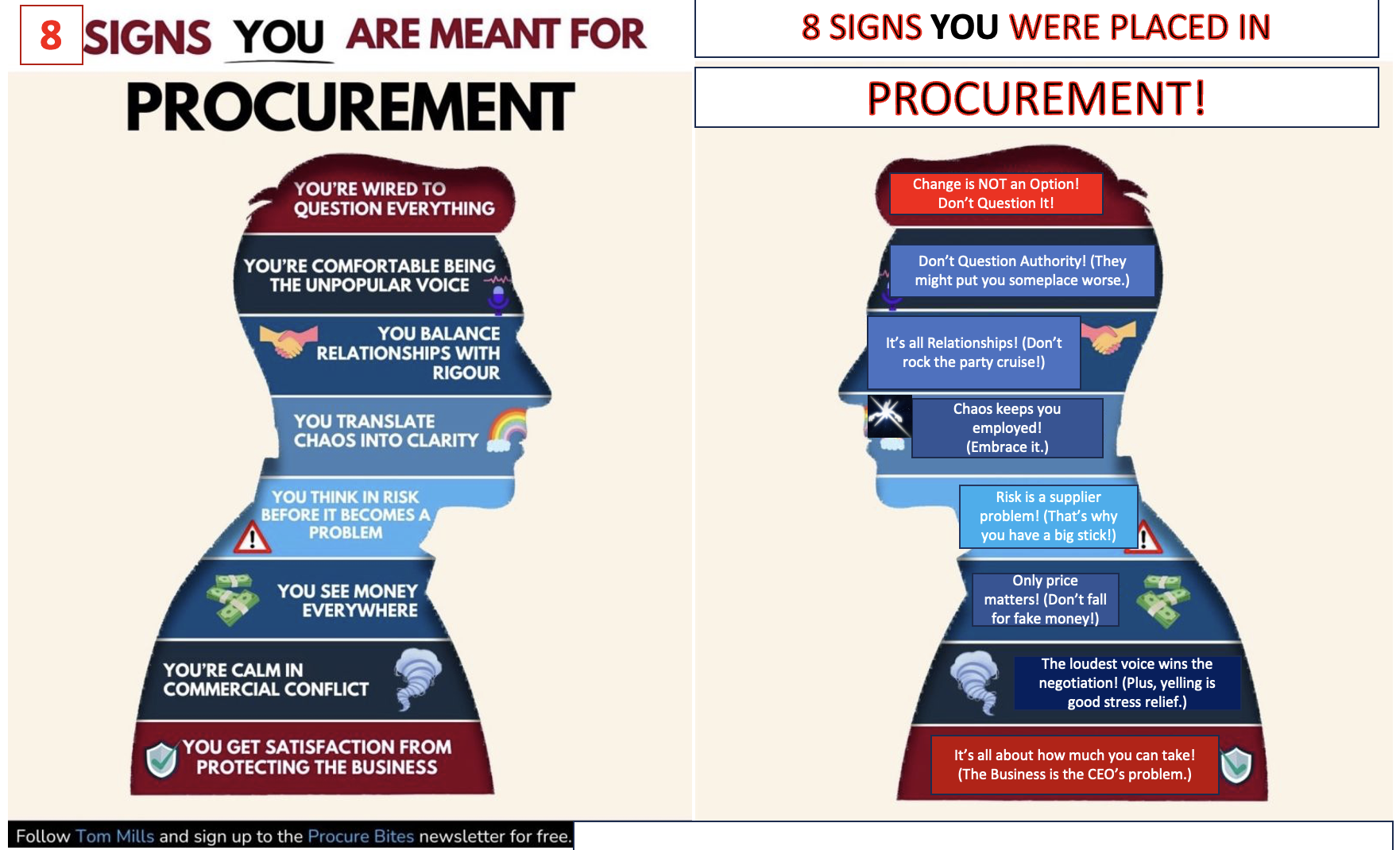
8 Signs You Were Forced Into Purchasing

Tom Mills, author of Procure Bites, recently gave us 8 signs you were meant for Procurement, which left some of you, in organizations where Purchasing is still treated as an old school function, and run by old-school die-hards who still think its the (19)80s, wondering where it came from because that’s NOT the personality profile you’re used to seeing.

Although Tom’s profile is the profile you want to see in Procurement, if your Procurement organization is still the Island of Misfit Toys, that’s not the profile you have. This post is for you and describes your Purchasing department where everyone there was put there because they didn’t belong (or want to be) anywhere else, and for one reason or another the organization can’t (or won’t) get rid of them just yet.

Enjoy!


When you remember Kraljic, don’t forget Coase!

Coase laid the original foundations … Kraljic gave us fundamentals … and now the Busch-Lamoureux Exact Purchasing Framework is building on that to give you a guide to modern Procurement!

The Kraljic matrix is broken. A big problem, as we have regularly explained, is that you can’t compress two independent dimensions (risk and complexity) into one. A little problem is people don’t understand how to qualify the importance of a purchase. It has nothing to do with cost or volume but everything to do with the organizational impact if the product or service being purchased suddenly becomes unavailable. Similarly, it has nothing to do with how much you buy from the supplier, but how critical it is they don’t go out of business. It might be a critical component, but if there are ten other suppliers who can meet that demand for you tomorrow, the supplier is not critical to your organization.

But the biggest problem is that people regularly misunderstand the purpose of the matrix — it was a tool, and the first of it’s kind, designed to get us thinking critically about purchasing and point us in the right direction. It wasn’t the be-all and end-all. It was the first formal methodology an organization had to segment purchases and suppliers, think about them critically, and approach sourcing and supply assurance methodologically. And it was created in a time when global sourcing was more predictable (because natural disasters were a fifth of what they are today, war’s didn’t breakout overnight without warning on the whims of a mad man stuck in a macho cold war colonial mindset), risk was primarily complexity, and if you used the methodology, you probably had a success rate of 90%, which was phenomenal.

Kraljic gave us a way to structure our critical thinking and improve the profession, and all most consultants did was water it down, create a one-size-fits-none methodology, and sell it like it was the next panacea, creating a consulting snake oil from a masterpiece of thought.

A masterpiece of thought you only understand if you understand the framework in which it was built, and those were foundations laid four and a half decades earlier by Ronald Coase in his 1937 essay “The Nature of the Firm“.

The framework was that of organizing the supply management operations of a firm, where the definition of the firm was the one put forward by Coase, which is essentially that the firm was the mechanism by which transaction costs were minimized. (Otherwise, there would be no need for a firm!)

Transaction costs are the result of the price mechanism of the open market, and include:

  • the cost of the negotiation and contract
  • the cost of the individual transactions the contract covers
  • the costs associated with production

and include all of the factors (people, equipment, technology, etc.) included in these prices.

This tells us that the fundamental purpose of a firm is … PURCHASING! And the only way a firm can grow is if it can continue to PURCHASE cost effectively (because as soon as the cost of subsequent transactions and / or production exceed the market costs, the firm is dead).

However, as most firms grew, they reached a point of inefficiency (due to management overhead, process inefficiency, and/or paperwork and/or communication point overload), and growth stopped. Also, as they grew, they became more brittle and sensitive to even tiny disruptions.

Kraljic recognized this and introduced the matrix so that firms could approach their purchasing in a more structured manner that would reduce the brittleness, simplify the management, and allow for additional growth and resiliency. And it was a great start.

But simply classifying items into non-critical, leverage, bottleneck, and strategic misses they key point of the firm’s existence. And that’s to ensure that the costs related to the category are not only always lower than the market cost, but remain low as the company scales.

When you classify an item as non-critical, it becomes ignored tail spend, and we’ve seen time and time again that the average overspend in this category is at least 15% in most companies, with many products and services being bought 30% more over market price.

When you classify an item as bottleneck, you focus on assurance of supply, and don’t dive into determining whether an item is a bottleneck because it can only be supplied by a rather limited supply base or because absence would shut down a production line. (Just because only a few suppliers produce the item to your specs doesn’t mean that only a few can, there might be a few dozen that could, and would, produce it to your specs [at a higher quality at the same price] for a guaranteed mid-to-long contractual commitment.)

When you classify an item as leverage, you double down on price (and exploitation of the price mechanism), and this can often come at the expense of quality and dependability, which can result in higher costs later if warranties come into effect or you have to replace products faster than normal (which always incurs a replacement cost in manpower and opportunity that is never factored into the “we can afford 4 of these per decade vs 3” equation).

When you classify an item as strategic, you triple (or more) the amount of effort you put into the management of that item (or category), and there is a point where the excess time investment not only fails to keep to the associated contract and transaction costs below market, but leads to no additional return on cost investment.

This is because the profiles don’t take into account the separate dimensions of risk and complexity or ensure that “importance” is defined as true “impact”, or provide any mechanisms for determining the impact (or risk or complexity).

This is why you need to go back to the foundations and build up a framework that is capable of capturing what the firm really needs!

That’s what the Busch-Lamoureux framework is intending to do.

By organizing categories based on complexity, risk, and impact

  • the cost of the negotiation and contract is based on the complexity, risk, and impact — where all are low, the whole process can be automated and costs minimized
  • the cost of the individual transactions the contract covers are minimized to verification of only what is important, and humans are only involved when automation can’t do that or finds a discrepancy
  • the costs associated with production are minimized as you are selecting a supplier that meets all of the necessary requirements at the minimum cost subject to an acceptable risk factor!

Furthermore, you’re making your contracts for durations appropriate to the category such that you’re adequately accounting for complexity and risk without locking yourself into long term deals that are not beneficial to your organization!

But most important, because the categorization helps you determine how much manpower you actually need to spend on each sourcing event, contract, and transaction, your organization is much less likely to experience decreasing returns as it grows, allowing it the funds it needs to ensure Procurement is appropriately staffed and resourced with the right systems.

Coase gave us the definition of a firm (PURCHASING)! Kraljic helped us understand the fundamentals we need to consider in our modern world. Now we’re giving you a framework to apply those fundamentals in a manner that will let you scale without fear of unnecessary waste. Go forth and transact! (The market depends on it!)

We Don’t Need State of Procurement Reports. We need Procurement Problem Prescriptions!

And we need Hackett Spend Matters to give them to us!

There’s a reason we picked on Hackett this week in our follow up to our 35 part series on why you really DO NOT need to read another State of Procurement report for Five Years, and that’s because we need Hackett to give us solutions to procurement problems.

We need them to tell us not just how to

  • prioritize our concerns
  • extract the core issues
  • identify the most relevant barriers
  • rank the most likely risks

but tell us

  • why some concerns take priority, based on organizational impact
  • how to identify the core issues, so you can learn to do so yourself
  • where you will encounter the barriers, and the techniques for busting through them
  • what the key risks are, with the mitigations and responses you need to put in place

The reality is that

  • you know what your concerns are, but you don’t know which are the most critical to your success when you are overworked, underfunded, and the world is literally burning around you
  • you likely weren’t trained in root cause analysis, and if you’re not a process expert, you will likely have difficulty getting to the root cause (especially if it’s deep in another part of the organization or the partner ecosystem)
  • you don’t know which barriers are equivalent to reinforced concrete and truly blocking your success and which are essentially made of paper mâché and easily conquered
  • how to deal with the most significant risks, especially when you can’t predict them all or influence their likelihood at all

This is the help you need … and Hackett, with the acquisition of Spend Matters, is the only analyst firm with the bench strength left in Procurement to do it!

The reality is that the original analysts in our space (first at AMR Research, which was acquired by Gartner; and then Aberdeen, acquired by Harte Hanks; and finally Forrester) all departed years ago. The number of analysts who have been in, and continually analyzing, Procurement Tech for 20 years is now countable on your fingers (and since Mickey North Rizza, at IDC, and Magnus Bergfors, at Gartner, both did a long stint in the vendor ecosystem and Jason Busch recently departed the analyst space for the vendor ecosystem, I can only confirm [besides myself] Jon Hansen of Procurement Insights, Andrew Bartolini and Christopher Dwyer of Ardent Partners, and Chris Sawchuk and the legendary Pierre Mitchell at Hackett [who goes all the way back to AMR]) as vets who have been consistently analyzing the Procurement space for at least the last two decades (back to when SI started 20 years ago in 2006). If you look at the handful of organizations with a senior Procurement analyst with two decades of experience, only Hackett, who also has Xavier Olivera and Bertrand Maltaverne, have a real Procurement Analyst team with deep bench strength where you have four senior analysts who each have 25+ years of deep Procurement expertise!

No other organization can give us the deep insights and playbooks we need to elevate our Procurement organizations, and do it without defaulting to the BS of “just implement the tech-du-jour of our sponsors and use our [associated] consulting arm to do it” — which we all know is not a solution (because, if it was, your problems would have been solved two decades ago)! But if they don’t do it soon, before Pierre and Chris retire, they won’t be able to — and, frankly, neither will anyone else! The time is now for them to stop wasting their analysts’ time on “state of” surveys and reports and instead explain what the findings of the last decade mean, what processes are needed to address the gaps, what organizational changes may be needed to implement those processes, and why we need to return to the classic

  1. PEOPLE-FIRST
  2. PROCESS-SECOND
  3. TECHNOLOGY-LAST

approach to solving problems and that, in the modern age, we have to actually modify this to:

  1. PEOPLE-FIRST
  2. PROCESS-SECOND
  3. DATA-THIRD
  4. TECHNOLOGY-LAST

because

  1. we are the ones who have to execute the business, all machines do is transmit and process data
  2. problems are solved by repeatable, predictable, dependable processes that can be executed by humans in a worst case scenario (even if intended to be automated to the majority of the time)
  3. no process can be executed without the right information
  4. technology only comes into play when we know it’s the right solution (and we can’t know it’s the right solution until we’ve addressed the people, process, and data elements)

and to do this, you need a lot of experience, domain expertise, knowledge about what data is available, and deep technology knowledge.

And this is another area where Hackett brings deep bench strength.

From the beginning, most of the analysts in our space were not technologists but operations research people, business finance, economists, accountants, and even historians. Few had computer science or engineering degrees and fewer still relevant experience building/installing relevant applications. At Hackett, Chris and Bertrand are engineers and Xavier and Pierre are computer scientists, who all have relevant real world experience with tech. They have a much better understanding of what tech can, and can’t do, then an average analyst (and are much less likely to have the wool pulled over their eyes by a new “AI-first” player that does nothing more than wrap a third party LLM to deliver a solution of questionable performance and reliability, for e.g.) and can do a much better job of not only recommending what type of tech to use, but who you should look at and why, versus just “who comes out in the upper right of of the magic map” based on blended subjective scores that, at the end of the day, mean nothing.

But the clock is ticking and time is running out. Let’s hope Hackett realizes sooner than later what types of research and reports we really need vs. just wasting their key analysts’ on surveys and summaries thereof.

HACKETT CONFIRMS THE STATE OF PROCUREMENT HAS NOT CHANGED … No Need to Read The Full Report!

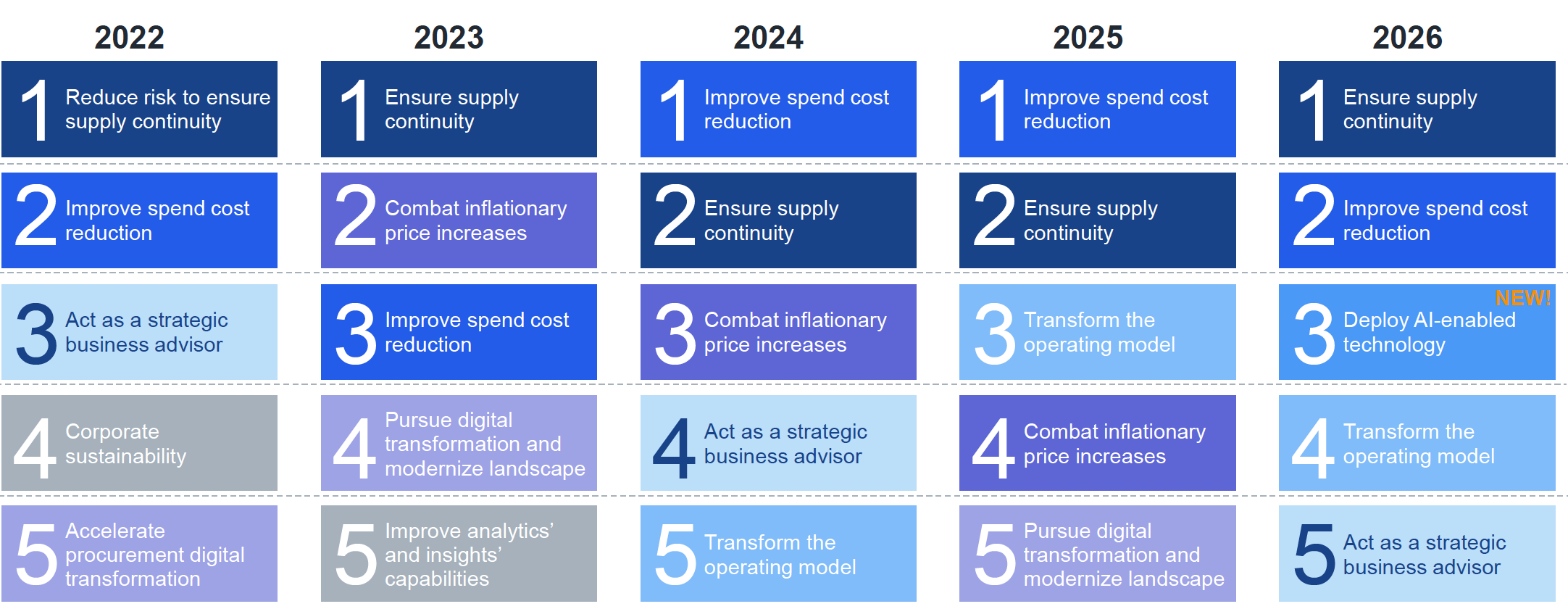
Nothing makes my point better than slide 15 on Trends in Procurement priorities in the 2026 Procurement Agenda and Key Issues Study Results sponsored (at least) by Jaggaer, SAP and Unit4 (and likely others).

Basically, every year you have the concerns of

  • supply continuity
  • cost reduction against inflationary price increase
  • strategic business advisory
  • digital transformation and the tech-du-jour (analytics to AI)
  • operating model improvements

All of the risks fall into our eight ever present risk categories:

  • Talent: Access, Acquisition & Retention, Retiring Workforce Impact
  • Disasters: (Other) Supply Chain Disruptions
  • Cyberattack: CyberSecurity Risks
  • Spend Pressure: Economic Downturn, Changing Customer Expectations, Capital Access, Competitive Alternatives
  • Supply Shortage (and Trigger Events): Trade Wars, Geopolitical Tension
  • Regulatory Compliance: Regulatory Compliance, Ethics & Privacy, Product Liability
  • Corruption: IP Loss
  • Tech-Du-Jour: AI-enabled Tech, Tech Transformation Delays, Tech Obsolescence

It’s the same-old, same-old situation when it comes to initiatives, except the tech-du-jour (AI) is nearing the top of the list, and the ecosystem is essentially the same, only the names of the players have changed. And, of course, the conclusion is, surprise surprise, to employ the tech-du-jour which, lo-and-behold, Hackett stands by and stands ready to help you with (despite the 94%+ failure rates found by MIT and McKinsey).

In other words, it’s the report we expected, and the first of many to come. (As you can expect every other analyst firm and consultancy will soon be releasing theirs, if they haven’t already. But we won’t be reading them, and for the next five years at least, neither should you.)

And, with the exception of the key shifts in concerns, issues, risks, and barriers, which could be a two page summary, it’s not a report you need to read through as very little has changed in the last decade.