Fail Fast And Forward? How About Not Failing At All?

A recent article over on The Sourcing Journal indicated that one should “Fail Fast and Fail Forward When Implementing AI into Workflows”. WTF? Why fail at all? Especially since if you’re using AI where you are expecting a high risk of failure, there’s no reason to expect that you’ll only fail once, or that you can actually fail forward.

Now, if we were talking traditional ML, where it’s just a matter of continually expanding and refining the model and training data, tweaking the parameters, and starting small, then fail fast, fail forward, get it working, use the spice weasel, knock it up another notch, and continue until you have automation across the platform in appropriate places, it would be good advice.

But when we are talking full fledged Gen-AI (which is the article’s focus) based on massively large and entirely unpredictable LLMs or super-sized DNNs, you can fail fast, but, with absolutely no way to control the models, you can’t fail forward. So while fail fast and fail forward is a good motto in general for technology, process digitization, and automation, as long as you take things step by step and control the risk, it’s not appropriate at all when we are talking about AI!

Recruiting Top Procurement Talent is More than Just Standard Best Practice Recruiting …

A recent article over on the Supply Chain Management Review proclaimed to offer 9 Ways to Recruit Top Procurement Talent in Today’s Competitive Market. So of course it caught our attention. However, the tips it offered were just standard Best Practice Executive Recruitment, and it was quite disappointing. According to the article, the best way to recruit top procurement talent, which is the rarest talent out there right now, is to:

  • Personalize the Recruitment Process
  • Optimize the Candidate Experience
  • Clarity and Transparency on the Role
  • Tangible Opportunities for Growth
  • Flexible Work Arrangements
  • Holistic Compensation Packages
  • Consistent Employer Branding
  • Empowered and Inclusive Workplace
  • Understand and Act on (Current) Employee Priorities

… and absolutely, positively NOTHING here is specific to Procurement talent. It’s the basics you should be employing when recruiting for ANY role as you are seeking out the talent (which is NOT coming to you). If you want Procurement talent, you have to do more than this. For starters, we recommend

  • Parity Compensation with Sales … in an average company, if that company is lucky, 10 cents of every sales dollar goes to the bottom line but the sales person, on top of a nice baseline salary, will get a 10%, 20%, and even 30% of the sale; in comparison, every dollar of spend reduction achieved by a Procurement professional goes straight to the bottom line (i.e. 10X the ROI, or more) and their commission is a pat on the back and maybe a trip to ISM … they should be incentivized to go above and beyond baseline expectations if you truly want the best (of the best)
  • Adequate Technology Budget … as almost half of organizations don’t have any modern sourcing and/or procurement technology solutions/platforms and the majority that do have not yet digitized the full Source-to-Pay+ process to maximize Procurement productivity and profits
  • Adequately Sized Procurement Department … while technology will allow the team to do more with less, as per the Hackett Book of Numbers, there’s still a minimum number of personnel you are going to need to sufficiently analyze and monitor the spend, strategically analyze and source all the necessary categories, keep the tail spend under control, improve sustainability, support the brand, etc. etc. etc.

… but what we really recommend is not trying to lure away more than one high talented Procurement individual (to be your Director / CPO if you don’t have one) but instead lure away top talent with the potential to become Procurement Rock Stars because they have deep category expertise in multiple categories the organization needs to source; outstanding project management, technology/math, and management skills; and the right EQ to be both a team player, team leader, and supplier development professional.

In particular, you should consider looking for:

  • new age logistics leaders (who can model supply chains, complex landed / ownership costs, and understand lead times and extended supply chain risks);
  • astute supply chain modellers and designers from consultancies who have particular expertise in your domain
  • engineering leaders (who know their categories inside and out, do complex modelling on a daily basis, have been trained in project management and managed projects, and have leadership and people skills
  • corporate / supply chain insurance actuaries and professional economists who have the expertise to appropriately predict, cost, and manage risk and create proper risk-aware sourcing events and risk mitigation plans

… and then training them on your Procurement processes, which will be easy-peasy for them to learn compared to the complex logistics, supply chain modelling, science/technology/engineering/math knowledge, and actuarial science and econometrics they had to learn to do the job they’re doing now.

Moreover, depending on your domain, you may also be looking for chemists (chemical manufacturing), biologists (pharmaceuticals), lawyers (if you do a lot of contracting / contingent labour / outsourcing), etc. The reality is that the best of the best for your organization likely aren’t in Procurement yet (because, as we pointed out in our recent article on how If You Want Good Procurement People YOU NEED TO TRAIN THEM).

Logility “Starboard”: The Real-Time What-If Supply Chain Network Modeller that Every Sourcing Professional Should Have

Now, it’s true that this blog is focussed on Source-to-Pay and it’s true that, as a result, we usually focus on Strategic Sourcing Decision Optimization and occasionally on Logistics-focussed Models and Optimization Solutions, as that what’s typically needed for a Sourcing Professional to make the optimum buy, but this time we’re going to make an exception.

Why is network modelling an exception (besides the fact that, as we told you yesterday when we said Don’t Overlook the Network, it has the absolute best return on investment across all supply chain applications)? Well, if you think about classic network modelling, it’s not something a sourcing professional would do because it’s typically up to logistics and supply chain to maintain the network infrastructure that gets the product from the suppliers to the ports and warehouses and then to the distribution centres, retail facilities, and end consumers in drop-ship models. It’s up to logistics to re-evaluate the supporting network infrastructure on a bi/tri-annual basis and determine if warehouses should be added, relocated, or deleted (on lease end); if ports should be changed (to reduce overall costs due to port fees or local carrier costs or rail vs truck options); if new carriers should be considered; and so on.

The reason that this is typically only done on a bi/tri-annual basis is because it has traditionally been an arduous endeavour where you have to

  • build a very detailed model of all
    • the supplier production facilities, ports, warehouses, distribution centers, manufacturing/assembly centers, and retail facilities
    • the lanes used
    • the modes used for each lane
    • the carriers used for each mode / lane combination
    • the LTL and FTL rates for each carrier
    • the drop-ship rates for direct-to-consumer
  • identify all of the products being purchased and
    • associate them with the appropriate suppliers
    • associate them with the appropriate lanes, modes, and carriers
    • associate them with the appropriate warehouses
    • associate them with the appropriate retail locations or drop-ship locations
  • collect all of the current rates, for every supplier-carrier-lane-mode option in use
  • then solve a current-state optimization problem to determine baseline costs, times to serve, carbon emissions, etc.
  • identify all of the potential port and warehouse locations you could (also) use
  • identify all of the new lanes that would create
  • identify all of the additional carriers that could be used
  • collect quotes for every lane-carrier-mode combination from the potential new options that might actually be used
  • then build an extended model that includes all options and feed in all of the data
  • then solve a full-state model to determine baseline costs, times to serve, carbon emissions, etc.
  • then determine the ranges for the number of ports, warehouses, distribution centers, carriers, time to serve, carbon emissions, etc. that are acceptable
  • solve a copy of the restricted full-state model to determine a new baseline cost
  • then make and create copies of the model and run analysis against different objectives until the model is acceptable, and the costs (time to serve, emissions, etc.) reduced significantly enough to do a network transformation exercise

and this endeavour would typically take three to six months due to the fact it would take weeks to build the baseline models, months to collect the data, and weeks to build, solve, and analyze the models and come up with a new state that improved all the measures of interest as well as the implementation plan to make it happen.

But the problem with doing this bi/tri-annually is that you never know the impact of adding a new supplier or, more importantly, replacing a supplier of a significant product line or category where that supplier is in a completely different location, and possibly one that the last network design never took into account. Plus, the removal of a big supplier might cause a certain node (warehouse, distribution center, etc.) to be significantly under-utilized, resulting in unexpected overspend in certain parts of the distribution network.

But this knowledge is critically important to know before making a major sourcing decision that might change the supply base for a highly utilized product line or category — because the costs of the award will not be the expected costs. They will not be the unit or expected transportation costs used in the analysis that the award decision is based on, but will instead be those costs plus the fixed and variable losses incurred from underutilizing a sub-set of the network and/or overutilizing another sub-set of the network.

While this has always been the case, as the belief was that nothing could traditionally be done about it, if there was a tool that could

  • actively maintain the current network model
  • allow for copies to be created on the fly
  • allow for those copies to be easily modified, including
    • the addition or deletion of nodes (suppliers, ports, warehouses, distribution centers, retail locations, etc.)
    • the definition of new lanes
    • the the addition of carriers and/or carrier modes
    • updated costs for every lane
  • solve those copies quickly and accurately

then a sourcing professional could have deep insight into whether their cost models and assumptions are correct and logistics could update the network model, or at least the future state (if leases/contracts need to expire and new leases/contracts need to be signed), upon every award, and the overall sourcing, logistics, and supply chain costs.

And this is what you can do with Logility Network Optimization, formerly Starboard Solutions (acquired in 2022) and exactly why we are making an exception and covering them.

With the Logility Network Optimization Solution (which really should be called Logility Starboard, for reasons that will soon become clear), a Sourcing Professional can:

  • instantly see a graphical view of the current global network
  • bring up reports that summarize all of the key data
  • drill in to node / carrier / supplier / port / warehouse / distribution / product / combination costs
  • create a copy of the current network with all relevant data
  • and then create a what-if baseline scenario where they can
    • add whatever they wish (through simple pop-up interfaces they can add nodes and relationships),
    • remove whatever they wish (by simply clicking on a node or searching for the entity or relationship and deleting it), and, most importantly,
    • change whatever they want through in the network design through a simple drag-and-drop mechanism
  • they can then specify any constraints and goals, run an optimization, and see the new costs, and, most importantly, extract lanes / costs / variables of interest to populate into the TCO (total cost of ownership) calculations in their sourcing events
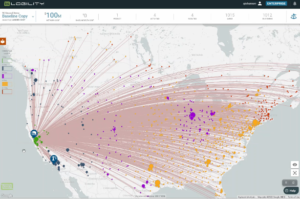
Logility Network Optimization can do this because it integrates with third party platforms and constantly extracts current market quotes and market rates for all major global lanes and can, when you change a design, automatically bring in those market rates and costs as a baseline for any lane / (generic) carrier / mode / volume combination you don’t already have a quote for. This not only provides a baseline rate (which might get better with a volume promise, negotiation, or current quote), but a statistically accurate one (especially if you just go with a generic carrier rate). (And, if there is no quote for a lane, the platform is smart enough to build one up from lane segments or tear one down using existing quotes and statistically significant costs per distance using statistically significant base rates for just securing the transportation mode.)

Furthermore, because it is a true multi-tenant cloud solution that uses a distributed “serverless” model that can decompose tasks into subtasks that can be run in (a massively) parallel (manner), such as data fetching, sub-model building, and even model solving (as all optimization models can be solved by solving sub-models on convex subspaces of the high-dimensional solution space), it can do it fast. And it’s just as accurate as the traditional, prior generation tools, at a speed that is breakneck in comparison, and that’s even if it uses statistically significant calculated data.

Moreover, it’s very easy to define multiple constraints and weighted objectives. You can guarantee maximum times to serve / times to deliver (subject to minimums that cannot be improved upon) while balancing overall cost and carbon footprint (through a weighted objective). (It’s quite easy to define objectives in the platform which have built in pop-ups to solve for different goals — service time, emissions limit, cost, and best X, where X is a single dimension or derived dimension that weights 2 or more other dimensions.) Or you can guarantee maximum times to serve, a fixed / x% carbon reduction, while minimizing overall cost. Or you can keep ports you know are stable and the warehouses with contracts you can’t break while allowing the delivery network architecture to shift to minimize overall costs.

The browser based interface to Logility’s platform offers a graphically represented virtual twin to an organization’s network with high-level summary data (products, facilities, lanes, suppliers, customers, activities, and costs) with easy scenario selection and easy definition and modification of scenarios. It’s very easy to dive into definition screens and see the suppliers, facilities, lanes, etc. and see/edit all of the data for any individual supplier, facility, lane, etc.; add a new instance, delete one, and see the associated costs, times, emissions, etc. and the underlying calculations associated with a node or relationship in the network graph (which is stored in a graph database that allows for massive scalability).

It’s also very easy to dynamically generate comparison reports between scenarios that compare (activity) costs (across cost types, such as leases, handling, transport costs, rail costs, ocean freight, tariffs, etc.), (average) service times (by supplier, product, lane, etc.), carbon (by carrier, lane, product, supplier, etc.), and other metrics of interest. Furthermore, when a user is happy with a scenario, they can one-click generate and output a complete comparison / summary report deck to PowerPoint for executive reporting (across as many scenarios as they like).

To enhance usability — which is quite obvious out-of-the-box to anyone who understands the basics of modelling, optimization, and decision analysis — Logility has an integrated quick-tour to get started, a full multi-media course on the platform and the modelling that can be done, playbooks for particular problems and challenges, and weekly office hours where users can ask Logility pros questions and get answers in real time. Logility Network Optimization was designed from the bottom up for usability and success.
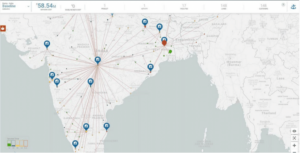
Logility Network Optimization is the perfect complement to optimization-backed sourcing platforms with bill of material support. Buyers can model potential changes that would result from awarding to a new supplier, not awarding to an existing supplier, changing carriers or lanes, get expected transportation and tariff costs, augment the supplier quotes with this updated data in real-time through a Logility API feed (from an identified scenario), run a total cost of optimization scenario on the full set of bids augmented with accurate total cost of ownership data, make an award, push that award back to Logility Network Optimization which will update the network model in real time, create a new what-if, and see if the network model should be altered when the new supplier is brought fully on board. For the first time, an organization could have closed loop sourcing, logistics, and network optimization in real-time — a reality that was once as far away as the stars themselves (and why the platform takes you Starboard). It’s a powerful concept, and worth branching out beyond traditional Source-to-Pay providers and Strategic Sourcing Decision Optimization to achieve.
Don’t Overlook the Network (that Corresponds to the Award)

According to a recent Forbes article on Supply Chain Software’s Best Return on Investment, per $1 Billion in company revenues, no supply chain application has a better return on investment (ROI) than network design! And the doctor couldn’t agree more.

Just like strategic sourcing decision optimization is the best bang for the buck in Source to Pay, with documented, average returns of up to 12% year-over-year (by multiple analyst firms) as it can minimize total landed cost, and even total cost of ownership in some cases (including internal inventory costs, waste costs, etc.) and not just bids, while ensuring all business constraints are adhered to, an optimization-backed network design application can help minimize overall organizational supply chain costs. This is because a supply chain network optimization platform can minimize transportation costs, intermediate warehousing costs, tariffs, waste, emergency replenishment in the case of an unexpected stock-out, carbon/GHG, etc.

Plus, as the article notes:

  • network design solutions are absolutely necessary to uncover business value when the production-distribution infrastructure is large (and not just because you just can’t model that infrastructure in a spreadsheet)
  • network design solutions can look at Total Cost to Serve (TCTS) across a wide-range of fixed and marginal costs (and identify unintended circumstances of network design changes that could cause marginal costs to skyrocket)
  • network solutions can allow for multiple scenarios to be defined and multiple models to be run and cross-model and cross-scenario Pareto analysis to be run, trade-offs to be analyzed, and the best decisions to be made

One point that should not be overlooked is that projects will take some time, and it’s not because of the complexity of the network modelling or the time it takes to run the scenarios (as modern computing architectures are super powerful and modern algorithms highly optimized to be efficient and take advantage of massively parallel processing), it’s because you need a lot of good, clean, data. It can take months (and months) just to identify, collect, clean, and enrich the data required for global supply network optimization. But once you do that, the ROI will be beyond the expectations you have for every other supply chain solution.

The article, which describes a project to redesign the spare parts supply chain for a global automotive manufacturer, resulted in a redesign that immediately reduced network costs by 4% and identified transportation cost reduction opportunities through consolidation and re-allocating of routes to a smaller set of 3PLs that will save another 2.5% at contract renewal time. In today’s climate, especially in direct supply chains, a savings of 6%+ across the entire supply chain, and not just one category, is phenomenal!

Plus, as the article notes, in the age of sustainability, reduced transportation mileage and fuller trucks also equate to significant reductions in carbon emissions. WHAT A BONUS!

Automation is Good Across the Board! But Automation still does NOT mean Automated.

Not that long ago, we penned Procurement Automation: Good. Automated Procurement: Bad because organizations that embrace the right digital technology do much better than their peers, but organizations that go all in and put too much trust in unproven technology without human oversight (while trying to run before they’ve learned how to walk) or good data (and then make worse decisions than having no technology at all, as recently determined by Gartner) are making a huge gamble while forgetting that it is the house who always wins. (And in this case the house is the technology provider that is charging you a lot of money for the technology that eventually fails and costs you time, money, and in the worst case, your job and/or business. But we digress.)

And while this blog is a Sourcing, Procurement, and related Supply Chain Technology blog, it was very happy to see a recent release from the Hackett Group, as advertised in a recent press release on Yahoo! Finance / BusinessWire, that noted that while HR (and Humans are VERY important to successful Procurement Operations) operating costs increased significantly in 2023, Digital World Class organizations continued to spend significantly less than their peers while delivering more resiliency, employee productivity, and greater business value with less staff than their peers. The Hackett Group concluded that increased spend on technology plays a key part in driving the superior performance.

Other key metrics that Hackett pointed out is that companies with at least one business services function operating at Digital World Class levels see a five-year average performance premium over their industry medians -– an 80% improvement in net margin; 24% higher earnings before interest, taxes, depreciation and amortization; 89% greater return on equity; and 44% higher total shareholder return. (So imagine how good your organization would be doing if you were world class in Procurement and HR, and ensured that your organization always acquired, trained, retained, and promoted the best of the best.)

Hackett found that a key aspect of Digital World Class Organizations in HR, just like Procurement, was a greater use of technology (to the tune of 60% more likely to have and use the full capability of Human Capital Management applications).

There are a lot of great applications that a leading HR organization can employ that go beyond the specific applications mentioned of:

  • Human Capital Management
  • Time Sheet Management (for hourly employees / contractors)
  • Health (& Welfare) management

and, as Hackett points out, include the use of emerging technologies such as:

  • smart automation (not automated Gen AI applications)
  • advanced analytics
  • collaborative tools

For example, a good HR department will employ platforms that:

  • will use smart automation to onboard employees, ensure they get paid on a regular basis, ensure that their expense claims are properly routed and evaluated on a timely basis (and OCR use to reduce receipt processing), ensure that all information they enter on health/disability/etc. claims is auto-routed to the right third party systems (and not lost/transcribed wrong), etc.
  • will use advanced analytics to analyze its highest contractor/third party costs, determine what functions should maybe be brought (more) in-house, analyze it’s biggest employee benefit plan costs, optimize those costs (without reducing benefits), etc.
  • use collaborative tools for onboarding, training, and continued professional development, especially for remote learning and self-study

Just like a good Procurement department will employ platforms that

  • use smart automation to onboard suppliers, automatically distribute and collect RFPs, verify data that can be verified by a third party, do automated sanity checks, do initial analysis for presentation to a HUMAN, automatically generate POs from carts/contract schedules, automatically match, to the extent possible, invoices to POs, etc.
  • use advanced analytics to identify not only the greatest costs but the greatest opportunities available to the organization based on PPV (purchase price variance), market opportunities, consolidation, demand management, substitution, etc.
  • use collaborative tools to involve all stakeholders and make sure processes are automated to the extent possible

Because modern technology is far superior for tactical processing (thunking) than we are as humans. However, the leaders understand machines, while they can augment our intelligence with finely tuned applications, cannot think and leave the final decisions to the humans. Technology is applied appropriately for maximum success.

As Hackett says, the bottom line is that Digital World Class HR organizations are better at enabling their companies to succeed. They have streamlined the day-to-day transactional elements of their operations, and through systematic use of global business services and process automation have freed up an additional 12% of their teams’ efforts to focus on value-added activities. Now, they can more effectively focus on attracting, retaining, developing and engaging employees. The right digitalization helps people, and that’s why the right digitalization helps Procurement.