
Is this the year CLM breaks the bank?

Or at least the deal?

Last year Icertis raised over 100 Million at a valuation that allowed it to become the next unicorn and Coupa bought Exari to fill the hole in their suite. Seal Software raised another 15 Million just to power contract discovery and a new startup, Lexion, raised 4.2M to bring AI to contract management.

Pure-play CLM, and its precursor technology, has been around for a long time. Exari was founded in 1999 and Selectica, which rebranded as Determine after it acquired b-pack and Iasta, dates back to 1996 when it offered a CPQ (configured price quote) solution. Not long after, Nextance (which was acquired by Versata) was founded in 2000. And the saga continued from there.

But we won’t bore you with a detailed recounting of providers that have come and gone over the past 20 years. The point was merely to make it clear that while CLM has been around for a long time, it hasn’t been very successful. The majority of providers have been acquired, acquired, and/or morphed into different solution providers in order to survive.

But this is the year CLM may finally come to the forefront. With risks increasing, costs escalating, and supply chains lengthening, contracts, and associated obligation and liability management, are becoming ever more important. It’s not just negotiating a good deal, it’s ensuring that deal is adhered to. That’s more than just loading the items into the catalogue with agreed to pricing and ensuring the invoices match the purchase orders, it’s ensuring the items are bought when they are supposed to be (so the company keeps its end), delivered when they are supposed to be, at the quality level they are supposed to be at, and free of the risks they are supposed to be free of.

This requires not only careful monitoring of execution, but careful construction and review (are there any clauses with ambiguous interpretations or would counter-party suggestions increase risk), and this is a capability most Source-to-Pay providers don’t have. When most vendors advertise contract management, what they really have are contract meta-data management — the system can track contracts, products and services, pricing, promised demands, and associated contract documents, but can’t suggest templates, analyze them, or intelligently determine when an obligation isn’t being met by either party. The systems can’t intelligently manage clause libraries or help with intelligent contract drafting, comparison, or exception management.

But if contracts are the only cure to the ills of risk and obligation management, considering the difficulty most organizations have in finding and getting a handle on them, then this might be the year that CLM finally comes into its own. It may not break the bank, but it may start being the differentiator in deals. And that may just be enough.
Tailoring in 2020 …

Even though bespoke tailoring didn’t come into vogue in the UK until the early 1700s, the modern art of tailoring is an age-old practice that dates back to at least the 1200s when skilled garment makers would make custom attire for the royalty in their realms. These tailors would provide a “made to measure” service would insure that each garment, original and unique to each customer, would fit perfectly.

Tailors understood the value of service, so the question is, why don’t your platform providers. They all promise the perfect fit, but most don’t deliver. Why?

Well, there are a slew of reasons. Many providers claiming to be Procurement 3.0 are actually still delivering hacked together 2.0 solutions with limited capability and even more limited customization. But will this change?

With some providers, especially those with platforms with true 3.0 foundations who are embarking on completing their journey with the hopes of someday embarking on the Procurement 4.0 journey (which right now is unobtainable* despite the proclamations of the futurists), it will.

Platforms will not only be more configurable, but they will be configurable by you and, more appropriately, as they get more complete, and smarter, they will begin to adapt to you. Smart assistants will learn your grammar and usage patterns and immediately guide you to what you ask. Augmented intelligence will provide you insights you need where you need them … not 3 reports and 6 drill-downs away from where you need the insight.

Basically, what we are saying is, now that we are into the third decade of stand-alone best-of-breed Procurement technology, it’s time that the technology works for you. No longer should you be burdened with technology that makes you work for it. So when you are looking for a platform, look for one offered by a tailor, not by a one-size-fits-all milling machine.

* For reasons that we’ll discuss in the near future …

Supply Chains in 2020 …

… are going to be hard to predict, and more complex than even the true experts are predicting. Why?

1. Tariffs, Trade Wars, and Escalating Tensions

Once upon a time, tariffs were well understood, changed rarely, and could be easily calculated into total cost of ownership equations. This allowed an organization to make long term sourcing decisions with a solid understanding of long term costs. But with trade wars on the rise, tensions escalating, and tariffs being introduced and increased on an almost daily basis … no sourcing decision is safe beyond the minute it is made.

The situation is not going to get any better, and, in fact, might get worse. As a result, the ability to track not only costs, but tariffs, tensions, and risks thereof is going to get more complex than even the average expert expects.

2. Carrier Complexity

Carriers continue to come and go at the regional and local level (as a result of recently introduced or increased insurance requirements in some countries), ocean carrier availability depends on overall demand, suitability depends on costs which depend on availability and unpredictable energy costs, and air carrier availability depends on plane availability (which is affected when planes get grounded), weather and the non-occurrence of natural disasters (such as volcanic eruptions and hurricanes and severe thunderstorms that ground airplanes), and, of course pilot availability (impacted by strikes).

Then we have the risks of war closing off routes and even downing commercial planes. The risks of regulation limiting driver, pilot, conductor, and captain availability and/or putting carriers out-of-business. And of course the risks of escalating high-tech theft, including theft from moving vehicles.

3. Automation and AI

Automation is taking humans out of the equation, and AI is threatening to take even more out. This isn’t a good thing. Automation can streamline tactical processing and information gathering and processing, but not strategic decision making. And despite what some enthusiasts may claim, AI does not improve the situation … in fact, it makes it worse.

You see, with so many unknown variables across such a broad spectrum, no AI solution can even know all of the data to monitor, yet alone interpret it all properly when there is no foundation to measure against with so many new situations cropping up daily. AI will work the 90% to 95% of the time that the statistics says it will, but will fail in the remaining situations, and fail miserably. All of the savings or efficiencies the solutions will deliver across the first 19 solutions will be undone, and then some, in the 20th situation when the solution goes unchecked.

Even without getting into specifics, supply chain complexity will be a challenge in 2020. And, if things get worse, it could be a nightmare. We hope you’re ready.

Sustainability is Getting the Buzz …

… but will it get the buck?

By now it’s very unlikely that you haven’t heard the recent news about Ecovadis getting a 200 Million investment to spread its sustainability ratings to a larger audience … both directly and indirectly through its ever-expanding partner network.

And while it may be the case that momentum towards a more environmentally and societally focused economy has been building for years, that doesn’t mean that it’s here. It doesn’t mean that an organization will put their money where their data is and actually choose the most sustainable supplier for the award.

After all, the last few surveys that have been done asking buyers how much more sustainability is worth to them in real dollar terms have continued to demonstrate that while buyers want ethical and sustainable companies and products, they aren’t willing to pay much more for them. A few percentage points, tops.

And with inflationary times back, this means that companies are still under pressure to keep costs down to sell in addition to keeping profits high to keep the shareholders happy. This leaves little room for a move to a costlier supplier, even if that supplier is much more sustainable.

After all, unless the organization is willing to stand up to its investors and take a profit hit in the short term to embrace a new sustainability agenda (which WILL pay off in the long term as lack of non-sustainable resources causes everything to go up in price), all that is going to happen is that the buying organization is going to use the sustainability data to choose the lesser of two or three evils, not the most sustainable organization that will generate the greatest benefits over time.

And despite the hopefulness of companies like EcoVadis, and their investors, the doctor doesn’t think that tipping point has been reached yet, or that we are even close. However, the need to look like you’re doing good is growing, and making statements about the use of independent data on sustainability and ethics helps you look good (for now, anyway), so it is a good time to be one of the few, big, global players so the doctor does project continue growth for Ecovadis, even if the companies that subscribe to the data aren’t using it the way that they should.

S2C Decision Tree …

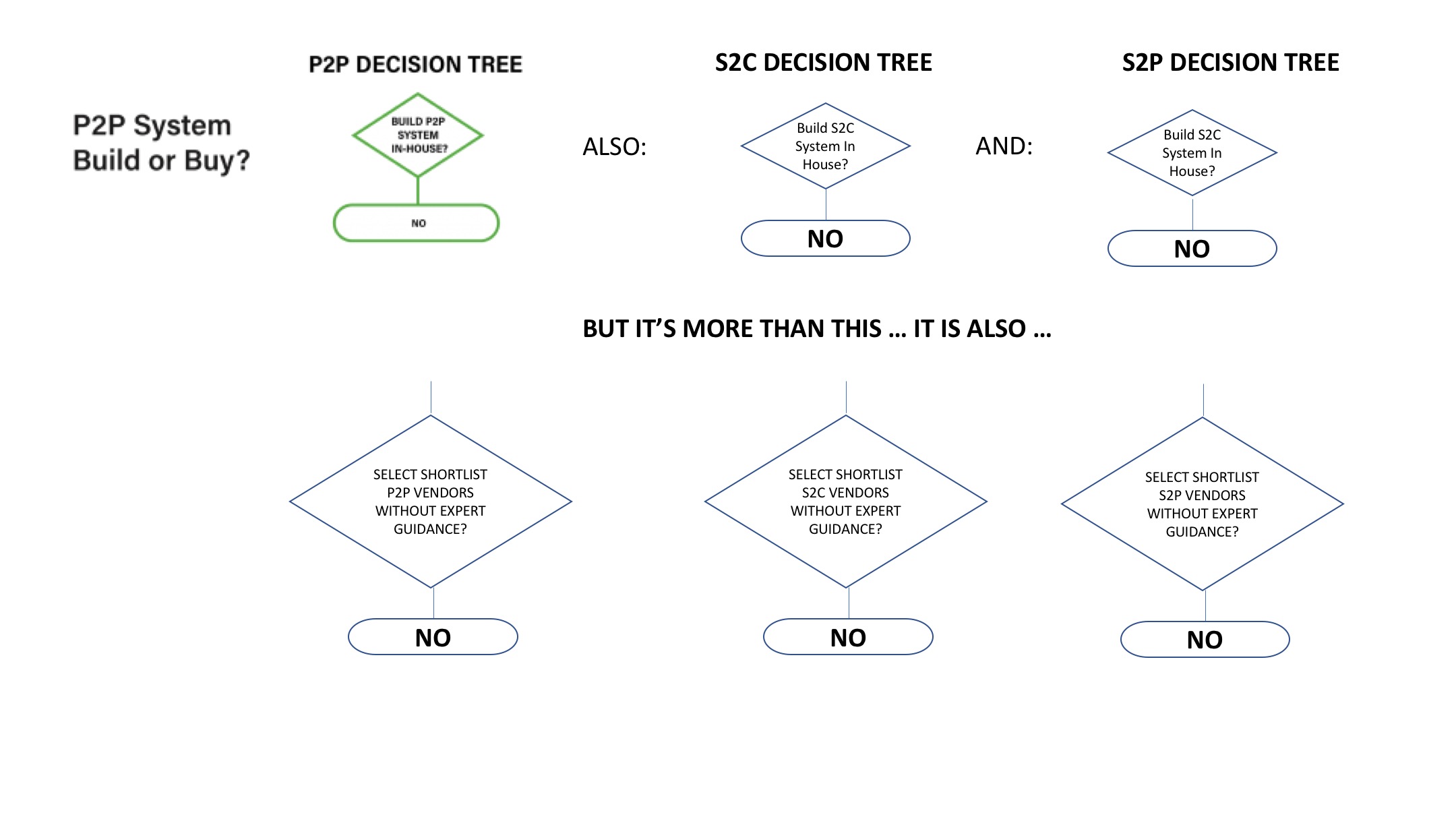
Over on Purchasing Insight, Pete Loughlin ran a great post on the “build or buy decision tree for Purchase-to-Pay” that should not be overlooked because it gives every organization a very simple answer that even the most luddite of C-Suites can understand … NO!

You do NOT build a P2P system in-house. In fact, you should NOT have been building or maintaining a P2P system in house since the early part of the last decade — but with so many suite providers to choose from now, the fact that some organizations are still even considering building a P2P solution is almost inconceivable in-and-of itself.

As Pete Loughlin clearly states, when facing the build-or-buy question you first need to to ask yourself if the problem you are trying to address is new, uniquely different or so rare that a suitable solution doesn’t exist already. And the only reason you’d build in-house is if you could honestly answer no. In the days where there were only a couple of solutions, and they only worked well with ERPs or indirect purchases, there might have been good reasons to say no, but now that there are dozens of options, that can be focused on indirect, services, direct, or the whole kit-and-kaboodle, the only reason you’d say no is if you were completely unaware of what has happened in the space in the last 20 years — and if that is the case, you really shouldn’t be making the decision.

However, the reason SI is drawing this to your attention is not just because you shouldn’t be building P2P in-house, but because you shouldn’t be building S2C and, most definitely, shouldn’t be building S2P (or any component there-of) in-house either! But the real reason SI is bringing this to your attention is the flow-start doesn’t stop there … it continues. Not only should you NOT build in-house, but you should not formalize the short-list in-house without the help of an expert advisory partner. There are 100s of companies out there, and just shortlisting SAP Ariba, Coupa, and Oracle is not the right answer — and it’s even worse if you shortlist Basware, Coupa, Oracle, and ScanMarket for S2P. While these are all great providers in their own right, they are not all S2P and it’s not an apples-to-apples comparison. And when it comes to best-of-breed solutions, the doctor has seen even worse shortlists!

This one of the reasons the doctor worked on the development of SolutionMap — by creating a custom profile, it can be used to identify the companies that best-match an organization’s need on the tech-axis, which allows the organization to shortlist the right vendors to invite to the RFI. Vendors that can meet basic tech needs and be compared in an apples-to-apples comparison … allowing the organization to focus on finding the provider that can best serve the organization overall and match their culture, versus focusing on basic check-the-box technology features just to find out 2 of the 3 shortlist providers don’t even meet the basics. (And this usually ends up with the organization having to go with the vendor that’s left versus selecting the vendor that’s the best.)