Supply Chain Disruptions Come Without Warning

Everyone is still talking about the recent Japan earthquake and the ramifications it will have on your supply chain for weeks, months, and years to come. No one is talking about the fact that, thanks to global warming, forest fire season is now upon as and that more than 30 wildfires raged through Oklahoma last weekend (Fark.com) and that it only takes one fire to destroy a plant or distribution centre.

But it doesn’t take a natural disaster or a political uprising (such as the recent ones in Egypt and Libya) to instantly shut down your supply chain. A simple regulatory decision can have ripple effects through your supply chain. On March 10, the US Transport Security Administration (TSA) issued an emergency amendment to security measures that would take effect immediately that required freight forwarders with air cargo operations at non US locations to request additional information for all shipments on each master airwaybill ( MAWB ). As a result, Air Canada had to embargo all cargo flown to the US until further notice until they could be sure they were in compliance. (Canadian Manufacturing) Now, this embargo only lasted a day, but it could have lasted a week had the regulatory change been more onerous. But like a natural disaster, this disruption came without warning to shippers who relied on Air Canada to deliver their goods to the US.

That’s why you need contingency plans drawn up and ready to go, because you never know when you will need them.

Vendors: When the Buyer is Right

I recently pointed my readers to Stephen Guth’s Contract Negotiation Handbook that exposes 16 of your dirty tricks which they hopefully won’t fall for again once they read the book and absorb its secrets. As a result, you’re going to have to make some concessions. But what ones should you make?

In order to show you that SI doesn’t play favourites (and is only interested in a fair and level playing field), I’m going to give you five examples where the buyer is right and where you should concede, inspired by this recent article over on MintLife that asks “is the customer always right?”.

  1. When it Costs Nothing To Let The Buyer Have Her Way
    Maybe she wants her paper, free training materials, or faster delivery. If the T’s & C’s she wants have no negative impact on your revenue, if you have e-versions of the materials that can be downloaded from your FTP server, or the buyer is paying for delivery, who cares? Concede. And maybe when the buyer feels like she’s getting her share of compromises, she will back off of some issues that are a lot more costly to you.
  2. When the Law is on the Buyer’s Side
    If you screwed up on a previous contract, and the buyer is asking for fair restitution (in the form of going forward discounts), and the law backs her up, you better concede this point quick before legal gets involved. Because any savings you negotiate then will be eaten up ten times over by legal fees.
  3. When Your Delivery Team Has Been Negligent in the Past
    Even if its questionable as to whether the buyer would win in court, if your team didn’t deliver on past promises, own up and make it right. This will instill a great deal of respect for you in the buyer, remove hostility, and considerably ease negotiations.
  4. When The Company Can’t Afford to Lose the Business
    If the customer is one of the company’s top customers, and accounts for a double digit percentage of revenues, even if the customer doesn’t know it, be prepared to make a few concessions. Losing a few profit points is much better than losing profitability as a business. However, this is one concession that should not be made too quickly.
  5. If failing to concede would bring shame to you or your department if the buyer brings the complaint to the organization’s C-Suite
    Let’s say you got caught trying to pull the GSA or SOX ploy or, even worse, making a claim that no one pays less than X when another customer made it public they got a great deal from you and paid only 90% of X. You may have been following the internal negotiations playbook, but it doesn’t matter now, because shame on you or the department could be much worse than failing to reel in a big fish. (After all, there are plenty more fish in the sea.) Immediately concede the lie, and if it requires an immediate price drop to the lowest known price, concede that too (with appropriate volume or contract term conditions if the price was granted only because a volume threshold was reached).

While there’s a sucker born every minute, not every potential customer will employ the sucker. So while the followers might employ a sucker you can real in with one of your ploys, there are leaders (who read SI) who won’t fall for them, or stand for any less than what was promised. Remember this, and you’ll get a fair deal from the leaders (who understand that a fair level of profitability is key to sustainability) and survive in your job long enough to reel in the next follower (who employs a sucker) that comes your way.

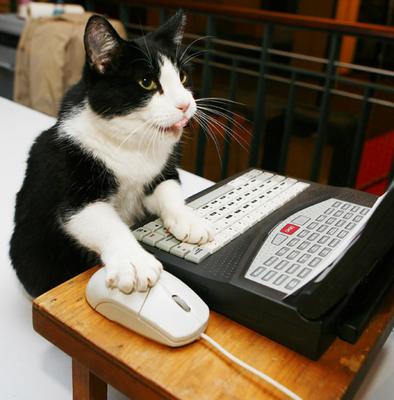
Geek Cat Says

You know I never
I never heard you talk so good
You never chat the way you should
But I like it
And I know you like it too
The way that I want you
I gotta have you
Oh yes, I do

You know I never
I never ever get home late
You know that I can hardly wait
Just to ping you
And I know you cannot wait
Wait to ping me too
I gotta chat you
Cause baby we’ll be

On the Facebook
In the Farmville pen
Behind the bushes
Until I’m begging again
In the chartroom
Lock the public out
And baby
Talk qwerty to me

With apologies to Poison.

Interpreting Japanese Communication

Editor’s Note: Today’s post is from Dick Locke, Sourcing Innovation’s resident expert on International Sourcing and Procurement. (His previous guest posts are still archived.)

Note to readers of the Purchasing Certification Blog: most of this post appeared in this morning’s post on “Japan’s Supply Chain Recovery: Interpreting The Estimates”.

I’ve been watching and reading the various sources of information coming out of Japan and trying to interpret it after filtering it through the cultural differences that can impede communication and sometimes action. I see one apparent difference and am concerned about another potential difference.

One consistent complaint is that the various spokespeople in Japan seem to be understating the seriousness of the radiation hazards. It’s very likely that this is due to a cultural difference that strongly affects communication. The difference goes by various names, and I call it a “need for harmony”. It could also be called a “low score on a frankness scale”. A strong cultural need for harmony can make it difficult for people in that culture to deliver bad news directly. They will often resort to various expressions such as the Japanese “honto ni muzukashii“. That literally means “truly difficult” in English. However, people in Japan will correctly take it to be a very frank statement that something will not happen.

A classic example is in the Japanese Emperor’s speech to the nation announcing the surrender at the end of World War II. It included “the war situation has developed not necessarily to Japan’s advantage”. This was after two nuclear bombs and a total collapse of manufacturing and logistics.

While Japan is especially strong in this need for harmony, it’s a fairly widespread characteristic among Asian and some Latin American cultures. Keep in mind that Japanese may be perceiving the messages differently than Westerners.

The second difference is just a concern at this point. There’s a well known cultural difference called “Uncertainty Avoidance”. It influences the willingness of people to make decisions without being sure of the outcome. It makes people much more comfortable with routine situations and incremental improvements than they are with dealing with the unexpected. While Japan is extremely high on the “Uncertainty Avoidance” scale, I really haven’t seen any indication of lack of creativity in solving the problems.

Now, for those of you who are trying to gauge potential supply disruptions:

If you can manage face to face meetings that’s clearly the best way to handle it. You’ll have to judge the danger of traveling to a particular Japanese supplier of course. Second best is video conferencing, so you can watch facial expressions and body language. Third best is telephone. In all cases, send some questions ahead of time by email. In questioning, be sure to probe assurances of continuing supply more deeply than you would with people from a frank culture such as Germany or the US. It’s best to ask open ended questions such as “how are the roads to the airport” or “how are your suppliers in the affected area” than questions that can be answered with a simple yes or no such as “is everything OK”.

You should also keep in mind that Japanese communicators are usually not being dishonest when they seem overly reassuring. It’s just that their culture makes it difficult to say some things too directly and they are seeing themselves as courteous.

Dick Locke, Global Procurement Group and Global Supply Training.

ERP is NOT Always the Answer

Reading this recent article on “Mitigating Risk and Exposure from Subsidiary Operations” in Industry Week, one could get the impression that the only way to mitigate risk is to deploy one or more (connected) ERP systems to manage corporate data. Nothing could be further from the truth. While you do need consistent data and compatible systems, you don’t need an ERP. But I guess I should have expected such misleading advice given that the article was written by a VP at SAP, one of the biggest ERP vendors in the world.

According to the article, in order to mitigate risks to the company’s supplier, quality, liquidity, financial reporting, and unbudgeted spending, a company must streamline and automate mostly manual systems to:

  • enable the sourcing group to automatically provide information on preferred suppliers and negotiated terms to every subsidiary
  • enable headquarters to have ongoing visibility into cash-on-hand and receivables and payables across the organization
  • streamline the financial consolidation process
  • streamline inter-company purchasing transactions
  • implement collaborate processes such as forecasting and budgeting

Furthermore, according to the article, to accomplish this automation, a company needs to either:

  • deploy the same ERP system across the company,
  • deploy a two-tier ERP with simple data integration, or
  • deploy a two-tier ERP with process integration.

First of all:

  • A (cloud-based) SaaS e-Sourcing/e-Procurement platform with contract & supplier management can maintain preferred suppliers and terms and be accessible by every subsidiary.
  • A shared (cloud-based) SaaS accounting / finance system will allow headquarters to have a view into each subsidiary’s financials …
  • … and this shared system will streamline financial consolidation.
  • A (cloud-based) SaaS e-Procurement system will streamline inter-company purchasing, and
  • a cloud-based inventory / distribution / warehousing / logistics management system will allow for collaborative forecasting and budgeting.

So you don’t even need an ERP at all to accomplish the stated goals. Furthermore, while you do need integrated data, you can maintain this data with a simple relational database and integrate it using an off-the-shelf data analysis package with good ETL (extract-transform-load) tools that can merge flat-file data dumps from each system into one file/database for analytics purposes.

This isn’t to say that an ERP at headquarters to maintain master data isn’t worthwhile, just that you don’t need one, and that you certainly don’t need ERP deployments at all of your subsidiaries to accomplish the goals, which is important because enterprise ERPs generally cost seven figures and the cost is generally not justifiable for a small subsidiary.