
Monthly Archives: December 2009

Kalypso’s Best Practices in Collaborative Innovation

According to a recent Kalypso white paper on “Best Practices in Collaborative Innovation: How Manufacturers and Retailers Can Profit from Collaborative Innovation”, there is an urgency for collaborative innovation as 95% of companies surveyed felt that collaborative innovation was very important to achieving their business objectives. One respondent even went so far as to say:

If you’re not collaborating, you won’t be around in 20 years. You’ll be gone.

With the global economic crisis driving a changing consumer focus on value, the need to streamline supply chains, and the need for consumer safety, companies are under increasing pressure to simultaneously deliver cost reductions and innovation at a faster pace. However, this is getting harder and harder to do in a vacuum. Hence the need for collaborative innovation.

This is a good thing. When successfulm collaborative innovation between manufacturers and retailers comes with a number of benefits which include:

  • differentiation, which makes them more indispensable to the retailer,
  • improved focus on consumers across departments and categories, and
  • brilliant retail execution

for manufacturers;

  • provision of a differentiated shopping experience,
  • more “shoppable” stores,
  • total shopper solutions,
  • improved focus on destination categories, and
  • new opportunities for product and brand differentiation

for retailers; and

  • shared sales and profit growth,
  • better ideas and improved decision making from shared shopper and consumer insights,
  • more innovative offerings, and
  • reduced rework, improved speed to market, and improved execution

for both parties.

But how do you get there? As Mike Oswalt of Fluor, a global leader in international sourcing and procurement, has astutely noted in the past, collaboration is hard to define. No one can quite put their finger on what it is, or how you get there. Outside of a recent Industry Week article I covered when we discussed the requirements for collaborative innovation, there aren’t many roadmaps. That’s why it was nice to see this white paper discuss four best practices of collaborative innovation which included a planning framework to help you get there.

The best practices of collaborative innovation addressed were:

  1. Develop a Strategy
    The strategy should be focussed on a win-win approach based on categories or brands that are best suited for collaborative planning and that represent the best opportunities.
  2. Collaborative Business Planning
    The goal of joint business planning is to align the goals and objectives of both parties around the brands and categories identified as the best opportunities. The iterative process consists of the following steps:

    • Define the Landscape
    • Develop a Growth & Innovation Strategy
    • Co-Develop the Joint Business Plan
    • Jointly Execute with Brilliance
    • Measure, Improve, & Renew
  3. Get Your House in Order
    Internal obstacles — such as management challenges, organizational challenges, and business process challenges — are often the largest roadblocks to executing upon collaborative innovation. Company leadership of both parties must provide support, incentives, and resources and the focus has to be communicated throughout both organizations.
  4. Build a Trusted Relationship
    This type of relationship can create a “barrier to entry” for competition as well as provide a competitive advantage as trusted relationships result in greater information sharing, which is a cornerstone of innovation.

Not a bad set of recommendations at all. The report also concludes with some questions to ask in a self-assessment to help you determine if you’re ready for collaborative innovation. You might want to check them out.
Share This on Linked In

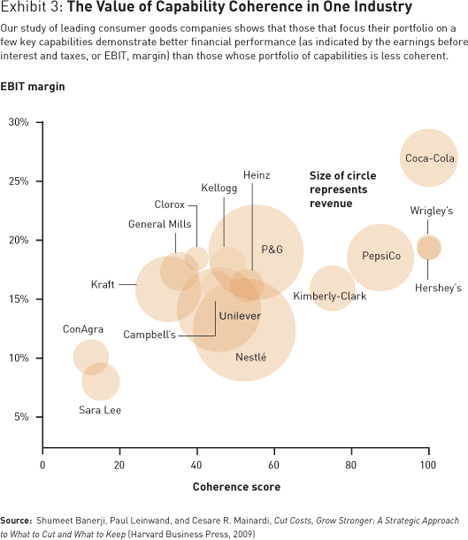
The Value of Capability Coherence in One Industry

A recent article in Strategy+Business on Cut Costs, Grow Stronger had the following graph which I think is just great:

Any guesses as to what most of the companies on the line (and, specifically, those closer to the upper right of the line) have in common? Anyone?

These companies were all early adopters of strategic sourcing decision optimization. Think about it.

Share This on Linked In

The Role of Optimization in Strategic Sourcing – The Optimization Sourcing Cycle

This series discusses the recent report from CAPS Research on “the role of optimization in strategic sourcing”. The primary goal is to highlight, clarify, and, in some cases, correct parts of the report that are important, confusing, or incorrect to insure that you have the best introduction to strategic sourcing decision optimization that one can have.

In this chapter, the optimization enhanced sourcing cycle is enhanced. The first issue is cycle time. According to the report “at one company, the time from first exposure to the optimization concept to completion of the first pilot run was one year … this is probably fairly typical“. While this is likely true at larger companies, it needs to be clarified that while it takes some companies a while to first buy into the concept and then acquire a solution, a good provider can take you through a pilot on a moderately sophisticated category in under 6 weeks.

The typical cycle times for each activity in the bid cycle given for the example company are worth noting:

  • one day to five months for internal customer engagement
  • one to five weeks for RFQ finalization
  • one day to four weeks to finalize bid submission screens for suppliers
  • one day to two weeks to permit bid revisions and close bidding
  • one to three days to clean bid data
  • one to two weeks for analysis and award recommendations

This says that cycles varied from two weeks and three days to over eight months, which demonstrates that simpler events will not take very long while you should plan for up to six months for very complicated events like rebidding all of your global freight lanes in a single project. (And yes, modern solutions are powerful enough to do just this. A customer of Trade Extensions recently conducted a self-service Billion Dollar event that consisted of 65,000 items, 60,000 transport destinations, and 400,000 bids from over 100 suppliers.)

Finally, as the report states, the total time to complete the sourcing process will be directly related to the number of scenarios tested and the number of rebidding cycles and solving the model with constraints can take from a few minutes for smaller, less complex buys to several hours for large, complex buys. Thus, the more scenarios you want to analyze, the longer it will take. However, you can still run through more scenarios in a day than a spreadsheet would allow you to do in a week, or a month, for more complex models. So while it can take a week or two to analyze all of the meaningful scenarios for a larger project, it’s a drop in the bucket compared to the analysis time if you were still using unmanageable spreadsheets.

Share This on Linked In

Is AstraZeneca Building the Center of Excellence Model for Emerging Country Sourcing?

A recent article on the Shared Services & Outsourcing Network on “What Drives a Best Practice Sourcing Strategy” contained an interview with Karen Mansell, the Head of Corporate Procurement and Business Process Outsourcing at AstraZeneca. While most articles of this sort don’t get my attention, as I already know what should drive a best practice sourcing strategy (just like you, as a regular reader of leading supply chain blogs), there was one paragraph that did get my attention as I was skimming through it.

Six questions in, the SSON asked about changes in sourcing behaviour as a result of AstraZeneca’s new outsourcing strategy, and related deployment methodologies, which puts everything on the table as an outsourcing candidate, including R&D. The response referenced AstraZeneca’s low cost country strategy and their presence in China and India. A low cost country sourcing strategy to India and China normally wouldn’t get my attention, as just about everyone is still jumping on that bandwagon whether it’s the right choice or not, but the article noted that AstraZeneca is looking at growing capability in all their emerging markets, especially from an original delivery centre point of view.

As a result, AstraZeneca is re-evaluating what supplier management looks like coming out of those areas and trying to put some supplier management on the ground, alongside the preferred supplier relationship. They’re trying to get closer to the supplier base, understand what innovation and insights look like, marry them up to business requirements, and drive aggressive supplier development programs.

This is the foundation for emerging markets done right! Get on the ground, get close to your supply base and improve their capabilities so you can manufacture for, and sell into, the local market. Then it’s not just outsourcing, it’s emerging market development, and that will be much more profitable in the long run. Logistics costs are only going to run-up again and labor costs are going to keep rising as the “emerging” markets of India and China take their place as the second and third largest global economies as the century progresses.

Share This on Linked In

Kate Vitasek on Game Changing Rules for Outsourcing (Vested Outsourcing)

Today’s guest post is from Kate Vitasek, a lead researcher and faculty member of the University of Tennessee’s Center for Executive Education and the founder of boutique consulting firm Supply Chain Visions.

For the past two years, I have had the opportunity to participate in a University of Tennessee research program, funded by the Air Force, to formally study companies that were employing performance-based approaches for outsourcing. The research has uncovered that there is a set of unwritten rules companies can apply to develop mutual symbiotic performance partnerships where both parties in the outsourcing relationship unlock win-win solutions to achieve much higher levels of performance and cost savings.

We have distilled our lessens and approach into what we call Vested Outsourcing — because it is typified by an outsourcing relationship where both parties have a stake in maintaining the arrangement and where both parties work together to create a performance partnership which takes both the company outsourcing and the service provider to new levels of cost, service and profitability not realized by traditional outsourcing models.

While no two Vested Outsourcing partnerships are alike, all good ones achieve a performance partnership based on optimizing for innovation and improved service, reduced cost to the company outsourcing, and improved profits to the outsource provider. This is what we call the performance pyramid. This trend towards performance partnerships has evolved to where outsourcing companies and service providers work together to develop a performance-based solution where both parties’ interests are aligned — and both parties receive tangible benefits (either through tangible or intangible incentives).

The heart of a Vested Outsourcing contract is an agreement on desired outcomes that explicitly states the results on which both companies will base their outsourcing agreement. A Vested Outsourcing agreement clearly defines financial penalties, or rewards, for not meeting, or exceeding, agreed upon desired outcomes. In the agreement, regardless of what is being outsourced, the outsourcing partner has the ability to earn additional financial value (e.g., more profit) by contractually committing to achieve the desired outcomes. Simply stated: if the outsource provider achieves the desired outcomes, they receive a bonus.

While many organizations tout they have “partnerships” — our experience and research found that most organizations have an internal desire to optimize their own self interests. This is often known as a WIIFMe approach (What’s in it for Me). How could they not when we are ingrained with “winning” from early childhood and most business schools and law schools focus on “winning”.

The very word partner implies that there are two sides. The progression towards a Vested Outsourcing agreement must focus on creating a culture where both parties are working together to ensure the ultimate success of each other. The mentality should shift from an “us vs. them” to a “we” philosophy, or what we call a What’s in it For We (WIIFWe) philosophy. For many companies, a win-win approach is a learned behavior — and they have to unlearn their conventional approaches and ways of thinking. In a Vested Outsourcing relationship, the organizations must work together upon a foundation of trust where there is mutual accountability for achieving the destined outcomes.

Five key rules set the stage of a sound outsourcing partnership.

  1. The business model is established based on outcomes versus defining transactions.
  2. The company outsourcing needs to feel comfortable describing the “what” and delegating the “how” to the outsource provider — and the outsource provider must be comfortable signing up to take the risk to deliver the “how”. Both organizations must constantly seek to overcome roadblocks in the processes, infrastructure, technology and people that prevent mutual success.
  3. Carefully aligned, clear and measurable performance objectives are used to monitor the desired outcomes.
  4. A balanced pricing model that includes mutual incentives and rewards, optimized for cost versus service trade off.
  5. The relationship is based on insight, versus oversight governance, that empowers both parties to pursue improvements that will deliver better performance, higher profits, and lower total cost of ownership.

The five key rules of a sound outsourcing partnership set the stage for companies to take their outsourcing relationships to the next level — a true vested performance partnership.

In Vested Outsourcing, the organizations work together upon a foundation of trust where there is mutual accountability for achieving the outcomes. Through the careful alignment of performance objectives, accountability, and control, the service provider, while absorbing additional risk, is empowered to pursue improvements that will deliver improved performance, higher profits, and lower total cost of ownership.

Vested Outsourcing uses the power of free market innovation to improve the outsourcing relationship. This can be challenging to achieve, but the Vested Outsourcing journey should always strive to arrive at this idealized end state to achieve the performance pyramid — where both the company outsourcing and the outsource provider are consistently applying a WIIFWe foundation and applying all five of the Vested Outsourcing rules.

Companies with a desire to explore Vested Outsourcing further, can visit the Vested Outsourcing website, hosted by the University of Tennessee, and download an excerpt of the upcoming book being published by Palgrave Macmillan titled Vested Outsourcing: Five Rules that will Transform Outsourcing.

Thanks, Kate.

Share This on Linked In