
Category Archives: Economics

It’s the Year of the Tiger … and China is Going to ROAR!

In 2008, according to the World Bank, China had a GDP of approximately 4.326 Trillion. Given that China projected growth of 8% in 2009, that puts them at about 4.672 Trillion for 2009. Continuing this trend, as China is projecting similar growth for 2010, that puts them at a GDP of about 5.046 Trillion this year. Meanwhile, Japan, which clocked in at 4.909 Trillion in 2008, just downgraded its projected growth to 1.3% for 2009, putting it at 4.973 Trillion for the year. As its economic outlook is not looking up, holding steady, this puts Japan at an estimated GDP of 5.023 Trillion for 2010. What does this mean? This will likely be the year that the Tiger ROARS and China becomes the 2nd largest producer of GDP in the world.

So what should you do besides learn Mandarin, if you haven’t already? (You can even start for free at sites like Chinese-Tools.com.) Good Question! While I still adamantly believe that you should not be importing goods from China that you can produce closer to home — as there’s nothing lean about an 8,000 mile supply chain — that doesn’t mean that you shouldn’t be producing in China for the Chinese market. Or that you shouldn’t be tapping the collective knowledge of the almost two million geniuses that live in the country.

But where do you start with the world’s fastest-growing economy? I’m not sure, but a recent article from Knowledge@Wharton on “The Road to China” that interviewed Harbir Singh, Saikat Chaudhuri, and Lawton Burns on their recent trips to China provided some fresh insights that are worth a second thought.

The economy is barreling ahead in high gear in major cities like Shanghai and Beijing which have literally transformed over the last decade. They have a strong infrastructure, a very strong manufacturing-based economy (as they are the manufacturing hub of the world), and are investing a lot of money to set up firms and an ecosystem to foster innovation. They’re trying very hard to move up the global value chain very fast. Plus, a lot of overseas Chinese are now returning to China — junior people as well as senior people.

However, they’re still a big country with a huge population which collectively has many different types of people with varied interests. As a result, where China is concerned, it’s still about managing diversity. It’s about meeting the aspirations of those people and managing the differences, as much as its promoting some uniformity in a standard of living.

In other words, you probably have to start by diving in head first because there’s so much happening, so fast, that it’s hard to really wrap your head around it all unless you’re immersed in it. But check out the article. Although it’s five pages, it is quite interesting.
Share This on Linked In

There is NO New Normal … Just the Old Normal Coming Back

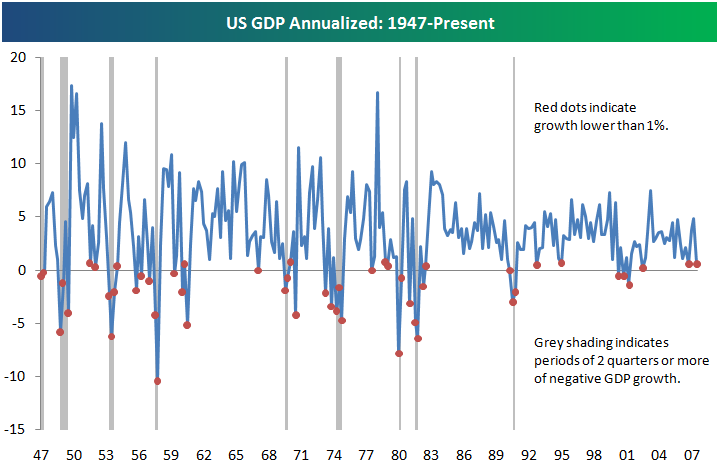
I have to be honest … I get sicker and sicker of “the new normal” each time I hear about it … even though I must admit that upon reflection I did find the recent article from McKinsey Quarterly’s Strategy Practice on “Navigating the New Normal” to be hilarious. For a while I couldn’t put my finger on why I couldn’t stand hearing about “the new normal”, but then it hit me. There’s no such thing as a new normal … just the old normal coming back after an extended 15 year hiatus. After all, if you think back to before 1995 and before the leading edge of the first tech boom, you see a slow, steady growth in the year-over year stock indices going back to 1975*1. And if you look at the annualized GDP data in the same time frame, you see that growth went up and down, usually between -7% and 7%, over time*2, but averaged out to slow, steady growth*3.

Not only does this mean, as the McKinsey Quarterly article pointed out, that (continual) market growth of 5% to 7% is a thing of the past, but that you have to go back to the good old days where your growth is going to be at the expense of your competitor’s loss. That means that you are going to have to buckle down and build better products, create better services, and offer them at a better price point than your competitors. In other words, the days of new markets and free growth are over.

And while I agree with the leading “strategists” that you are going to have to limit growth plans to “growth above market” and adapt to changing conditions on a quarterly basis, I am fed up about this bullshit about having to go to shorter and shorter planning cycles. That’s why the economy is in the gutter. No more long term thinking. No more research labs. No more support for long term research projects in academia (where it’s now “publish another paper, no matter how trivial, tomorrow or perish”). It’s one thing to be on short production cycles … as that lets you adapt to changing market conditions. But it’s another thing to not be planning beyond three years. It’s just crazy. We need to get back to the days where companies not only had five year plans, but ten year plans … and even longer term plans where innovation roadmaps were concerned. Until we do, I don’t see things getting much better. But in the meantime we’ll get lots of five page articles on discussions with “leading” Chief Strategy Officers who, in long winded diatribes, essentially tell us that they don’t know where things are going … which is exactly what you get when you stop planning for the future.

*1 Comparison of the Dow Jones Industrial Average, NASDAQ Composite, and S&P 500 after 1975

*2 Annualized US GDP Growth from 1947-Present

*3 US Gross Domestic Product 1947-Present

Share This on Linked In

Are Economics Going to Push Us Back to China?

Despite the disadvantages, which include

    • limited ability to respond to demand changes,
    • high logistics costs in boom economies, and
    • the potential for large currency-exchange losses

it looks like economics are going to push many multi-nationals back to China.

Consider the following advantages that the global recession has created, as pointed out in a recent article on “Sourcing Successfully in the New China” by Accenture’s Jonathan Wright:

  • Dips in the global economy have left China with lots of excess manufacturing capacity, which exceeds 50% in some industries.
  • Dramatic overcapacity exists in ocean freight, with hundreds of vessels floating fallow in Hong Kong’s harbours.
  • China’s domestic growth is as promising as any economy in the world.
  • Labor rates are still significantly lower than Western countries.
  • Most suppliers have dramatically improved their product/service quality by implementing control mechanisms and systems, renewing manufacturing lines, and increasing their available talent pool. They are also much more open to continuous improvement methodologies.

When you put all this together, those companies with good demand planning systems and dual sourcing strategies (to allow for unexpected demand increases to be handled near-shore) could lock in great deals now on both production and transportation and have a significant advantage during the forthcoming recovery while being in a great position to serve the emerging domestic market in China. While I normally don’t push the outsourcing bandwagon, it looks like those companies that climb aboard early could benefit greatly while those companies who wait until it becomes the “in-thing” will have totally missed the boat (as prices will rise as capacity diminishes).

Share This on Linked In

Will the State of the US Economy Finally Lead to Adoption of the Amero?

Reading this recent article in The Raw Story on how the “United Nations Conference Is Calling For A New Global Currency” got me thinking if the current state of the US Economy, which hasn’t seen it’s current level of debt in almost 65 years, will finally see the introduction of the amero.

The fact of the matter is that it might be just what the US needs to maintain its status as the global defacto currency standard. Consider the recent posterity potential index that measures the likelihood of economic transparency in the year 2020 for 30 developed countries which puts Canada, currently #7, at #6 with the Scandinavian countries of Norway, Sweden, Denmark, Finland, and Iceland and Switzerland rounding out the top 7. The US, which is currently #9 in the global prosperity index doesn’t even crack the top ten in 2020 at #12 and Mexico, which is currently #43, climbs up to #23. The Amero could certainly rival the Euro, especially when you consider that the combined population of North America is approximately 440 Million while the combined population of the countries who have adopted the Euro is only about 335 Million.

What do you think? Will it happen?

Share This on Linked In