Now is NOT A Great Time to Buy (Part 1)

Standalone “Intake to Nowhere”, “Classic Onboarding and Supplier Management”, “Predictive” Analytics, “Contract” AI, “Agentic” AI or Classic Mega-Suites … until 2029

Yes you need intake and orchestration.

Yes you need supplier management.

Yes you need predictive analytics.

Yes you need AI-based contract analytics.

And, yes, you definitely need “Agentic” AI that executes (but does not make) decisions.

And if you’re a (mid) mid-market or larger, you need a suite.

But you should not buy any of these products, at least not now.

Why?

The majority of intake and orchestration platforms, and especially the ones that have raised nine figure VC (i.e. 100M or more), are overpriced and under featured. Modern intake and orchestration that modernizes interfaces, simplifies workflows, optimizes clicks, and makes process adherence easier than doing it any other way is valuable, but not that valuable. It’s essentially better middleware 3.0 for the web, and very easy to replicate. There might only be a few players now, relatively speaking, but you’re about to see a slew of these players who literally do nothing but put very nice lipstick on a big fat prize-winning pig (who’s not happy about it), which is a lot easier to do than raising the prize-winning pig from a piglet to a prize winner. At the end of the day, you need actual functionality, and that’s where the real value lies. (And today, that means shilling out for a classic mega-suite to layer the fancy new intake platform on top of, which costs you more, not less.)

As competition heats up, and technology advances, this will be the easiest, cheapest, play and you’ll soon find out that what the big players claim is worth 1M is only worth 100K to 250K, and you still need to go spend that 1M+ on traditional platforms that have deep functionality. So either buy a platform with real functionality with orchestration built in, or wait another year or two. It’s gonna get cheaper and better for standalone I2O. The market has not yet been zipped up.

Supplier Management is very important, but the vast majority of the one hundred plus (yes, that’s 100+) solutions on the market — be they best-of-breed, suite-modules, or hybrid data/contract/content management solutions with a supplier focus — are no longer up to the task. As per our recent post on supplier management must be continuous and proactive throughout the supply chain, these classic point-in-time solutions are no longer up to the challenge of modern supplier management as they can’t even detect changes in supplier behaviour in real-time that are indicative of emerging risks, yet alone supply chain events that are going to seriously impact supplier behaviour in short order.

As a result, they aren’t worth very much. Moreover, if you look at what classic onboarding applications do, they collect data that they force the supplier to enter during the onboarding process — data that, for the most part, is publicly available on the supplier’s web site, third party registries, and other (internal) enterprise systems — data that could easily be consolidated and pre-filled by modern RPA / Agentic applications that would not only allow a supplier to “onboard” in a fraction of the time by pre-gathering all of the fields. In other words, modern (A)RPA and Agentic data gathering applications do the work of classic onboarding, and with their prolific propagation, do it cheaper and put serious downward cost pressure on these classic applications. Moreover, these next generation solutions, which are dropping in price as well as they are becoming a dime a dozen, can continuously monitor these data sources, detect data changes, and (queue) update(s) in real time. Plus, they can accept feeds from supply chain systems and correlate events that might be meaningful.

So, if you’re still in the situation that can survive off of a last generation solution, wait a year or so, and get it for pennies on today’s dollar. But if you can’t wait, make sure you get a modern solution that can monitor supplier and related supply chain changes — it won’t cost more, and if you don’t lock into a long-term subscription, you’ll be able to keep costs way down on renewal (or easily switch to another platform with the same functionality for a lower cost in a year or two).

To be continued …
Supplier Management Must Be Continuous AND Proactive Throughout the Supply Chain!

Xavier recently wrote a great article over on Hackket Spend Matters on how you must treat Supplier management as a continuous signal because it points out that while traditional supplier management worked well when supplier ecosystems were smaller and more stable, it does not scale well in today’s operating reality.

As Xavier points out:

  • risk does not neatly emerge during onboarding, it accumulates through behavior over time and
  • risk changes continuously with performance and fitness as
  • pricing behaviour shifts, reliability degrades, dispute frequency increases, payment anomalies appear, and compliance exposure evolves with regulation

And this is not captured by periodic reviews.

However, just continuously capturing the updates that flow through the P2P system (from POs, receipts, invoices, payments, and disputes) is not enough for continuous management and monitoring. As per above, you need to be monitoring for regulatory compliance changes that can impact the supplier or the relationship. You need to be capturing returns and issues in the warehouse and with service for performance. And you have to be tracking the identified risks.

But that’s not enough. You have to get into the supply chain.

  • pricing behaviour shifts with supply chain events — supply gets caught off, transportation becomes scarce, the Tariff King decrees new tariffs, etc.
  • on time delivery and lead time reliability shifts with carrier availability which shifts with overall demand, geopolitical events, labour availability, and the current price of oil
  • payment issues arrive AFTER impact events (loss of a major customer, supply shortages, major financial loss from a lawsuit or natural disaster, etc.)
  • etc.

There’s a reason the doctor co-authored a series with Bob Ferrari on why Direct Sourcing Should Be Part of Supply Chain Management, and that’s because if you’re not tapped into the supply chain, you’re not getting all the signals you need to manage suppliers.

Because it’s not just the supplier signals, it’s the supply chain signals that will, in short order, impact the suppliers and their ability to serve you. This includes border closings, strikes that shut down docks and ports, natural disaster that cut off entire regions and disrupt flows, and geopolitics that have sweeping implications globally and that’s why, as Koray Köse says, Geopolitics Now Lives Inside the P&L.

So integrate with your supply chain, or realize that you’re still operating in a static bubble when the world is a very dynamic one and that if the static bubble pops when you’re unprepared, your supply chain pops with it and then you’re in trouble.

SaaS Discounts are Lies and Other Common Tricks and Traps You SHOULD NOT Fall For!

(These are also signals that you should run for the hills at their first utterance.)

In our last post on the subject we told you that If A SaaS Provider Offers You a 95% Discount you should

Slam the door, lock it; close the shutters, bolt them; don’t answer the phones, and rip the cables out of the wall; turn on the frequency jamming, and throw the cell phones in the Faraday cage; close the gates to the parking lot, and man security 24 hours. Because, no matter what they told you, the discount meant one of two things:

  1. the provider was trying to rip you off or
  2. the provider is in serious financial difficulty

And both are reasons NOT to do business with the provider.

Unfortunately these aren’t the only tricks and traps you have to watch out for. Other common tricks and traps include:

  • 1. We will give you a 50% discount off of standard prices if you don’t do a bid and just award us the contract without going to market.
  • 2A. Since we lost the bid, you can have it for a 95% discount and a right to use your logo on our webpage …
  • 2B. … but note that, once the contract is signed, we have to right to reprice your entire enterprise deal based on the total number of associated members [including janitors, advisors, and part time contractors who will never use the software] in your organization on LinkedIn (if we’re charging by the seat) and/or average daily use in the prior month (based on CPU cycles and storage against our chosen enterprise averages). [This will probably quadruple the quote within a few months.]
  • 3. If you [still] don’t select us after we drop our price (multiple times), we will go straight to the CFO/CEO of your company to tell them YOU are an incompetent fool bribed by our competitor who is making a huge mistake.

Before you even think twice about their offer, you need to remember that expecting them to treat you well as a client after you sign the contract is akin to expecting your abusive significant other who beats you regularly in drunken fits to all of a sudden stop once you get married. (And yes, I went there. It’s the same rationalization. As per my last post, if they give you this much of a discount, they’re losing money until they can trigger price escalation clauses or change orders, and even then they might not break even on your account. As a result, it will be too costly for them to give you any support whatsoever and, thus, they will ignore you the majority of the time and treat you poorly when they do respond.)

While I shouldn’t have to state this again, all of these situations happen way too often in our industry when companies are struggling (due to taking too much investment at too high of a valuation which resulted in angry investors breathing down their neck with nooses in one hand and pitchforks in the other when they didn’t make ridiculous targets) or they hire that 1/20 pathological salesperson (with a great close record at his last job) who only cares about his* year end bonus and not about whether or not you actually get served once you’ve paid the bill.

* Yes I’m being sexist here as a man is 3 times as likely to be psychopath than a woman, and a salesperson in enterprise software is 2 times as likely to be a man. This which means that your chances of a being ripped off are at least 6 times higher (and I’d argue more) if the salesperson is a man. (I can’t speak for everyone, but like many who have been in the enterprise software space for 30 years, I’ve encountered my share of sleaze-bags and grifters, and, as you might have guessed, every single one of them has been a man — and, FYI, they don’t think much of technical people either!)

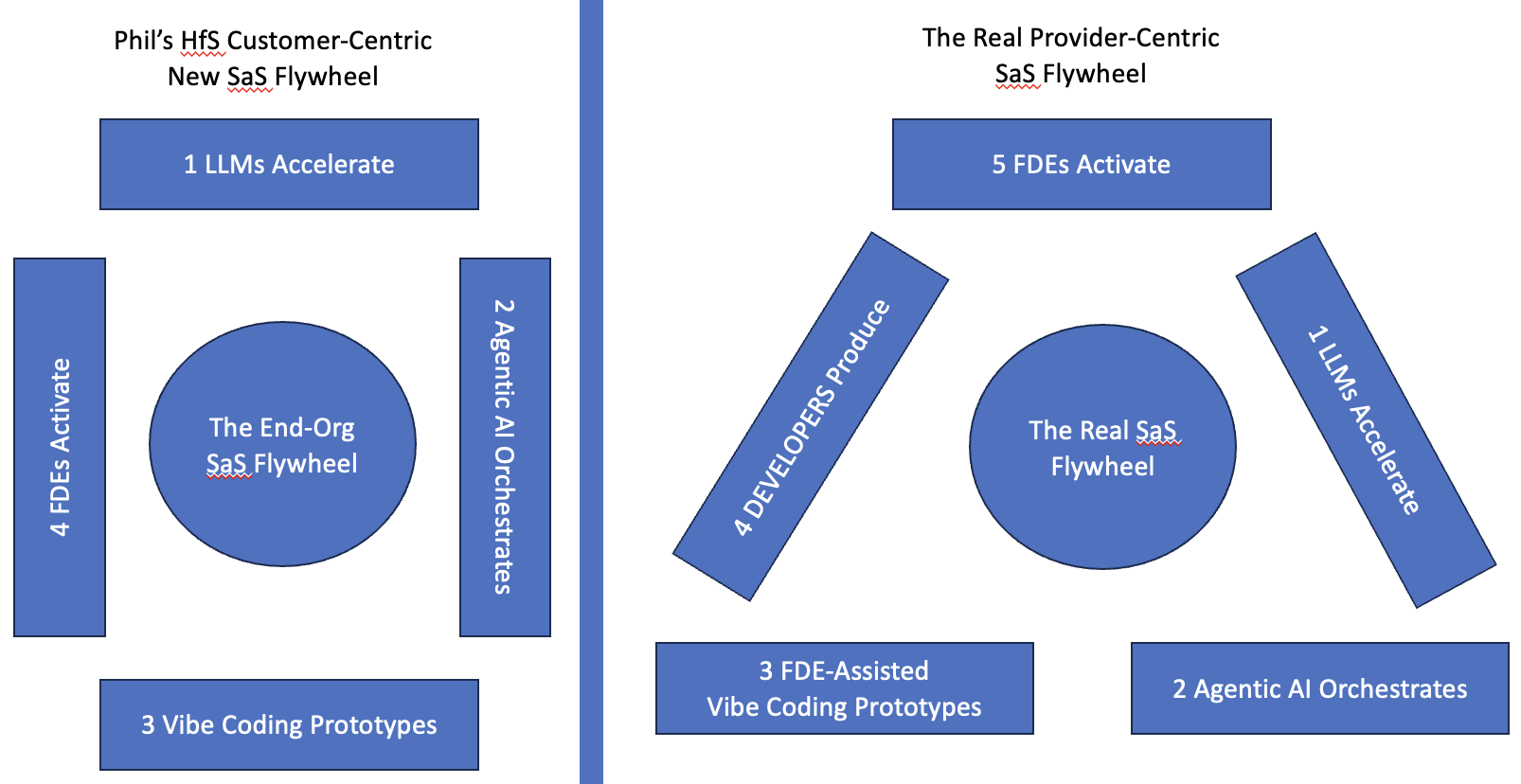
Phil’s new HfS Services-as-Software FlyWheel Is Right On the Mark From a Customer-Centric Viewpoint

… but hides the full support required on the back-end!

This is important to point out for two reasons:

  • Gen-AI Hype-mongers will use this as another excuse to claim most white-collar functions will be entirely eliminated when, in fact, it strengthens the need for true back-office white-collar workers and real software engineers
  • Expert human support becomes more critical at each stage of the process (while bit pushers became less and less useful)

But let’s backup. In his most recent piece where he (re-)introduced the SaS Flywheel, Phil made one critical statement which is constantly overlooked by the industry: Stop treating FDE as optional: Your AI Flywheel will not spin without it.

As Phil astutely points out: the hard question nobody is answering is this: who actually wires AI into your live systems, governs it in production, and makes it keep working when the AI software vendors leave the room. The answer is, of course, your Forward Deployed Engineer (FDE) — and if your transformation strategy does not have it, you are building an AI theatre, not an AI operating model. (Which, FYI, is what most companies are building — and, as Stephen Klein astutely points out, putting on puppet shows. Great for entertainment, but not so great for getting anything done. Especially since they all overlook what AI can actually do.)

Now, a forward deployed engineer alone will not get you out of pilot purgatory, but it is an essential condition — just like you can’t climb out of a deep wide hole with smooth 90° vertical surfaces on all sides without a rope or a ladder, you can’t fly your way out of a pilot without a working plane, which you don’t have without an engineer to keep it running.

As Phil continues, FDE is not implementation – it is the engineering layer that makes AI governable this is because FDE teams build ontologies that reflect how the enterprise actually operates, wire models into real data with real permissions, and design the governance architecture that keeps autonomous systems accountable, which will, and for quite some time into the future, wire in non-overridable human oversight, approval, and review.

Phil goes on to list a few key things that LLMs cannot do on their own. (It’s in no way a complete list, but hopefully enough to get executives questioning all the AI-BS form the AI-Hype-mongers presenting grandiose claims that likely won’t be a reality within most of our professional life-times. Even better, Phil points out that Agentic AI without FDE governance is not transformation. It is risk accumulation!, and points out five key requirements of workable AI that can’t be achieved without an FDE. (There are more, but again, these should be enough key points to help executives realize that not only are LLMs sorely insufficient for almost every task they are being promoted for, but they aren’t even usable at all without the help of a FDE team.)

Phil also does us a great service by pointing out that while vibe coding creates velocity, FDE prevents it from becoming chaos — which is what happens every single time you employe vibe coding without FDEs (and a real engineering team — but we’ll get to that).

Vibe coding is simultaneously one of the biggest boons to software development and the greatest destructors, especially since it is almost universally misunderstood and misapplied. For example, while Phil’s statement that business analysts can express intent and receive working agent code in return is technically correct, it’s not practically correct. That’s because vibe coding produces code that is insecure, inefficient, and not appropriate for enterprise software. In fact, just about every startup that tried to launch an enterprise app on vibe-coding alone have lost hundreds of thousands (or more) attempting to do so — see this great post from Alex Turnbull.

Vibe Coding is super useful because, with the help of an FDE team with a good business analyst, the end user organization can quickly create functional prototypes that demonstrate precisely what they are looking for, which are much more powerful functional specifications than traditional functional specification documents with text descriptions of required functionality and powerpoint mockups. Plus, these prototype specifications can be created in a fraction of the time. But that’s all they are, prototypes. Real applications still need to be built by real software engineering teams who can build optimized, bug-free, secure code — vs. unoptimized, buggy (especially at the boundaries), and insecure code regularly generated by AI-based vibe coding tools (where, depending on what source you access, 53% to 78% of code generated has serious security issues).

In other words, it’s a great article, from a customer-centric viewpoint and written for customer executives. From a back-end, provider perspective, it’s missing one key step — the development step that takes vibe coding prototypes and produces real (AI-backed) enterprise applications.

Moreover, it centralizes the FDE activities when, in reality, they are ongoing throughout the entire cycle.

  1. they activate, and put the foundation in place
  2. they train the users on how to properly use the LLMs for accelerated research and are always on call for help
  3. they maintain the orchestration layer, and improve (and correct) it as necessary
  4. they work with the end users to vibe code prototypes
  5. they work with the development team to build the next generation (or iteration) of the enterprise apps in the SaS model

In other words, AI can enhance SaS, but it cannot replace the need for skilled humans on the provider side (for development, implementation, maintenance, and improvement) or the buyer side (for process definition, improvement, decision criteria, etc.).

At the end of the day, AI can only replace bit-pushers who do tactical data processing tasks which should have been automated by machines 30 years ago (when it was promised), but it can’t replace anyone who needs to make a (strategic) decision. This is true regardless of the model, and the right model, like Phil’s SaS flywheel, actually exemplify the need for the right, skilled, talent.

Tired of Geopolitical Chaos? You Wouldn’t Be if You Were Prepared!

In a recent article, Koray Köse pointed out that Geopolitics Now Lives in the P&L because it can re-price your inputs, trap working capital, and./or change who you are allowed to buy from or sell to, all with the stroke of a pen by a single individual entrusted with too much power.

And, as Koray points out, most organizations are structurally unprepared. This is partially because fewer than half of companies have visibility beyond tier-one suppliers, but mostly because the majority of organizations have to scramble and allocate resources to figure out whether or not the event has changed cost, liquidity, access, or structural dependency.

And, as Koray points out, organizations that don’t know what the real impact of major events on them are will:

  • panic dual- (or tri-) source and increase cost without reducing real risk (as sometimes they’ll source from another distributor or supplier with the same risk in the same region subject to the same events)
  • knee-jerk re-shore, waste 18 to 36 months, and increase costs without addressing the core issue
  • sign emergency renewals at premiums for risks that never materialize
  • continually react in a manner that achieves nothing

and, simply, burn time and value by not doubling down focus on the events that really matter to them. Because they don’t know what those events are.

That’s because they haven’t

  • identified their key product lines,
  • broken them down into components,
  • identified those that have limited supply items or rely on rare earths or other limited substances,
  • mapped the supply chains for those limited items, rare earths, or other limited substances, and
  • marked the supply chains they (and their current suppliers) are currently using

so that, when their constant 24/7/365 global monitoring solution detects a significant event, they can quickly determine

  • what active supply chains it impacts,
  • what substances, rare earths, or items could be impacted,
  • to what extent they are relying on those substances, rare earths, or items,
  • what components they are in,
  • what product lines are impacted and to what degree, and
  • what alternatives the organization has

This way you instantly know

  • what the impact is,
  • what other options you have, and
  • what the cost of those would be

If the event impacts a supply that is easily obtainable from other, unaffected regions; that is only used in a couple of low revenue (and lower profit) product lines, or that can be replaced simply by shifting supply to other suppliers with which you have existing relationships (and contracts), you can simply ignore it; but if the event could cut off a key substance, rare earth, or part, and you were sole sourcing, you need to leap into action immediately to contract another source of supply (before your competition does and its gone).

The only way you can do this is if you did a proper risk assessment of each major component, raw material, and item, and tracked your current and potential sourcing options. i.e. you did proper risk mitigation planning.

But if you take the time to do proper category assessment and risk mitigation planning, you’ll be well on your way to Köse’s Sophisticated Simplicity that will allow you to identify the one or two events that really matter, address those, and get on with business while the world burns around you. (Or, you can continue to react blindly and burn with it. Your choice. Either way, follow Koray. You can’t manage supply without being aware of what threatens it.)