
Category Archives: Analyst

We Don’t Need State of Procurement Reports. We need Procurement Problem Prescriptions!

And we need Hackett Spend Matters to give them to us!

There’s a reason we picked on Hackett this week in our follow up to our 35 part series on why you really DO NOT need to read another State of Procurement report for Five Years, and that’s because we need Hackett to give us solutions to procurement problems.

We need them to tell us not just how to

  • prioritize our concerns
  • extract the core issues
  • identify the most relevant barriers
  • rank the most likely risks

but tell us

  • why some concerns take priority, based on organizational impact
  • how to identify the core issues, so you can learn to do so yourself
  • where you will encounter the barriers, and the techniques for busting through them
  • what the key risks are, with the mitigations and responses you need to put in place

The reality is that

  • you know what your concerns are, but you don’t know which are the most critical to your success when you are overworked, underfunded, and the world is literally burning around you
  • you likely weren’t trained in root cause analysis, and if you’re not a process expert, you will likely have difficulty getting to the root cause (especially if it’s deep in another part of the organization or the partner ecosystem)
  • you don’t know which barriers are equivalent to reinforced concrete and truly blocking your success and which are essentially made of paper mâché and easily conquered
  • how to deal with the most significant risks, especially when you can’t predict them all or influence their likelihood at all

This is the help you need … and Hackett, with the acquisition of Spend Matters, is the only analyst firm with the bench strength left in Procurement to do it!

The reality is that the original analysts in our space (first at AMR Research, which was acquired by Gartner; and then Aberdeen, acquired by Harte Hanks; and finally Forrester) all departed years ago. The number of analysts who have been in, and continually analyzing, Procurement Tech for 20 years is now countable on your fingers (and since Mickey North Rizza, at IDC, and Magnus Bergfors, at Gartner, both did a long stint in the vendor ecosystem and Jason Busch recently departed the analyst space for the vendor ecosystem, I can only confirm [besides myself] Jon Hansen of Procurement Insights, Andrew Bartolini and Christopher Dwyer of Ardent Partners, and Chris Sawchuk and the legendary Pierre Mitchell at Hackett [who goes all the way back to AMR]) as vets who have been consistently analyzing the Procurement space for at least the last two decades (back to when SI started 20 years ago in 2006). If you look at the handful of organizations with a senior Procurement analyst with two decades of experience, only Hackett, who also has Xavier Olivera and Bertrand Maltaverne, have a real Procurement Analyst team with deep bench strength where you have four senior analysts who each have 25+ years of deep Procurement expertise!

No other organization can give us the deep insights and playbooks we need to elevate our Procurement organizations, and do it without defaulting to the BS of “just implement the tech-du-jour of our sponsors and use our [associated] consulting arm to do it” — which we all know is not a solution (because, if it was, your problems would have been solved two decades ago)! But if they don’t do it soon, before Pierre and Chris retire, they won’t be able to — and, frankly, neither will anyone else! The time is now for them to stop wasting their analysts’ time on “state of” surveys and reports and instead explain what the findings of the last decade mean, what processes are needed to address the gaps, what organizational changes may be needed to implement those processes, and why we need to return to the classic

  1. PEOPLE-FIRST
  2. PROCESS-SECOND
  3. TECHNOLOGY-LAST

approach to solving problems and that, in the modern age, we have to actually modify this to:

  1. PEOPLE-FIRST
  2. PROCESS-SECOND
  3. DATA-THIRD
  4. TECHNOLOGY-LAST

because

  1. we are the ones who have to execute the business, all machines do is transmit and process data
  2. problems are solved by repeatable, predictable, dependable processes that can be executed by humans in a worst case scenario (even if intended to be automated to the majority of the time)
  3. no process can be executed without the right information
  4. technology only comes into play when we know it’s the right solution (and we can’t know it’s the right solution until we’ve addressed the people, process, and data elements)

and to do this, you need a lot of experience, domain expertise, knowledge about what data is available, and deep technology knowledge.

And this is another area where Hackett brings deep bench strength.

From the beginning, most of the analysts in our space were not technologists but operations research people, business finance, economists, accountants, and even historians. Few had computer science or engineering degrees and fewer still relevant experience building/installing relevant applications. At Hackett, Chris and Bertrand are engineers and Xavier and Pierre are computer scientists, who all have relevant real world experience with tech. They have a much better understanding of what tech can, and can’t do, then an average analyst (and are much less likely to have the wool pulled over their eyes by a new “AI-first” player that does nothing more than wrap a third party LLM to deliver a solution of questionable performance and reliability, for e.g.) and can do a much better job of not only recommending what type of tech to use, but who you should look at and why, versus just “who comes out in the upper right of of the magic map” based on blended subjective scores that, at the end of the day, mean nothing.

But the clock is ticking and time is running out. Let’s hope Hackett realizes sooner than later what types of research and reports we really need vs. just wasting their key analysts’ on surveys and summaries thereof.
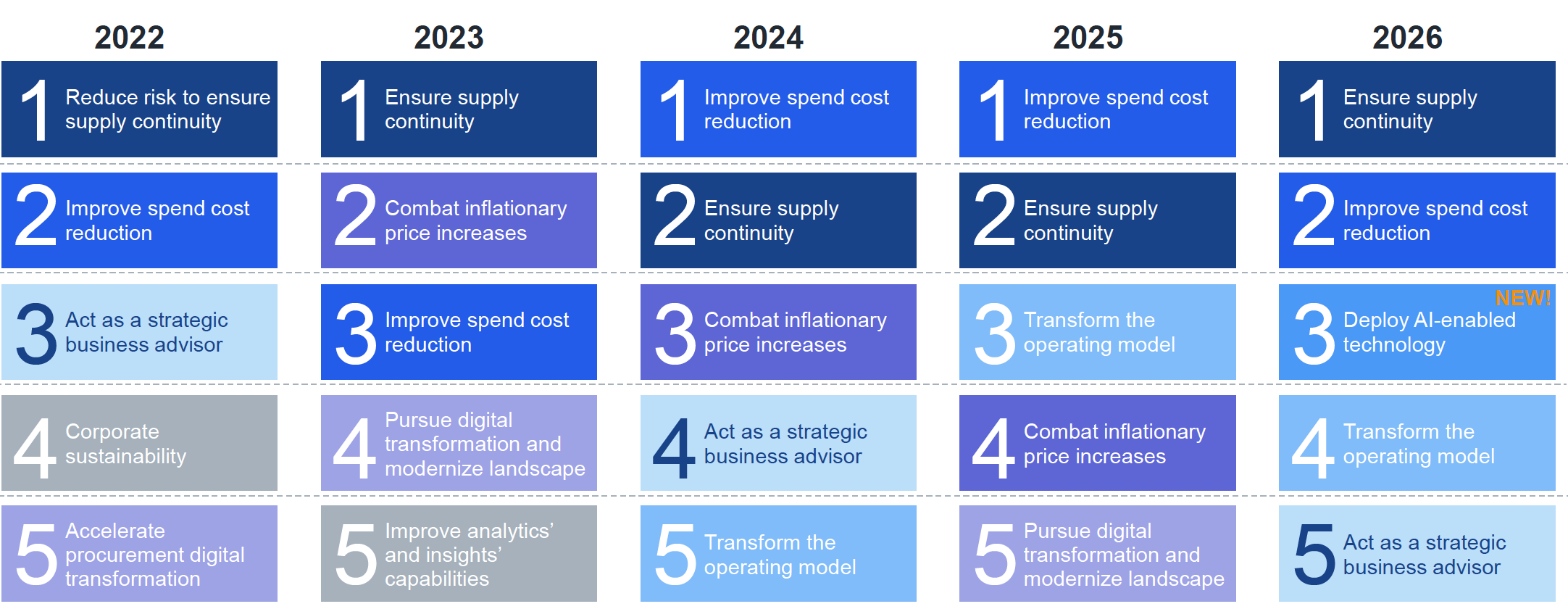
HACKETT CONFIRMS THE STATE OF PROCUREMENT HAS NOT CHANGED … No Need to Read The Full Report!

Nothing makes my point better than slide 15 on Trends in Procurement priorities in the 2026 Procurement Agenda and Key Issues Study Results sponsored (at least) by Jaggaer, SAP and Unit4 (and likely others).

Basically, every year you have the concerns of

  • supply continuity
  • cost reduction against inflationary price increase
  • strategic business advisory
  • digital transformation and the tech-du-jour (analytics to AI)
  • operating model improvements

All of the risks fall into our eight ever present risk categories:

  • Talent: Access, Acquisition & Retention, Retiring Workforce Impact
  • Disasters: (Other) Supply Chain Disruptions
  • Cyberattack: CyberSecurity Risks
  • Spend Pressure: Economic Downturn, Changing Customer Expectations, Capital Access, Competitive Alternatives
  • Supply Shortage (and Trigger Events): Trade Wars, Geopolitical Tension
  • Regulatory Compliance: Regulatory Compliance, Ethics & Privacy, Product Liability
  • Corruption: IP Loss
  • Tech-Du-Jour: AI-enabled Tech, Tech Transformation Delays, Tech Obsolescence

It’s the same-old, same-old situation when it comes to initiatives, except the tech-du-jour (AI) is nearing the top of the list, and the ecosystem is essentially the same, only the names of the players have changed. And, of course, the conclusion is, surprise surprise, to employ the tech-du-jour which, lo-and-behold, Hackett stands by and stands ready to help you with (despite the 94%+ failure rates found by MIT and McKinsey).

In other words, it’s the report we expected, and the first of many to come. (As you can expect every other analyst firm and consultancy will soon be releasing theirs, if they haven’t already. But we won’t be reading them, and for the next five years at least, neither should you.)

And, with the exception of the key shifts in concerns, issues, risks, and barriers, which could be a two page summary, it’s not a report you need to read through as very little has changed in the last decade.

THE STATE OF PROCUREMENT HAS NOT CHANGED! So Ignore all the Reports Flooding Your Feeds!

Between November of last year and January of this year, SI published a 35 part series on why you really DO NOT need to read another State of Procurement report for Five Years in order to save you the trouble of reading yet another report that was 95% the same as last year’s report, and 85%+ the same as the report you read five, if not ten, years ago.

The realty is that:

  • the barriers to success never change (just their relative criticality based upon which ones are currently your biggest obstacles)
  • the risks never change (although some go up each year while others temporarily go down)
  • the concerns never change, with the exception of the tech-du-jour which just replaces the previous tech-du-jour when the hype cycle changes

And this is because

  • the core function of Procurement HAS NOT changed since the first manual was published one hundred and thirty nine years ago, which means
  • the issues Procurement is addressing today are essentially the same fundamental issues Procurement has always been facing which means
  • the priorities have not changed either

And you don’t need to read 30 to 60 page reports to realize this. All that’s relevant is what climbed or fell on each list since last year since that tells you

  • which challenges are coming your way if they haven’t hit yet,
  • which technologies and trends are gaining hype status, and
  • how your peers see their priorities for the year

Nothing beyond that is useful, as the functions, issues, priorities, concerns, risks, and barriers are the same (although some have rapidly climbed the charts with a certain World Leader randomly removing regimes, starting special military actions, and blocking trade routes with no warning).

Vendors Have Lured Big Analyst Firms Astray Because Buyers Don’t Understand They Get What They Pay For!

About the same time we asked Why Aren’t ProcureTech Analysts Doing Their Jobs Anymore, THE REVELATOR asked, in a comment stream, how did … the analyst consulting and ProcureTech solution providers lose their way by championing technology-led, equation-based modelling?”.

Which is a fair question as this ties into why we believe many ProcureTech analysts aren’t doing their job anymore. As per our previous post, we believe the firm is the problem (even if the firm doesn’t know it, but in most cases, the firm should), and, more specifically, the primary reason is bad direction.

But let’s get back to THE REVELATOR‘s question. The answer is this:

At one point, the successors to the founders and/or the sales team took the easy way out and switched to vendor sponsorship.

As us grey beards, who have been around since the beginning of ProcureTech, will recall, there was a time buyers paid for research because they understood the value of unbiased research. But, like Project Assurance, that’s a hard sell when a buyer might spend 10K, 50K, or 100K with no guarantee they’ll identify a single viable solution among those covered in a report. Seasoned, well educated, and thoroughly experienced executives will understand the value of risking 10K to 100K on a report or study before committing to a 100K or 1M+ annual investment, because losing 10K is much better than losing 100K or 1M, and can be chalked up as a cost to doing business. But those executives who are uneducated in management and risk and inexperienced, which are many of today’s executives who were put in place because of their affiliation with investors, or a perceived ability to run a business off of balance sheets alone (even though these MBAs are the reason so many high tech companies are struggling and companies like Boeing are facing disaster after disaster — they don’t realize that you can’t run a business you don’t understand and that’s why, in the first Industrial Revolution [and the Gilded Age the US is so desperately trying to bring back], Engineers ran the show, and not over-glorified accountants and lawyers), don’t understand that or the risk of using vendor funded reports to make a decision.

For these successor and sub-par sales people who just weren’t up to the task of the hard sell, when marketing organizations come along and, out of the blue, threw big money at them to sponsor a study, no sales effort required, they jumped on it. More vendors see the success of the first vendors to adopt this approach, follow suit, the money starts flowing in, and the model shifts. Unbiased researchers have to shift their studies to those aspects where the sponsors do well or leave the firm. Moreover, the search for new hires focus on those with less experience or ethics (who can be easily swayed in the direction the big sponsors want). (So before accepting the results of any study, you should be echoing Mr. Klein and asking Who Paid For That Study?)

This means that, over time, instead of an industry leading analyst firm we get a marketing organization that echoes the “technology-led” approach or puts the product, vs. the solution, first.

Moreover, it’s going to stay this way until some big firms step up and say “enough is enough” and stop vendor sponsorships all together and some big clients step up to fund the research. As Mr. Köse keeps saying, you get what you pay for.

If You Want To Get An Analysts Attention, Don’t Insult Their Intelligence Or Integrity!

This is a response to another MUST READ article from Mr. Köse on how NOT to do product launches and analyst relations! (And a shorter version might still be found at this link on LinkedIn.)

Mr. Köse’s post was a response to a new marketing campaign from a big Intake-to-Orchestrate (I2O) vendor who sent a very insulting cold email with a cringeworthy cocktail of buzzwords (“agentic procurement orchestration”, seriously?), inflated ego (“category we created”), and the cherry on top that made this one boil over … a beg for free LinkedIn amplification.

More specifically, the request included in his LinkedIn Post.

Before we continue, I must say that I’m ecstatic that I didn’t get this PR spam, because I do not know if I would have been so civil in my response. It took every ounce of restraint to maintain even a shred of my civility last year when they released their “FREEIntake and Procurement RFP which, as I have screamed from the rooftops, is an outright lie (and using any of these “FREE” RFPs will be the most expensive thing you ever do! [Source]).

After all, as Mr. Köse states:

  • Analysts are not influencers.
  • Experts are not free marketing channels.
  • Your CEO ghosting emails while your marketing team spams us … is damaging you, not us.


Moreover, as Mr. Köse has stated, nothing they stated would indicate they discovered fire (which, by the way actually works), built a new category, or did anything except repackage existing automation with a fresh coat of jargon.

As Mr. Köse notes:

  • it’s disrepectful to the analyst (are we so dumb and lazy we can’t do our own write-ups?)
  • it’s transactional (and that should be reserved to describing specific types of ProcureTech)
  • it’s dumb (the louder you shout nonsense, the louder we’re going to respond)

But most importantly, nothing sums the situation up more than when Mr. Köse states:

“If your innovation is real, show it to me!

He’s not alone in this belief.

As I said to Pierre in a recent comment stream in one of my many (ProcureTech) AI is BS posts, “why are you the only one defending the current state of AI in ProcureTech … if the vendors in our space actually have it, and it works … why aren’t the vendors defending it … and if it’s so great, why are they all scared to show it to me?”

Any vendor can come here to Sourcing Innovation, check out any of the 300 plus reviews of over 200 providers I’ve written about over the past 19 years, and see that there isn’t a single negative post about any vendor who offered a real solution that

  1. did what was claimed and
  2. solved a problem for
  3. the niche they targeted
  4. efficiently and reliably.

(Moreover, if these vendors have a Spend Matters subscription, where I would hope that at least half of the 200+ vendor reviews I (co-) authored are still up as well, they could check those reviews out as well.)

(Side note: the I2O vendors have been as quiet as the Gen-AI wrapper vendors ever since I called them Clueless for the Popular Kids and said it was time for Revenge of the Nerds.)

In other words, if you have something great, and you want a real analyst to talk about it, then don’t spam us with (what appears to be) Gen-AI generated marketing drivel. Instead, have an intelligent human reach out with a compelling new module, use case, etc, and maybe you’ll get a response and, if you give an honest demo, a good write up. (And that’s infinitely more valuable than someone sharing your Gen-AI marketing drivel on LinkedIn.)

Otherwise, as Mr. Köse makes abundantly clear, it’s probably best that you pretend the analyst doesn’t exist until you’re ready to engage properly. Otherwise, you’re just insulting our intelligence AND our integrity, and the only result you’re going to get from that is an analyst who doesn’t want to cover you (and who will happily blow up the false illusion you are trying to create).