Category Archives: Guest Author

Rinehart and Andraski’s Top 10 Negotiating Mistakes

In order to whet your whistle for Rinehart’s upcoming guest posts on relationship management and negotiation management, here are Rinehart and Andraski’s Top 10 Negotiating Mistakes, which they have compiled during their research (and which they have described in detail in their books available through the CSCMP store).

  • 10. Negotiators who do not want to negotiate – SHOULD NOT.
  • 09. Negotiators who do not have time to negotiate – SHOULD NOT.
  • 08. Negotiators who do NOT prepare for a negotiation do not have enough information to create a successful outcome.
  • 07. Negotiators who share more information than the other party will gain fewer financial benefits within an agreement than the other party (but may gain relationship benefits if the long term financial benefits can be established).
  • 06. Negotiators who do NOT accurately link the importance of the issues and the discussion order may give away critical information to the other party.
  • 05. Negotiators who are NOT willing to risk resources are more likely to lose from the negotiation than more risk prone negotiators.
  • 04. Negotiators who “care” and cannot walk away from the bargaining table will not maximize their outcomes from each negotiation.
  • 03. The negotiator who STARTS the negotiation, FINISHES the negotiation.
  • 02. Negotiators who openly trust the the party, without history, are less likely to create a WIN-WIN outcome.
  • 01. The negotiator who does NOT accurately assess the power / dependence relationship between the parties will NOT gain the desired benefits from the negotiation.

Share This on Linked In

David Clevenger on “Line-Item Outsourcing”

Today’s post is from David Clevenger, Vice President of Corporate United.

Having spent most of my professional life in the supply chain field, I have become a fairly outspoken proponent of outsourcing. My commitment to these ideas are based not in the cost saving potential of these arrangements, but rather in what I have always perceived as the value of having someone else invest in competencies not relevant to one’s direct business.

A recent post by the doctor (Why Are You Paying PR Firms to Develop Your Marketing Plans?) led me to leave a comment on his site regarding what I felt were misguided views on strategic outsourcing. In turn, the good doctor has asked me to expound upon my own thoughts in a guest post; an act that has led me to question my own sensibilities.

In sitting down and really thinking through whether outsourcing strategic relationships is a viable path for any business, I have been forced to consider whether or not recommendations I have made to clients for more than a decade have been as sound as I once thought them to be. In considering these interactions, I am reminded of what drives so many organizations in the direction of outsourced solutions: cost savings.

I have long felt, and continue to feel, that outsourced arrangements initiated with the primary objective of cost savings are destined to fail. Instead, it is important to investigate the more relevant cases for identifying a third party to replace in-house resources.

  • Competency: In short, the presumption here is that a specialist in a given field will have greater focus on a given area than a member of an organization for whom the function is not a core competency. This is not to say that the employees of companies assigned to roles in IT and HR are not competent in their field, rather that their organizations are not as focused on those functions as IBM and Hewitt, respectively.
  • Investment: Because human resources is not the core competency of, say, a manufacturing organization, it makes incrementally less sense for that company to invest in the best people and tools for that function. Instead, the manufacturer is wise to invest their resources in advanced production techniques or distribution models.
  • Relevance: An important question to ask when considering an outsourced arrangement is whether or not your customers care. Think of it from a consumer’s perspective; when you are shopping at The Gap does it matter to you that their data centers are managed by IBM or CSC? Identifying what’s relevant to your customers is a good litmus test for deciding whether or not something belongs inside your walls.

Once a company has reached the conclusion that a given function lends itself to outsourcing, and that an appropriate business case can be established, the difficulty begins.

The challenge outlined in the original post is a common one, i.e., what should this provider do?

The example cited in the original post delineated the responsibilities of a public relations firm, specifically between developing a communication and managing communications. In that post it was argued that an outsourced provider was less qualified to do the former and better suited to the latter.

While I may have taken exception to the specific tack taken in that example, there are two excellent questions raised as a result of the discussion:

1. When is an indirect function strategic?

Another common error associated with outsourcing is painting all activities related to a specific function with a broad brush. Let’s use legal services as an example. Activities like immigration law are relatively commoditized and non-strategic, and other specialties like contract, labor, and product liability law have been mastered by niche firms; general counsel is a different animal altogether. This is a role that most [large] companies will absolutely want to have in-house because an intimate level of familiarity with the business is key to their ability to serve effectively in their role. This role may include the identification of outsourced partners to represent the company, but is probably too strategic to outsource.

2. When are elements of a function not appropriate for outsourcing?

The mere fact that an outsourced provider can accommodate a “soup-to-nuts” solution, doesn’t mean that you have to take them up on it. While, as I mentioned, I support outsourcing in many forms, the question of competency must be raised in dissecting the ability of the outsourcers themselves.

The answer to these two questions result in a solution that I call “line-item outsourcing”. This is the practice of selectively outsourcing the pieces of a function that are non-strategic, while maintaining control over those things not done effectively by the outsourced provider. While this practice can be applied across functions, let’s use facilities management as an example. Facility managers are responsible for an enormous amount of activity ranging from financial issues around leasing and capital management, to the oversight of hundreds of vendors performing functions as disparate pest control and elevator maintenance. For nearly every company in the world, performing these tasks does not represent a core competency, and further represents a major administrative burden. As a result, organizations like CB Richard Ellis, Jones Lang LaSalle, Cushman & Wakefield and others have thrived.

These organizations are without peer when it comes to property management, development and operations. As a result, many companies are content in allowing them to take over these and all related functions; but what about buying? Under this outsourced management umbrella there are contracts for janitorial services, HVAC maintenance, security monitoring, food services, landscaping, lot sweeping, snow removal and literally dozens of other functions. Being highly competent at managing properties does not make these providers equally capable of sourcing great contracts for these services.

By taking a “line-item” approach to outsourcing, companies can optimize these relationships by (i) outsourcing only the parts of the functions that can be done more efficiently and effectively by another provider and (ii) maintaining responsibility for the elements of those functions at which the outsourced provider does not excel.

Ultimately, the responsibility to make outsourced relationships blossom falls back on the customer. As a general rule, it’s not in your best interests to employ a call center in India if you have no intentions of getting on a plane once in a while to ensure that it’s being appropriately managed. Furthermore, don’t outsource complete functions when the strategic components of that function should be kept in house. Finally, do not presume to think outsourced providers are any more universally capable than your own organization…no matter the bill of goods they are attempting to sell.

Outsourcing can be a positively game-changing approach for any business, but not unless it’s taken up with the care and vision that decisions of this magnitude warrant.

Thanks, David.

Share This on Linked In

Robert Rudzki on “Procurement and Supply Chain Transformation: How Fast?”

Today’s guest post is from Robert A. Rudzki, a former Fortune 500 senior executive of supply management who now advises other companies as President of Greybeard Advisors LLC, a strategic management advisory firm. Bob has authored several business books including Beat the Odds: Avoid Corporate Death and Build a Resilient Enterprise and Straight to the Bottom Line. Bob also writes the Transformation Leadership blog for the Supply Chain Management Review. (e-mail Bob at rudzki <at> greybeardadvisors <dot> com.)

How fast can a company transform itself to world-class supply management?

One of the most interesting conversations I participated in recently centered around the subject of how long it takes to transform procurement to become world-class at a large (or medium sized) company. The conversation started with this comment:

“We benchmarked Company X, and learned that it took them 7 years to transform their indirect procurement activities to become world-class.”

That’s a quote from a recent meeting I attended, and the speaker was interested in my reaction. Company X was identified, and is a well-known company in its industry.

My reaction to this statement was, and is, straightforward: lacking an assessment process and a transformation roadmap, it can take a long time to achieve successful transformation of your procurement activities (direct or indirect spend). In fact, without a roadmap and the associated business case, the goal is probably not achievable in any reasonable amount of time.

On the other hand, with a well-constructed roadmap, it is possible to achieve a great deal within 18 to 36 months.

What’s involved in creating a good transformation roadmap? It starts with an independent, candid and comprehensive comparison of the “current state” at your company versus appropriately identified “best practices” in supply management (for your company). That provides input to an opportunity assessment, as well as input to constructing a roadmap that is tailored to your company’s situation — and to your desired speed of progression. In our experience, I can tell you that sequencing the roadmap elements is part art, and part science*. Finally, a credible business case is developed which wraps it all together: what you are proposing to do, the expected $ results over the next few years, and the requested internal and external resources to accomplish the plan.

Done well, this Assessment and Roadmap process creates executive understanding, excitement, and support (budget and otherwise). Believe me, this works. I say that as a former corporate finance guy who became a successful CPO (and obtained all the executive support you could wish for) and as an advisor to clients who I’ve guided in their transformations. (I’ve even helped clients obtain approval to expand their strategic resources while the recession was gaining speed.)

That’s the real litmus test — senior management committed to creating world-class supply management regardless of the economy. That’s an indicator of what is possible if you approach this subject properly.

To read more about building a transformation roadmap, you can download A Leader’s Guide to Supply Management Transformation , which was featured in the Supply Chain Management Review.

Thanks, Bob!

*Editor’s Note: For a discussion of Supply Chain Process: Art or Science, see the linked post.

Share This on Linked In

Chris Jacob Abraham on “The C-Shaped Recovery”

Today’s post is from Chris Jacob Abraham of IBM and blogmaster of @ Supply Chain Management.

Are you pat down with the “V” shaped recovery or perhaps the “U” shaped recovery? Or perhaps, you’re attuned to stair stepping model of recovery that is headed to the dungeon of doom (nefarious toothless grin on my face)?

As you might gather from the dates between the last post and this one, I’ve been so long in the dungeon of doom, it is so dark there, that I’ve made only the slightest efforts to surface albeit with a severe case of decompression. I am decompressing actively now and hopefully I don’t get an acute case of the bends.

I still maintain my bearish bias but in the dark corners of the dungeon, one doesn’t really know whether one is amongst many or accompanying the few that remain. The last two months have been a veritable siege on my sensibility and not to mention stability. In retrospect, this was to be expected as I was well aware that there is no end to the machinations of an administration (any administration) hell bent on righting a sinking ship. While the previous administration might have protested that the ship was not sinking but it was that the storm was raging, this administration notes that while the storm has passed, there are so many tropical paradises nearby that you’d do well to use this straw to get from here to there. The more articulate ones have even begun to say that getting wet is the point of sailing. Meanwhile, “Full steam ahead”.

This is no critique of this administration because no administration save a brazen one could create sensibility when it has been jettisoned wholesale (or as a serving of humble pie a moi — offer sensibility where it is lacking. My sensibility, I confess, was lacking because I didn’t recognize the true extent of the power of government but I’m young and can be forgiven my insistence on comeuppance — well, that’s my “cop out” apology sort of thing). And this administration, like those before it, are brazen dispensers of promises and promissory notes — a brazenness more banal than breathtaking, partly because it is so predictable. While uncertainty is a staple, even necessary, when it comes to the machinations of countless parties, second parties and third parties in a web of agreements, only the steadfastness of that nameless bureaucrat and his ilk can save our world — for obvious reason: in that his chief means — power, is balanced by his chief virtues — ignorance and stability. The bureaucrat is ignorant because he was never a party to nameless and faceless agreements and his career is a glorious hymn beginning “Don’t rock the boat, baby..”.

It must come a sigh of fresh air to a bureaucrat when a cursory sampling of the latest uproar on his table reads, “Extravagant bonuses at bailed out banks, unemployment and regulatory loopholes”. These are the bread and butter of a bureaucracy — incompetence, corruption, ad hoc rules, fly by night consultations and visitations — what bureaucrat is unfamiliar with those, these can be dealt with, even swiftly if the overlords in the political world so desired it. What a bureaucrat cannot deal with is “Value”.

To illustrate, chain a man to a treadmill with rules and regulations — now, that is an easy thing in and of itself. The cheery bureaucrat will write himself a bonus for this task and no doubt countless pages of regulation that no one other than his cousin the lawyer would ever read. Why a man would run on a treadmill of his own accord — that is a secret that a bureaucrat cannot ever hope to fathom? So what does he do in the face of the latest tumult, order more treadmills and more importantly, more chains.

But this is not a question of sensibility (there’s that bearishness creeping right back in). When the agents of the government go on offense, even in a haphazard way as is their wont, even style, you’d better take note. My pocketbook took a lot of hits because I insisted on reason — governments, as I have been educated, insist on a different kind of reason.

So how have our fearless bureaucrats sought to return us to health? “Get on into more debt, young man,” blares every program in some form or the other. Take a look:

  1. The stimulus (and all others to come) — borrow against future tax receipts but spend it today.
  2. Cash for clunkers — Destroy a working (polluting?) car and go into debt for a new one with a little help from us — save the earth, save on oil but tie this chain around your neck.
  3. Homebuyer’s credit — The first $8000 is on us, the next sum of an order 100 times our bait is on you — go into debt for the sake of cycling those homes through the market, er, no better time to buy a house.
  4. FDIC is broke — This program which operates through the fees collected from the participating banks is floating a plan to have its members pre-pay up to three years of future dues in order to resume its mission of finding, taking control and then reopening failing and failed banks.

And the list goes on and on… Which of these spell restraint, awareness of the system or something wise? If we were reckless getting to this point, the administration responds with another form of recklessness getting out. The constant is a yearning for the halcyon days of but a few years ago (which having lived through were anything but) and the method of madness is to get into debt. Draw me a fine distinction, if you will, between

(a) the worry free days of getting into debt during the housing bubble that has just revealed a chain of corruption, wheeling and dealing all the way from the mortgage officers right through Wall Street and into the books of government backed institutions such as Fannie Mae and Freddie Mac

(b) government enticing homebuyers with a credit and saddling them with homes the value of which they are certain would crater if they didn’t endeavor this way to get their citizenry into debt. Of course, if the home prices still declined, though at a lesser pace, we would revisit this same issue a few years later.

In an insane world, if a bunch of guys were determinedly pouring water into a sinking ship, they would be keelhauled without delay. However, in this sane world, determined guys can pour more water into a sinking ship by pointing out that only then would the ship’s pumps be fully utilized. Furthermore, this is widely praised as distinguished public service.

So what then of the recovery, “V”, “U”, “L”, “W”… twenty two letters to go? To me, this is a “C” shaped recovery i.e. “Consumer” shaped recovery. I’m in the least concerned about the shape of the recovery. I’m more concerned about the consumer, the customer — the true end point of every supply chain. From my vantage point, talk about the shape of the recovery treats the consumer as the animal that he is (as in the repository of the animal spirit) — to be whipped onto the next treadmill of consumption and debt until he collapses.

And this is my contribution to the masters of the supply chain universe — if you can, for a minute, get away from the forecasts of recovery, and the talk of priming the supply chain pump, long lead times, weak dollar and what have you, and ask yourself — how is my customer dealing with a drawdown in credit lines, loss of equity in his home, chopped liver in his 401K…? In looking at the coverage of the consumer and businesses, we have gone from “Things are terrible” to “Things are bad”. However, now, I note an impatience to getting to “Things are great” while I’m expecting a “Things are not so bad” followed by “Things are Ok” followed by “Things are not so bad” followed by “Things are Ok”. The policy actions of this administration and the next would set the direction of that cycle in motion and there is every evidence that we’re gearing up for more spending, more debt, pressure from creditor nations and so on.

So is there any evidence of a consumer recovery? Yes, there is some but it is by no means something that presages significant improvement and the petering out of some of the extant stimulus programs should impact consumer confidence negatively going forward. As it stands now, note the rebound from the all too widespread feeling that went along the lines of “The world is ending”:
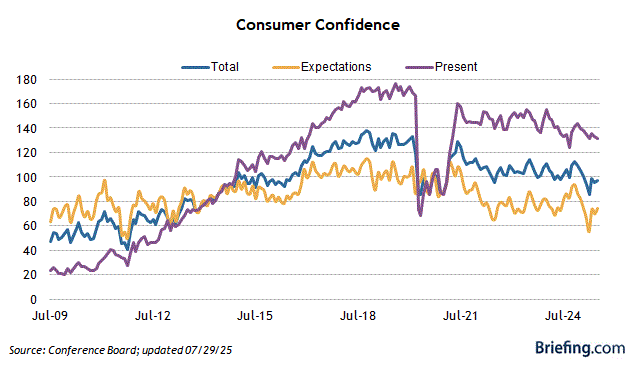
Consumer Confidence from 1993 to 2008
There was a slight decline in September 2009 and as they note,

Consumer sentiment indices get way too much attention. The simple fact is that sentiment does not correlate strongly with consumer spending and thus has little predictive value. Consumer spending correlates more closely with income. Sentiment tends to reflect well known factors such as unemployment rates and gas prices more than it predicts future spending patterns.

Meanwhile, “Romer: Impact of stimulus will wear off” (Christian Romer is a top White House economist) notes,

A top White House economist says spending from the $787 billion economic stimulus has already had its biggest impact on economic growth and will likely not contribute to significant expansion next year.

But I thought the bulk of the stimulus effect would be felt in 2010 and not in 2009 — What’s the deuce here? As this CNN story notes from January 2009: Stimulus will take a while to work.

All in all, the legitimate infrastructure spending, which in its expanded form would include Obama’s ambitious plans to invest heavily in renewable energy sources, will most likely not start coming on line until the fourth quarter of the year and its full effect is at least 12 to 18 months away. In other words, the fiscal stimulus measures that the incoming Administration will be pushing through are more a 2010 story.

And as for numbers of jobs created, A look at the effect of stimulus on States notes

Economists on both sides of the debate agree that the actual number of jobs created by the stimulus package will likely never be known. Large swaths of stimulus money went to provide tax relief, extend unemployment benefits and provide fiscal relief to beleaguered state government budgets. These programs have largely indirect effects on employment.

Only about a third of the stimulus funds — some $275 billion — are going to grants, contracts and loans that will be tracked on Recovery.gov. The 30,000 jobs reported so far cover only direct contracts, which represent $16 billion of that total.

So what can one conclude from this sorry state of affairs? What can one say about the “C” in the “C” shaped recovery? In a post a little while back, I had noted that there will be many more stimulii in the pipeline and one can already see the trial balloons being floated for them.

However, there is another “C” in the “C” shaped recovery — the Corporation. That will be next.

Thanks, Chris!

Share This on Linked In

Vinnie Mirchandani on “The Costs of Software Renewal”

Today’s guest post is from Vinnie Mirchandani of Deal Architect and New Florence. New Renaissance. Vinnie, a founding member of the Enterprise Advocates, is a tireless advocate of trends and technologies that can help buyers get more for less.

Ray Wang gives us a timely reminder that “Labor Day (US & Canadian Holiday) traditionally marks the end of summer BBQ’s, the beginning of the fall conference season, and yes, the time to begin a review of your software maintenance contacts that expire at the end of the year.”

I would say start with that — and then keep going. Take a look at all of your contracts that renew through the end of 2010.

Several good reasons to this include:

  • Establishment of a savings target on the total maintenance spend for 2010.
    Have your staff focus on every software contract, especially those that have been “auto-renewed” for years now because they were “small” and fell under attention thresholds. If you make the overall target part of a compensation plan for key IT and procurement staff, you’ll quickly find that Thar’s gold in them yellowing software contract files.
  • Multi-year maintenance deals which looked good when signed may now be overpriced.
    Current market trends are driving the cost of maintenance down, especially through third party services. Don’t assume they cannot be re-opened. (See Marc Freeman’s tips for “renegotiating with integrity”.)
  • If you don’t start now, you might not finish the renegotiations in time.
    Don’t overestimate the ability of your team to get organized — or underestimate the ability of the vendor team to stall — beyond the end of the year. If maintenance expires, and something goes wrong, you could be at the vendor’s mercy in renegotiations. Formally document your new process and let the vendor know next year will be different. Furthermore, be sure to allow 6 months for the renewal negotiation next year.
  • Even if you are looking to migrate, you will still need incumbent vendor support until the cut-over occurs.
    This holds true whether you are looking to migrate away from the incumbent vendor to SaaS, or to third party maintenance, or to do-it-yourself support (and readers of Deal Architect will know I am a broken record on the subject of considering all of these options). This will likely push you into 2010 planning and funding.

So, use Ray’s call for intensity over the next 3 months and build momentum for another 12 months. The payback will be huge — software maintenance continues to be one of the items on the IT menu with the most “empty calories“.

Thanks, Vinnie!

Share This on Linked In