From Dark Roasted Blend‘s Never Give Up! Crazy Logistics, Part 11.
Crazy People Transport
Hang on Tight!

Watch Out for the Bumps!

Look Out for that Train!
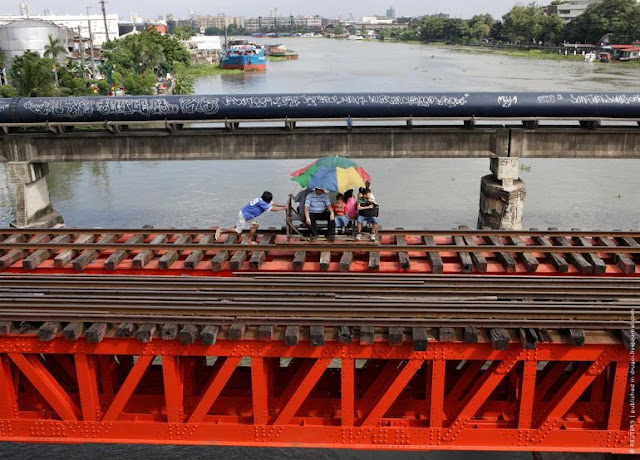
Proud Larry Keep on Rollin’

Keepin’ Cool in the Hot Sun


From Dark Roasted Blend‘s Never Give Up! Crazy Logistics, Part 11.
Hang on Tight!
Watch Out for the Bumps!
Look Out for that Train!
Proud Larry Keep on Rollin’
Keepin’ Cool in the Hot Sun
Last year, David Jacoby wrote in The Economist Guide to Supply Chain Management: How getting it right boosts corporate performance that China’s high supply chain costs are limiting its growth. Noting that, as per a recent study by the US Chamber of Commerce, China’s logistics costs are the second highest in the world at 22% (compared to the global average of 13%), China is choked by the high cost of inbound logistics.
With the rising cost of production in China (as more and more middle class workers demand higher salaries in their quest to maintain a middle class life style on par with their peers in other parts of the world), repeated calls to allow the yuan (which is rising against the US Dollar [WSJ]) to float with the market, and rising raw material and oil costs, it appears that China’s days of being a LCCS destination might be coming to an end if it doesn’t get its logistics costs under control.
Now, you can argue, as Jacoby points out, that China’s government is investing massively in infrastructure, having recently laid out a broad-scale and ambitious programme to improve supply chain performance by creating third-party logistics (3PL) enterprises and deregulating certain transportation areas; promoting the establishment of logistics networks throughout the country; and building 30 modern logistics parks that will serve as distribution centers throughout the country in their 11th five-year plan, but you could also counter-argue the facts that the Shenzhen Dongdao Logistics Co. became insolvent and collapsed on January 25 and Guangdong-based Nan Yue Logistics posted an RMB 190 Million loss in 2009. In other words, it would appear on the surface that logistics are becoming too costly for even the logistics providers in China, yet alone the foreign buyers who need to use them.
So is this going to mean the end of the China surge, and an eventual shift to new LCCS locales when the market returns? Or will China find a way to get its logistics under control? Not Necessarily. For what it actually means, we turn to Dick Locke, SI‘s resident expert in international trade.
| Well frankly I don’t believe the US Chamber of Commerce. I don’t think it’s because of their anti-Health Care, anti-regulatory reform, anti-environmental policies but that doesn’t help their credibility.It’s because there is such a trade imbalance from China to the rest of the world that logistics costs into China have been dirt cheap for years. Freight companies were moving 40 foot containers from Europe to China for around $400 back in the boom days.
Here’s an excerpt from an academic paper on trade imbalance in container movements in and out of China. TEU means “Twenty Foot Equivalent Units.”
And the WSJ says the yuan is strengthening? Excuse me? Where do they get that? On the first of the year the dollar was worth 6.8291 yuan. Today it’s worth 6.8360. (oanda.com) Maybe the WSJ is careless about verb tenses and means it will strengthen soon. It might. It might not.
When will the China surge be over? That’s a product by product question but the general answer is when you can find better suppliers elsewhere. No one’s buying a third of the way around the world unless the suppliers there are the best. But you need to test other countries periodically. Global Sourcing is like painting the Golden Gate Bridge. You never finish. |
In other words, the cost of logistics is all relative and it’s the total cost that matters in the end. While China, and its suppliers, remain highly competitive, it will be the location of choice.
The reality is that while logistics costs in China might be “high” relative to its GDP, they’re still “low” in absolute cost compared to costs for moving the same volume in the developed world. The yuan may be “rising”, but it really hasn’t risen much against the American dollar, so it’s still not an issue. And wages may be rising, but they’re still rising by pennies, not dollars, and the wage costs are still relatively insignificant. In other words, all the noise you hear is just much ado about nothing … and it’s time to go and buy another can of vibrant orange paint.
Everyone should read this recent article in Strategy + Business on Virtuous Connections that presents a case study on how local “fixes” that don’t take into account dependencies can actually result in global “breakdowns”. The article, which presented a case study from a large chemical manufacturer, described how numerous attempts to “fix” existing supply chain issues resulted in the creation of additional supply chain issues that were even worse and more costly.
For example, the article describes how:
But when a more holistic view was taken and Supply Chain focussed on:
the results were astonishing. Inventory on hand decreased by 20 percent, shipment costs stabilized in a period of rising fuel prices, and stock-outs fell by 50 percent — resulting in exponential gains.
When they failed to look at the big picture, intended “improvements”, including the selection and integration of expensive new systems, had disastrous consequences because their “side effects” were never taken into account. But when they analyzed the system as a whole, even minor changes had major positive impacts. You need to look at your supply chain as a whole, and select systems that allow you to analyze the supply chain as a whole. Otherwise, that “fix” might introduce a fatal flaw!
As per this recent news release from Materials Management & Distribution, Halifax has broken ground on its $35 million berth project that will see the port’s berth become the deepest on the eastern seaboard of North America. Once complete, the South End Container Terminal will be able to simultaneously service two full-sized post-Panamax vessels (and Panamax II type vessels can carry up to 12,000 TEUs). 24,000 Twenty-foot Equivalent Units is an awful lot of freight. (It should be enough to make Halifax a top 10 North American port at the very least!)
And this is just the beginning. Over the next five years, the Halifax Port Authority — which has invested more than 100 Million in cargo-related infrastructure improvements in the past five years (in addition to 250 Million in investments from the private sector), will invest more than 225 Million dollars in port and infrastructure improvements.
If you’re wondering how you can take advantage of these improvements and leapfrog your competition (as Halifax is the closest port to many overseas locations in Southeast Asia), you could always contact the World Trade Center Atlantic Canada or Nova Scotia Business Inc. They’d be happy to help. And as I pointed out, Halifax is The Best Place to Do International Business in Canada.