Category Archives: Compliance

Contract Compliance Trust But Verify Part II: Monitoring the Vendor

Today’s post is from Eric Strovink, the spend slayer of spendata. real savings. real simple. Eric was previously CEO of BIQ; before that, he led the implementation of Zeborg’s ExpenseMap, which was acquired by Emptoris and became its spend analysis solution.

If you have a contract with a vendor, you should be paying the contract price. But until you check, you don’t really know — and what you find out may surprise you.

In Part I of this series we discussed the two pieces of data required — transactions from the vendor, and contract prices for the items under contract. The next step is to join those two datasets together, in this case by Part Number.

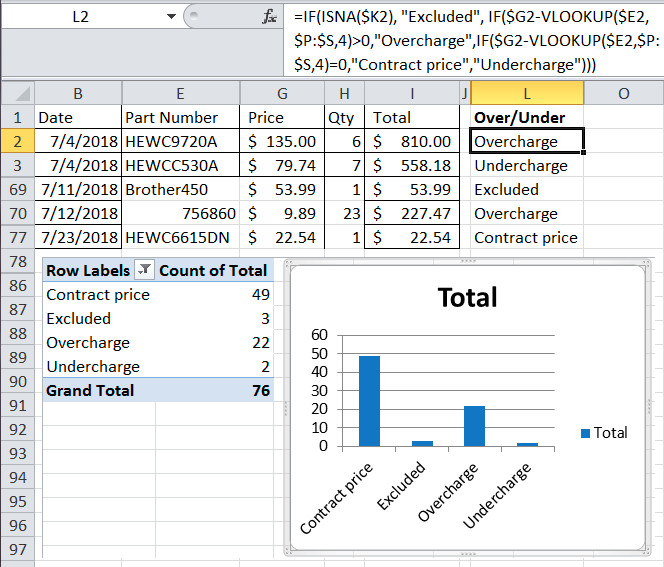
Here is what that might look like if we do it in Excel:

This was done by:

  • Sorting the contract prices by Part Number so VLOOKUP will work
  • Building a helper column K which is the difference between invoice price and VLOOKUP’d contract price (hidden)
  • Building a VLOOKUP to compare contract price to invoice price (shown)
  • Building a Pivot Table to roll up column L

Lots more could be done. For example, we could:

  • Add a computation of the amount of overcharge.
  • Add year-month to the pivot table, giving us an idea as to the distribution of the overcharges. Have they all occurred recently, or just in the relatively distant past?
  • Produce a table of only the overcharged items, in order to send it to the vendor with a request for compensation.
  • Identify “who” is buying the excluded items (more on this in Part III).

However, as the model becomes more complex, it becomes more difficult to maintain. What happens next month, when a new tranche of transactions is available? Who updates the model? Each of the formulas and pivot tables needs to be updated carefully — a process that’s irritating and time-consuming at best, as well as highly error-prone.

Make it Easy, not Hard

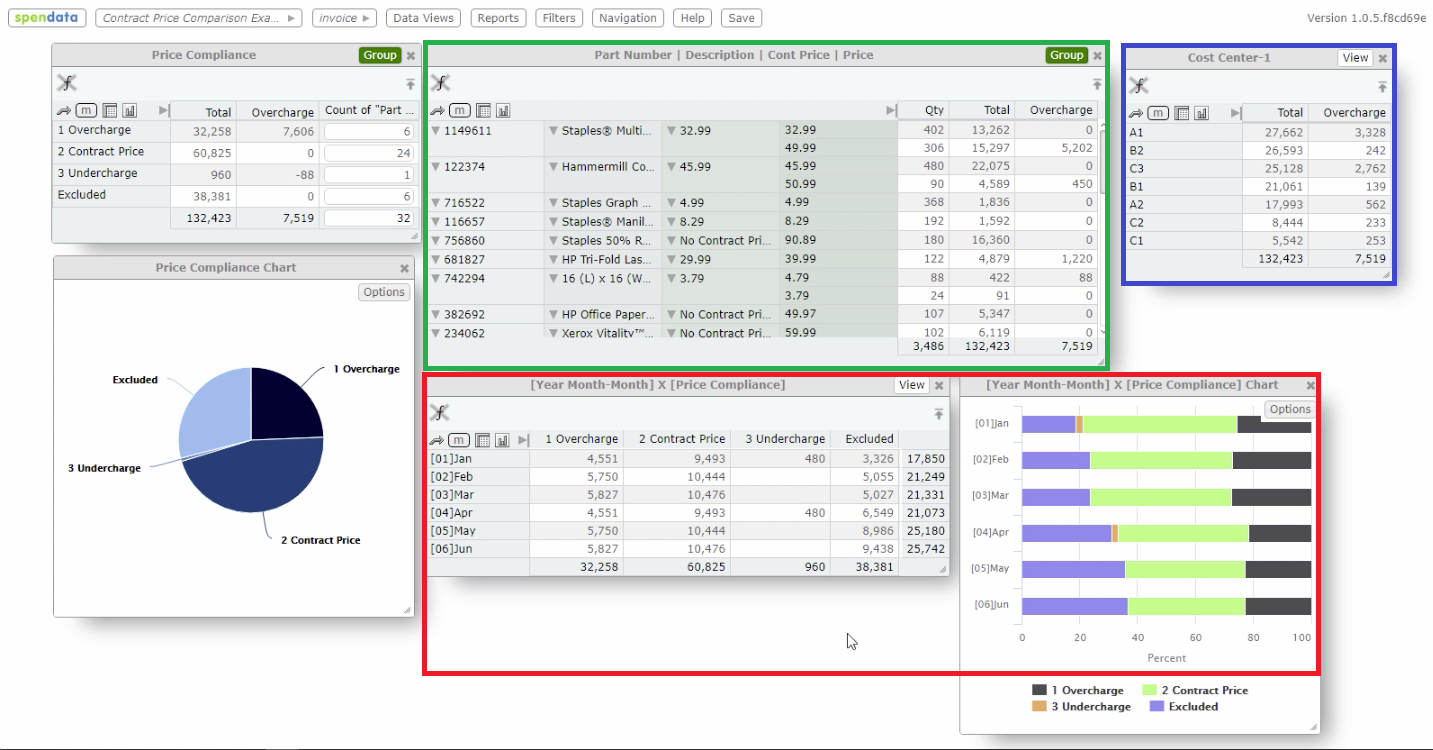
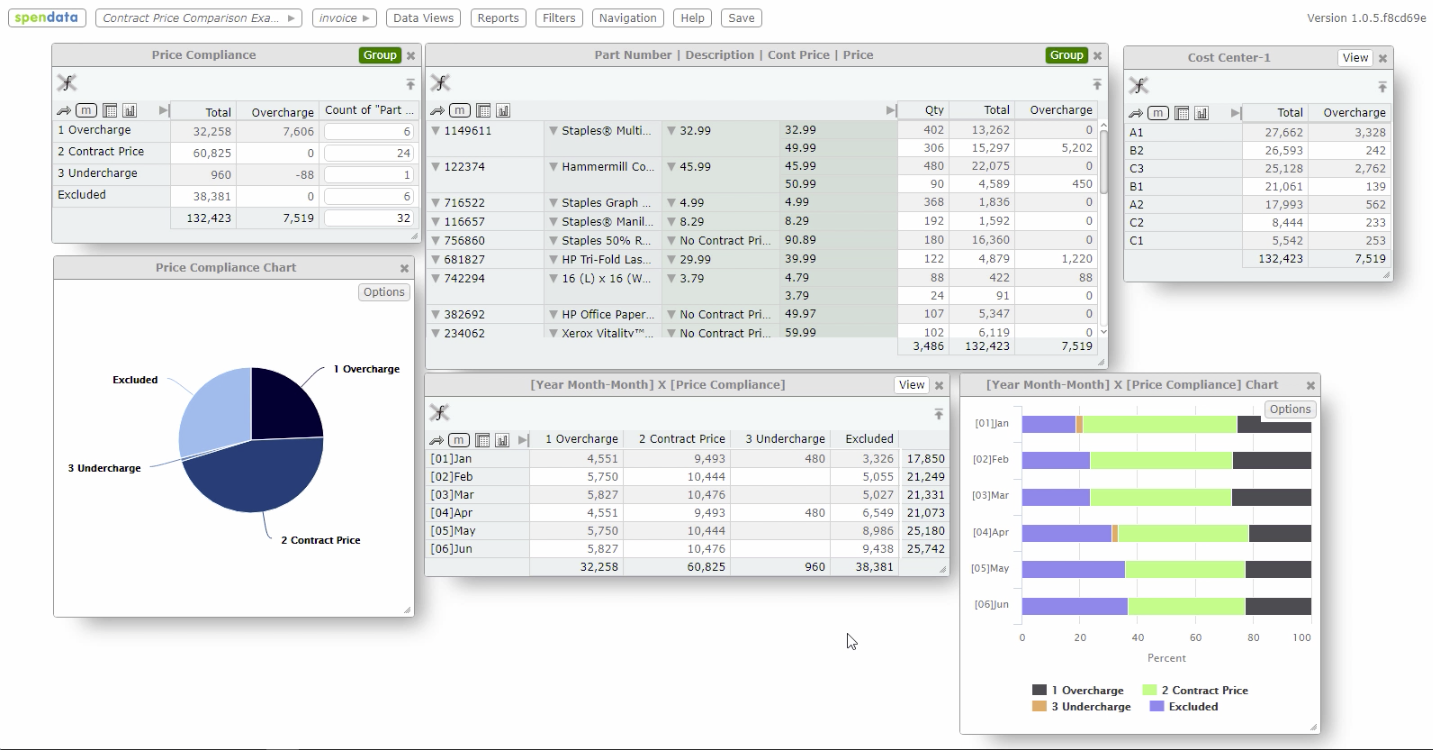
A spend analysis tool can make this a lot easier. Load the two datasets, and link them by Product Number. Then build a price difference column, set up a range, and you’re done. This requires no advanced Excel knowledge, and produces a model that updates automatically when new data are added. This dashboard was put together using Spendata, but there are certainly other options.

Click to enlarge

And now, adding next month’s data to the analysis is anticlimactic — literally a couple of clicks, and everything auto-updates. So, even if you could “do it in Excel”, you won’t, because it’s just too painful. But if you use the right tools, you can produce compliance models quickly, and you can maintain them with near-zero effort.

We’ll conclude our discussion in Part III: Monitoring Demand. Thanks, Eric!

Contract Compliance Trust But Verify Part I: Compliance Data


Today’s post is from Eric Strovink, the spend slayer of spendata. real savings. real simple. Eric was previously CEO of BIQ; before that, he led the implementation of Zeborg’s ExpenseMap, which was acquired by Emptoris and became its spend analysis solution.

If you have a contract with a vendor, that’s good news — you’re not paying list prices any more. At least, that’s what should be happening.

It’s fascinating what can really happen. We’ve recently seen a vendor raise prices in a distant region while maintaining contract prices in the headquarters region. This and similar disparities aren’t necessarily deliberate — mistakes can be made by anyone. Even items purchased through an e-procurement system can fall off the price-compliance applecart as a result of exception-handling processes. The lesson is that “Trust but Verify” is a necessity, not a nicety. And, since manual inspection of a large volume of items and invoices is impossible, this process must be mechanized.

The good news is that many goods and services can be standardized with a fixed price. These items can easily constitute 25-30% of spending. For these goods and services, contract compliance is (at least conceptually) straightforward. Examples include physical items, such as computers, office supplies, phones, furniture, MRO parts, facilities supplies, vending items, security equipment, mobile phone plans, stationery and forms, promotional items — even some types of software. Services examples can include cleaning, appraisals, training classes, recruiting, records management, armored car, overnight mail, hotel, and car rentals (when they are for a fixed unit of time or work).

If contract compliance for these goods and services is straightforward, why doesn’t everyone do it? As usual, the devil is in the details.

  1. Who builds the (usually spreadsheet) compliance model?
  2. Does the model show who is buying off-contract items from the vendor? Which items? When?
  3. Who loads next month’s data into the model, and adapts it accordingly? What’s the cost of this, versus the payback?

For these questions, invoice data, aka Price X Quantity (PxQ) data, is required.¹

Acquiring Data

PxQ data is best acquired directly from the vendor. It’s your data; you have a right to it; and you’ve a right to ask for it. Many vendors will supply it in a reasonable format, such as in an Excel spreadsheet, or as a CSV or DSV file. Some vendors, though, will attempt to discourage you by providing data in an unreasonable format — for example, by supplying every invoice they’ve sent, in PDF format, as an individual file (don’t laugh; we’ve seen this). You may want to consider whether doing business with that vendor is in your best interest moving forward. Certainly you should write into any future contract that the vendor must provide PxQ data in a reasonable format.

But, you also need contract data — that is, contract price by item. That data is probably already in a reasonable format, for example as an addendum to the contract. At worst, it can be keyed in manually or minimally edited into shape.

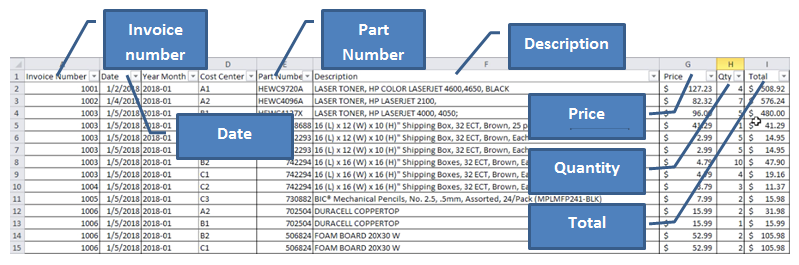
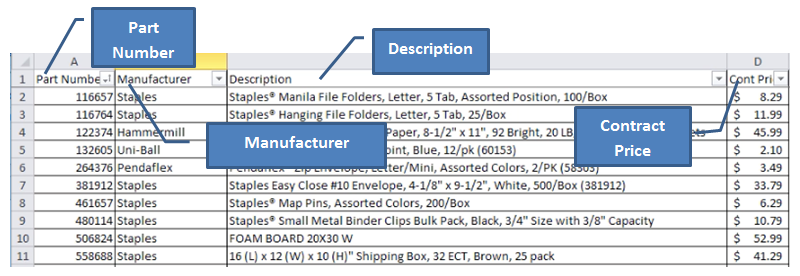
So, there are two datasets to consider. The first, consisting of invoice level PxQ data, comes from the vendor and resembles this:

Click to enlarge

The contract pricing, which you should already have, resembles this:

Click to enlarge

Once you have the data in this form, you can easily figure out whether the contract is leaky or solid. We’ll continue this discussion in Part II, Monitoring the vendor.

Thanks, Eric!

¹Accounts Payable-based spend analysis can help to determine what spend is definitely not under contract. But it is helpless to address contract compliance issues.

Compliance – A Complex Problem with few Procurement-Centric Solutions

Why is compliance a complex problem with few Procurement-Centric Solutions? Because compliance goes well beyond the narrow view that many platforms take. At a high level, we have:

  • Regulatory Compliance
    which consists of government regulations at various levels that need to be adhered to and consists of requirements across organizational governance, workforce, materials, services, trade, and environmental considerations
  • Organizational Compliance
    which consists of adhering to the policies your organization puts in place for purchasing, inventory tracking, regulatory compliance, auditing, etc.
  • Industry Compliance
    which consists of adhering to industry standards and collective agreements
  • Governance
    which consists of ensuring that all governance requirements of the organization are met across the regulatory, organizational, and industry efforts

And when you look at the market, most of the solutions on the market are narrowly focussed on:

  • Environmental Compliance across environmental sustainability factors
  • Trade Compliance to insure that all trade regulations are adhered to (and appropriate paperwork filled out)
  • Tax Compliance to insure all appropriate taxes paid (or reclaimed)
  • Workforce Compliance to insure all workers are eligible, appropriately paid, and/or appropriately insured
  • Governance Compliance which makes sure appropriate internal processes are followed (and documentation maintained for audit trails)

… and, to slightly modify a common phase, never any two shall meet. And that’s why it’s a complex problem with few solutions in Supply Management. Will this change soon? We shall see …

Integration Point: A Global Content Provider

When we last covered Integration Point (in 2008 and 2010), we discussed their solutions for customs, security, and product classification; for free / secure trade zones and for regulatory compliance.

We talked about how their SaaS solutions helped companies with product classification under HS codes, advance notification (as required by 10+2), denied party screening (through integration with the US denied party lists), free trade / special economic zones (and identification of associated agreements), and the creation of necessary documents as well as the creation of surveys to determine if the supply base was compliant.

It was a good all-around solution, but it wasn’t a one-stop shop. While the import and export management solutions were extensive, the supply chain compliance solutions were limited; free trade was primarily ECCN, entry visibility, and country of origin; there was no automatic HS or country of origin classification; and content was primarily limited to HS/HTS codes, common import documentation, custom compliance documentation, and FTA summaries.

However, recognizing that their entire solution was dependent on good content, Integration Point, which now has twenty (20) offices across six (6) continents (and which promises an Antartica office as soon as the penguins start trading), started working on a Content Repository ten years ago and over the last decade has grown that content repository into a Global Content Repository with relevant trade data for over 185 countries. This include HS Codes, Tariff Schedules, Import/Export documentation requirements, rulings, free trade agreements, free trade and special economic zones, customs compliance programs, denied parties, sanctions and embargoes, and relevant trade acts, such as Lacey. The repository, which is maintained by a team of over 200 people globally, contains millions of base documents and millions of codings and mappings and is updated daily.

Daily updates is a critical part of a trade content repository. While some countries only update their tariff schedules a few times a year, others update their schedules monthly, and some update their schedules weekly (or more as Brazil once updated its schedules 80 times in one year). In addition, as trade relations improve or break down between countries, new trade restrictions / sanctions / embargoes are created almost overnight, denied parties get added to the list daily, and new regulations and rulings also come out on a daily basis. Correct classification, coding, and documentation is the difference between trouble-free trade and having your shipment held up for days, weeks, or months. And not shipping a restricted product to a denied party is the difference between smooth sailing and being federally investigated and fined millions of dollars. In both cases, your logistics and trade managers can only insure properly documented, legal, trade if they are on the ball with up-to-date data.

Since Integration Point has a global team, Integration Point, which sells access to its content repository as well as its trade management solutions on a subscription basis, is able to keep its repository current, which is no mean feat considering there have been over 2M updates to HS classifications alone on a global basis so far this year and over 1M updates to the import / export document database were required to capture regulation updates, trade agreement updates, form updates, and new rulings.

Integration Point now has one of the best and most complete Global Content Solutions out there and should be included in your list of content solution providers as you endeavour to get your compliance under control because Content is a Cornerstone of Compliance.

Plus, based on this content, Integration Point is now able to offer innovative solutions around country of origin determination, product classification, tariff analysis, and supply chain costing. We will cover these in future posts in early 2015.

Content is a Cornerstone of Compliance

In Friday’s post, we asked if you could solve the compliance challenge before it cost you tens or hundreds of millions of dollars. We noted that the biggest reasons for lack of compliance are lack of knowledge, policy, visibility, analysis, and procurement technology and the fixes are knowledge, policy, and appropriate technology.

One of those technologies is a Procurement Marketplace that can steer (or force) buyers to buy the right products from the right (and approved) suppliers. Another is supply chain visibility technology that lets a company monitor what is going on in the supply chain and evaluate a potential supply base before making a decision. A third is import/export/trade management software that helps the organization identify the regulations it must comply with, collect the necessary information, produce the required documents, make sure the documents get to the proper authorities complete and on-time, and track all of the associated certifications and insurance certificates that go with the products and the supply base.

A good trade solution will address, at a minimum, import/export requirements, ECCN (Export Control Classification Number), custom security programs, FTA/FTZ/SEZ (Free Trade Agreements/Free Trade Zones/Special Economic Zones), country of origin, HS (Harmonized System) codes / HTS (Harmonized Tariff Schedule) codes, DPS (denied party screening), and entry visibility. Essentially it will help a company determine all of the export requirements, all of the import requirements, produce the necessary documentation, and track its product from country of origin to the destination country.

In order for this solution to work, it needs a lot of content. Namely:

  • import/export regulations for all of the countries being sourced from, sourced through, and shipped to
  • US ECCN database
  • requirements for programs such as C-TPAT, PIP, and AEO
  • Free Trade Agreements between all of the relevant countries
  • database of all FTZs / SEZs in the relevant countries
  • HS schedules for all of the relevant countries and mappings
    and/or mappings to from country specific schedules
  • Denied parties lists for the relevant countries

That’s a tall order. But no longer an impossible one. Stay Tuned.