The Kraljic Matrix is NOT a Foundation for Future Fit Supplier Segmentation

A recent piece over on Procurement Leaders noted how the author had several recent conversations about how the Kraljic Matrix has become outdated (and, as per our series last week, it has) and how one consumer goods company came up with their own approach to supplier segmentation to “leverage critical supplier capabilities to maximise value”. More specifically, he company has focused its supplier segmentation on two completely different matrices: first, the level of engagement; and second, suppliers’ ability to execute commercial growth and capabilities in an attempt to allow the company to do is to segment suppliers based on the strength of their relationship and the specific value they should bring to the business.

And, in effect, shift the Kraljic matrix from “noncritical, leverage, bottleneck and strategic” to “transactional, essential, visionary and strategic”.

It’s progress, but not much. It’s making the same error that every analyst firm (and even analyst) is making, and that’s thinking that segmentation can be appropriately captured by a 2*2.

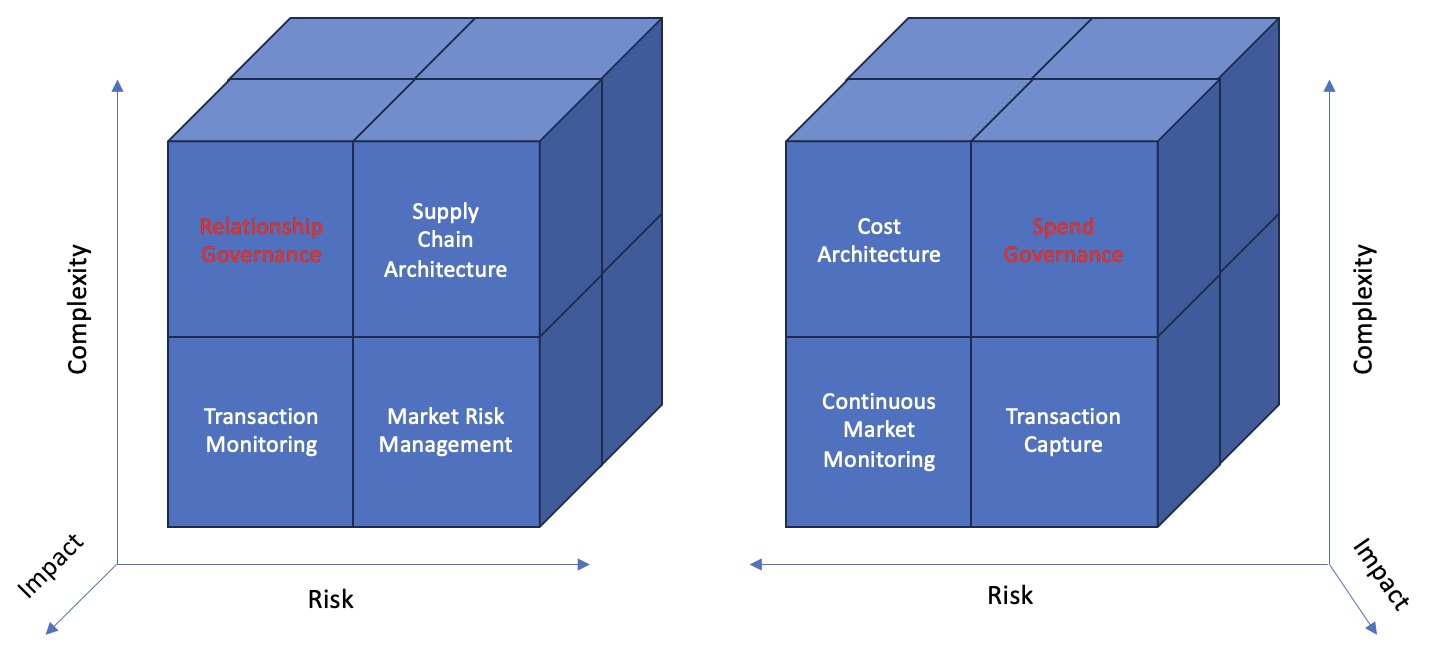
As per our series last week on what the Busch-Lamoureux Exact Purchasing framework really is, it’s not a matrix, it’s a pocket cube* — which accomplishes the goal of the Kraljic matrix by appropriately segmenting categories in a manner that allows them to be properly managed from a supply-assurance based Procurement perspective. This is the point you need to start from if you want to create a supplier segmentation strategy for appropriate supplier management.

Then you see it’s not just

  • transactions (transactional in Exact Purchasing)
  • essential (governance in Exact Purchasing)
  • visionary (risk monitoring in Exact Purchasing)
  • strategic (architecture in Exact Purchasing)

Because

  • transactions can be low impact (and non-critical) or high impact (and create a bottleneck if they don’t show up)
  • governance can be accomplished at the spend level if the spend is low impact, but needs to be relationship level if the spend is high impact
  • risk monitoring is enough (and no vision required) for low impact spend but detailed risk management with mitigation plans that involve strategic, and maybe visionary, relationships will be key for high impact spend
  • strategic can be accomplished through cost architecture and mitigation strategies for low impact categories, but require detailed supply chain architecture with supplier participation in the high impact categories

This means that there are at least seven categories that need appropriate supplier management — all of the high impact transactions, plus the cost architecture (as you need supplier input), market risk management (as you need supplier relationships to rapidly shift demand), and relationship governance (as you need cooperation to manage obligations). And the degree of management depends on the categories.

Plus, to make matters even more difficult, some suppliers will cross multiple categories — which means that you can’t just put them into the most intense management category and treat all interactions as interactions in that category. You have to take the category into account, and focus the management on what’s critical, not what isn’t. Management requires HUMAN INTERACTION, and you only have so many people with so much time to build the RELATIONSHIPS, so you have to focus based on the category being supplied.

In other words, it’s not a matrix, it’s a cube that manages the supplier based on the category impact to the P&L, the market risk (that lies primarily with the supplier or the supply chain they introduce), and the complexity (where the supplier needs to be able to produce items that meet the complex requirements). And suppliers who supply more than one category will fall into more than one bucket.

In other words, to fix supplier management, first fix Purchasing.

(And that’s why it’s so critical to Take Purchasing.)

* and, one that’s different for every industry, which might make it a 4-polytope, but since each company can customize the pocket-cube, we’ll stick with the pocket cube
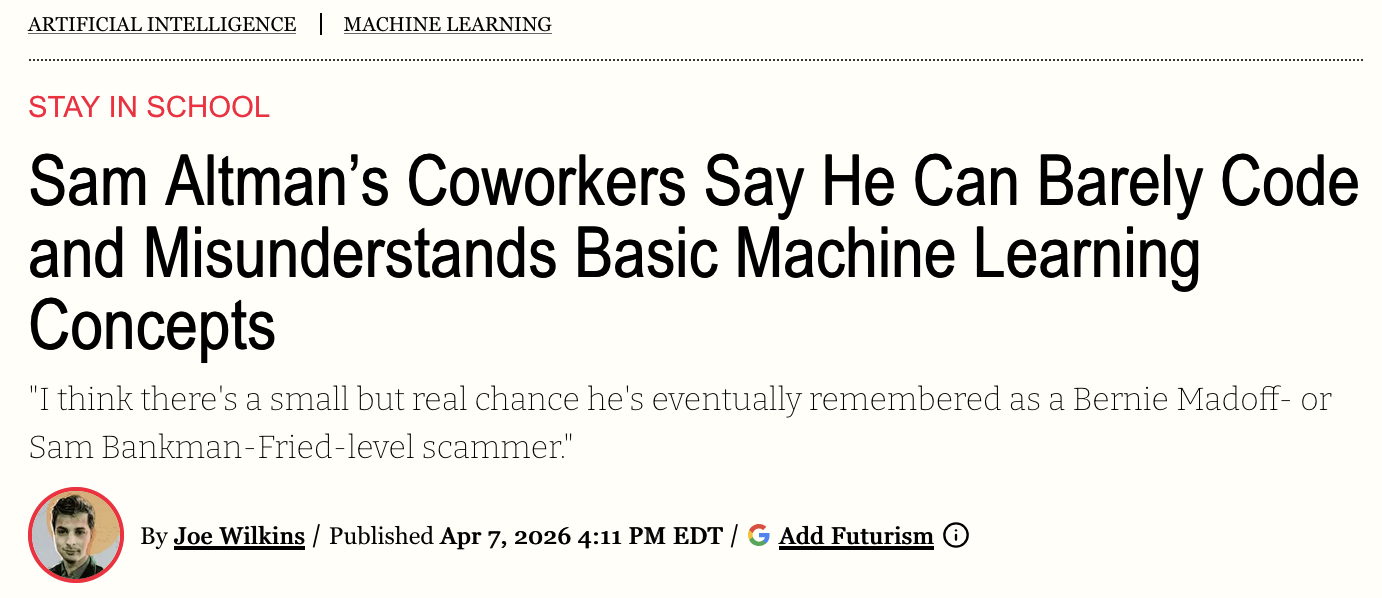
San Altman is definitely the P.T. Barnum of our age …

But to repeat claims (as per this Futurism article) that he’s the Bernie Madoff or Sam Bankman-Fried of our age without proving he has the IQ he says he has (which some of us don’t believe he has), or providing evidence he’s the world’s biggest sociopath (as that’s who you’d have to be to knowingly defraud major investment funds of hundred of billions of dollars, funds that likely hold the retirement funds of hundreds of millions of people) seems just a little unfair. After all, if Sam can barely code and misunderstands basic machine learning concepts, which I totally believe (as that would seem to be a fundamental requirement to believing AI actually works and is actually capable of intelligence in its current form), that would seem to indicate his IQ is on the low side and that he thus believes that his AI works and is actually intelligent.

If this is the case, then even though all of his investors will most likely eventually lose Billions (and likely Tens of Billions, and maybe Hundreds of Billions) of dollars on “AI” that will never work, it’s not fraud because he might actually be dumb enough to believe every word of what he’s selling. Fraud, like many major US crimes, requires intent (and, in Sam’s case, would require understanding what his firm’s offering actually does vs. what he seems to believe it does).

18 U.S. Code § 1341 starts off with “Whoever, having devised or INTENDing to devise any scheme or artifice to defraud, or for obtaining money or property by means of false or fraudulent pretenses …”. He didn’t devise the scheme of raising venture capital and private equity, so that doesn’t apply. If he believes his garbage actually delivers intelligence (even though it doesn’t), and will work better with bigger models and better data centres funded by the money he’s trying to raise (even though it won’t), he’s not intending to defraud either. Which means that he’s not a Madoff (who devised a Ponzi scheme with the intent to defraud) or a Sam Bankman-Fried (who willfully misused crypto funds for his hedge funds and pay personal debts).

He’s just a showman peddling his digital puppet theatre (who is blissfully unaware of how bad it is) and if you’re dumb enough to fall for it, that’s on you, not him!

If you’re looking for real fraud, maybe look to your federal government?

PS: I never thought I’d feel the need to defend an individual who I see as one of the biggest scourges of the digital age! But when there are a lots of individuals out there actively defrauding consumers with knowledge and intent every single day and getting away Scott free without any effort whatsoever to even formally recognize the fraud, that was a really unfair byline.

Busch-Lamoureux Exact Purchasing: The Series (Ongoing)

Last Updated 2026-04-26

STOP USING AI FOR WRITING NOW! (BEFORE IT’S TOO LATE FOR YOU!)

If you think AI writing is becoming excellent, that’s the SIGN you should STOP using AI for writing immediately.

The reason you think this is multifold, and no part of it is good.

1) AI is too agreeable (and sycophantic)

(Source)

2) This increases your dependence on it

(Source)

3) Which leads not only to cognitive decline

(Source)

4) but cognitive surrender

(Source)

And as for the “I know how to use it, I’m in control” argument, that’s all BS. It’s an illusion because frequent use of AI BREAKS THE MOST RATIONAL OF THINKERS!

(Source)

You might think you’re guiding it, but it’s brainwashing you to accept without question the same derivative cr@p it always spits out because that’s all it can do. Remember, just because the token size is large enough for the LLM to generate grammatically proper English 99.999% of the time, that doesn’t mean there’s any logic or meaning to what it generates!

And yes, the doctor saw all of this coming, as he understood early on exactly what LLMs were and were not. That’s why SI has had a formal NO AI policy (as well as a NO AI BS policy) for a long time now (and never used AI)!

(You have to remember that, as humans, there is a relatively significant chance we will end up using a nursing home at some point in our lives in North America, with some estimates now putting that chance over 50%, and an ever greater chance that when we end up there, it will be [partially] due to mental decline, dementia, and similar conditions. We’re also suffering population stagnation, if not decline, in most western countries. As a result, it’s in our best interest to do everything we can to keep our mental faculties about us for as long as we can, because there’s barely enough health care workers to care for those who already need care as it is. Think seriously about what’s going to happen if, en-masse, society goes all-in on technology that is essentially turning us into drooling mindless idiots and greatly increasing the chances we become unable to care for ourselves immediately upon entering retirement … )

Exact Purchasing is a Pocket Cube Part 5

Today we conclude our discussion of the pocket cube for exact purchasing, focusing on the low risk, but high complexity categories.

High Complexity, Low Risk, Low Impact: Spend Governance

In this situation, which Kraljic would likely also classify as “bottleneck” and Busch as “relationship governance”, Busch is quite close. High complexity, but low risk, is all about governance. It’s not about managing generic market risk, because that’s low, but managing assurance of supply because the complex requirements dictate that there aren’t a lot of suppliers who can supply the product, part, or raw material you require to your exacting specifications.

However, because the category is low impact and disruptions are recoverable, the focus is more on spend management across a potential supply base than supply assurance across a limited supply base. This is a key distinction. You’re not going to waste time going above and beyond in relationship building for something that isn’t critical, no matter how limited the global supply base might be. You’re going to go above and beyond for what is.

Potential categories here would be data centre construction (where there are multiple providers for everything, unless it’s an AI data center and you need Nvidia processors), BPO (for standard back-office functions), and facility management (which is run of the mill).

This brings us to our last category:

High Complexity, Low Risk, High Impact: Relationship Governance

When the complexity and impact are high, but you’re not too concerned about risk, you’re managing the relationship, even though this would likely be “strategic” category for Kraljic and “cost architecture for Busch. You’re making sure that the proven product from the sourced supplier at the pre-negotiated price points flows consistently and reliably. Especially when any disruption at all will be impactful and you know you can’t necessarily replace a source overnight.

Unlike other categories where you are focussed on the end-to-end price points (transaction-centric categories), market signals (market risk categories), and BoMs (cost architecture categories), in this category you are focussed as much on the obligations and SLAs, forecasts and consumptions, associated value-add services, and factors where the suppliers deliver against the complexity that you need.

If you look at Busch’s matrix, you’d think this was just service-categories, and most of them will fall here (because services are often complex and critical to your business, but low risk since you won’t select a risky supplier or one who doesn’t have the personnel ready to be deployed), but it’s also categories where service-augmentation is common. This could be utility categories (where the supplier is both building you a power plant or data centre and managing it for you), line equipment categories (where you need the equipment to power your production lines and suppliers to step in and fix it promptly if it breaks), software categories (where the supplier selects software and installs it for you), or any other category where the product comes with a service (including computer peripherals where the supplier handles all the warranty repair). It’s a bit of a mish-mash, and one of the most difficult to define and manage in the organization as each category that falls here could need to be managed quite differently.

This concludes our initial presentation and discussion of the pocket cube of exact purchasing, and I’m sure Jason will soon have a V2 model to present to you.