Category Archives: Logistics

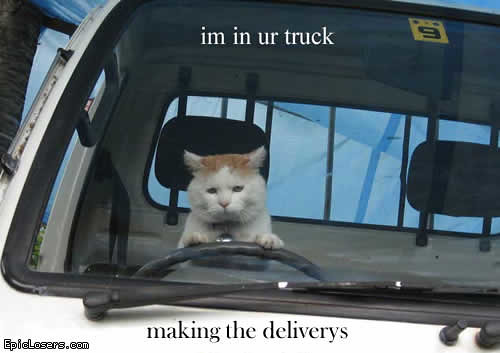
Driverless Delivery? Tantalizing Theft Target!

With the emergence of drones and, now, self driving cars, a number of delivery companies are promoting these as low cost delivery options to companies that want to reduce delivery costs, especially for small businesses shipping low volumes (that fit in a large van or small truck) or retailers doing B2C delivery. But are they really low cost?

Yes, drivers cost money because, like all workers, they expect to be paid. And if you could obtain a driverless vehicle for the same price of a driver-required vehicle, you would save. But driverless vehicles come with a higher price tag. Now, the argument is that over the lifetime, the savings from a reduced driver workforce will cancel out the increased up from cost, and this would be true if the driverless option were as reliable as the driver-required options.

Now at this point, you’re probably asking what madness has the doctor contracted because, unlike humans that get sick, get lazy, make mistakes, and need rest — as long as the equipment gets the fuel and proper service, the software can drive it 24/7 — and this is true. The equipment can run 24/7, but this doesn’t mean you’ll get your stuff.

First of all, if there’s a programming error, or GPS error, there is no one there to detect and correct it. If GPS steers an Uber off course (and it does regularly in big cities with lots of tall buildings … sending multiple Ubers in a row a block away from where I was in Chicago recently despite the fact I was very sure to provide the address and not accept the default GPS location), the driver can say “there’s no one here”, call, and figure out where to go. If GPS steers a delivery drone off course, the customer’s neighbour gets a free gift and you get to eat the replacement cost as the credit card company is not going to rule in your favour in a dispute where the customer provided correct shipping information but you delivered to the wrong address. And the cost multiplies if an entire truck is shipped to the warehouse next door and you can’t prove it. (Even if you can, it does not mean you will get your goods or money back.)

But the biggest problem is that there is no guarantee that the goods will even make it to the destination. Goods being delivered driverlessly are very tantalizing theft targets. Not only is there no security to worry about, but there is no driver to even notice a theft as it is happening, report it, and get descriptions of the perpetrator — which means 0 chance of recovery. And do not think for a second that insurance is going to cover it in a cost effective manner. As claims start rising, and investigations into reasons continue, rates are going to either become unaffordable for driverless delivery options or become nonexistent options for the average business.

The argument that the drone is not interceptable until it drops low enough to deliver the package is not going to hold because signals can be hijacked and they can be hacked. (If top of the line cars can be hacked, how hard do you think it is to hack a bottom of the line drone?). And the argument that the delivery vehicle is secure until it reaches its destination is not going to hold either because if thieves can bust open a lock and rob a moving delivery truck with a driver unnoticed, how hard is it going to be to do the same to a driverless one. (Answer, even easier — no one to see the theft. Cameras do not count. They are easily hacked if they are digital and easily blinded by LED lights.)

Driverless trucks are already becoming theft ring targets, and delivery drones will soon be the target of bored hackers everywhere who will be able to get stuff en-route and not have to wonder if the order on the stolen credit card number will go through before the theft is detected and reported.

Driverless delivery is a tech-dream, but, for the time being, is not a Procurement one. You have been warned.

One Hundred and Forty Five Years Ago Today …

Saw the opening of the first rack railway in Europe (and the second in the world), the Rigi-Bahnen, which even today is the highest standard gauge railway in Europe. Located between the two arms of Lake Lucerne on the Rigi Mountains, described by Mark Twain as “the charmingest place we have ever lived in for repose and restfulness”, this could be seen as the beginning of mountain tourism in Switzerland. It’s hard getting people up a mountain, and this is an important landmark in human (and cat) logistics history.


Infrastructure Sustentation 12: Airlines

Airlines are sometimes the most unpredictable of the infrastructure damnations. Postal services failures can be overcome with private carriers. Road closures can be overcome with longer detours. Port closures can be overcome by routing to alternate ports and trucking for longer distances. But when airlines fail, especially when all airlines are unable to serve a region, what do you do. Send a zeppelin? (And when was the last time those great balls of fire just waiting for a spark were used?)

The reality is that airlines are subject to a host of threats that can shut them down at a moment’s notice including, but not limited to:

  • Environmental Hazards

    planes can’t fly through hurricanes, tornados, or tsunamis; they can’t fly when the air is filled with volcanic ash (that will choke up an engine); they can’t land on water or thin ice); etc.

  • Geopolitical

    embargoes, disputes, and wars can close down a zone for an extended period of time

  • Labour

    worker strikes can take an airline down for an extended length of time

And even if this doesn’t happen, there’s still the risk that:

  • AirFreight can skyrocket over night.

    It’s not only ocean freight that can increase 20% or 30% almost overnight, air freight can too (especially when fuel costs skyrocket)

So what can you do?

Minimize Dependence on Air Freight

Yes it’s nice to get things overnight, but with proper supply chain planning, do you really need things overnight? For the bulk of enterprise and consumer goods, the answer is no. And with ocean freight able to get things across the ocean in as little as 23 days, that should be fast enough for most needs.

Have a Backup Plan

Have a backup airline, a backup departure point, a backup arrival point, plans to rail/truck the cargo to backup departure and destination points, and worst-case ocean or land backup plans for at least part of the journey if airlines shut down in a region due to another volcanic eruption.

Get Your Own Cargo Jet (Fleet)

As long as planes can fly, you can have more control. This isn’t a solution for anyone who doesn’t do a lot of air freight, but if you do, just like building your own power plant may soon be a necessity, so may be controlling your own air fleet.

RIP, PER

Fifty-Five (55) years ago today, the Pacific Electric Railway, once the largest electric railway in the world in the 1920s, ended operations.

It was a sad day in history because despite the perceived infrastructure cost, electric transportation can be a lot a cheaper than gas-transportation with the regular, repeated, rises in oil that have been happening over the past 40 years, especially when you consider improvements in electricity generation from sustainable sources including sun, wind, and water power that is almost free once the infrastructure has been paid for.

As this isn’t an engineering or energy blog, we won’t dive into pages of discussion as to why clean, smog-free electric streetcars are much preferable to the gas-guzzling busses of today, but simply mourn the passing of the streetcar and the great networks that used to power the great cities of North America.