
Category Archives: History

The Dark Ages Were Bad …

… and, after most of western society was likely still recovering from the long term devastating effects of the volcanic winter of 536, that probably set us back 1,000 years in the grand scheme of societal development and civilization advancement.

… but that’s a minor setback compared to what’s in store for the Age of Retardation that is coming!

But let’s back up. Consider this recent article on LinkedIn by Karl Waldman on this Medieval Lesson: Cutting Skilled Workers Hurts Long-Term Growth where Karl discussed why the age of great cathedrals came to an end.

It had nothing to do with lack of wealth — there’s always been wealth, all that changes is who controls it — or a lack of interest — the Christian religion has consistently held more than its fair share of dominance through Europe from the building of the first great cathedral until the present day (and whenever it loses control in one country it finds a new one to take over). It was lack of skill.

As per the post, the European cathedral builders developed an ornamental tradition so specialized it took decades of guild training to master. When the Black Death killed a third of Europe’s population, the skilled tradesmen disappeared because the training pipeline that produced it had been destroyed.

Now think about what we’re doing today.

We’re pretending AI can do the work of experienced professionals and cutting them left, right, and centre. We’re pretending we don’t need junior workers (because they do the tasks that AI seems to do okay) and not hiring. We’re walking all of our institutional knowledge out the door, as well as our ability to react and fix exceptional situations with creativity (that will break AI when they arise), while ensuring there’s no one around to absorb even a morsel of that knowledge and skill.

We’re not only replicating the end results of the black plague at a rate that’s even faster than the black death spread across Europe (it took about 7 years with the first 4 being the worst) — and not only are we destroying all of our capability to build tomorrow’s businesses, but we are throwing away all of our capability to even maintain today’s businesses if something goes wrong! After all, our current staffing levels are minimal, and most of the people we have left are in cognitive decline thanks to the AI they are being forced to use for “productivity” reasons.

When the next unstoppable pandemic hits, and wipes out all of our silver haired experts with no skilled talent to replace them, we will enter the Age of Retardation and our global society will collapse faster than the Aztec Empire. (And if you don’t know how fast one of the greatest civilizations in Central America fell, maybe you should brush up on your history!)
Remember the 80’s? You should!

And no, I’m not talking about That ’80s Show that was an abysmal failure (as they tried to follow the magic of That ’70s Show too soon with a cast that had no chemistry on set’s that had no style with laugh tracks recorded by people who were clearly trying not to cry), I’m talking about the decade. A decade you should have learned from, not forgotten.

And I’m not talking about the extreme fashions (such as the iconic big hair, the ripped jeans, the leather, the leather, the leather, etc.) the birth of the yuppies, the dominance of a republican regime that was, well, not run by corrupt or inept leadership, breakdancing, the rise of rap (even if it did tell us to fight the power with funky cold medinas), the great nuclear meltdown , or the fall of the Berlin Wall (although that should not be forgotten).

And while relevant, nor am I referring to the end of the Cold War (which indirectly led to more trade and globalism), the mass famine in Ethiopia (which gave us our first mass collaborations between musicians in the modern age), the rise of the personal computer (though very relevant to the world we live in today), the first mobile phones (which have now morphed into mobile computers that do everything, but, apparently make calls in the hands of a millennial), the rise of dungeons and dragons (which would have prepared you well for the endless entrapment in the dungeons we have created for ourselves), or ALF, even though he would make a much better world leader than many countries currently have (who insist on electing celebrities and populists instead of economists and politicians who actually have some idea how to run a country).

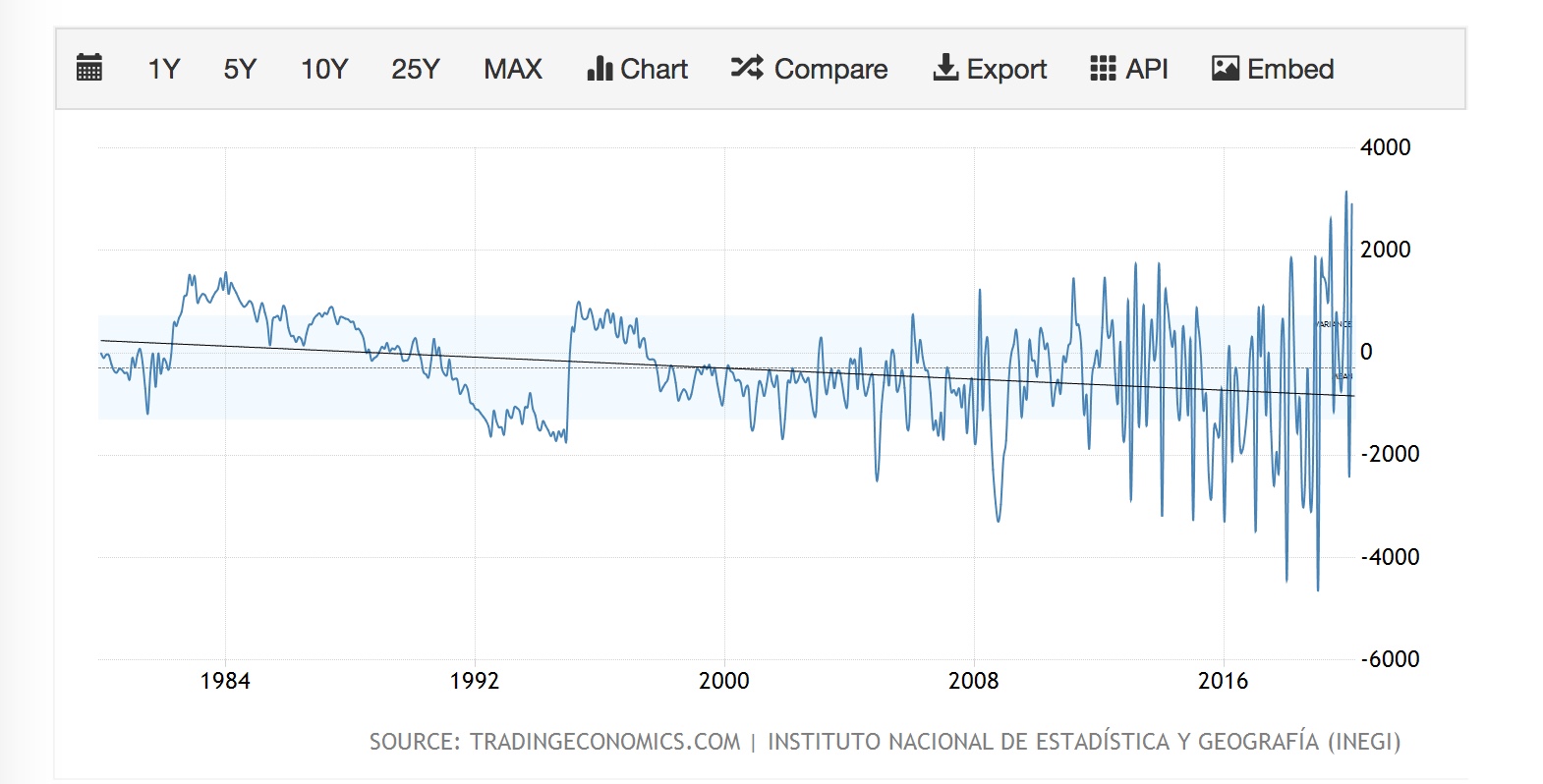
No, I’m asking you to remember Mexico, the country the current President of the United States wants to wall up, and the significant contribution they made to the North American economy. More specifically, the contributions Mexico made to the North American economy in particular. As per this graph below, which can be found on Trading Economics, you can see that from about 1982 to 1990, Mexico had a balance of trade consistently in its favour.

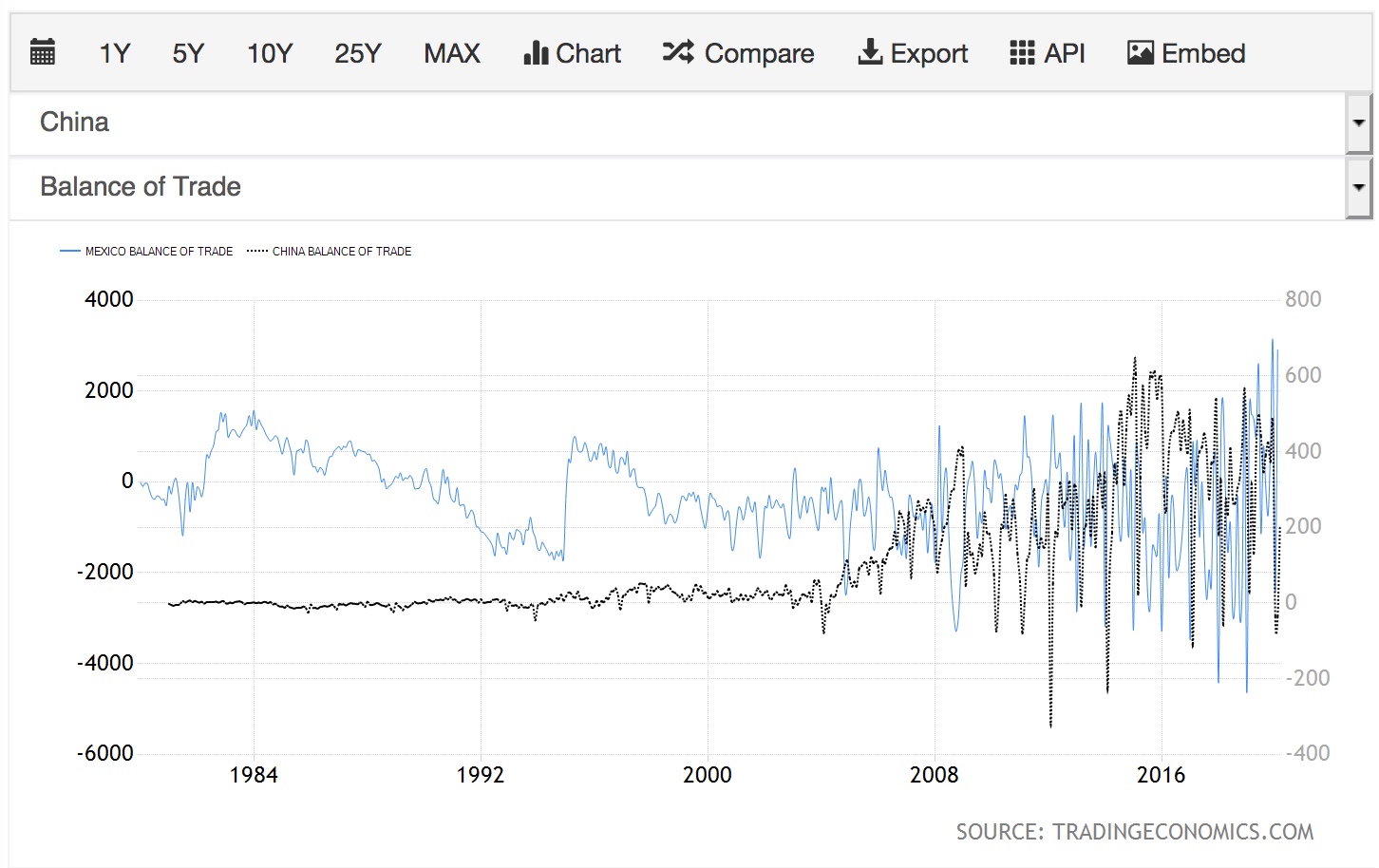
Why is this important? It’s important for the same reason that, during the same period, the balance of trade for China was significantly not in China’s favour, as per the graph below also from Trading Economics.

And that reason is …

Something you’d be well aware of if you’ve been reading this blog from the beginning and actually listened to the warnings the doctor gave you last decade about improperly designed supply chains. And that we’ll remind you of in our next post on the subject.

Forty Two Years Ago Today …

The world’s first Global Positioning System (GPS) signal was transmitted from Navigation Technology Satellite 2 (NTS-2) and received at Rockwell Collins in Cedar Rapids, Iowa, at 12:41 a.m. Eastern time.

That’s right! Forty two years ago, something we couldn’t imaging living without didn’t exist! No way to track our goods in real time. No way to even figure out where we are in real time. No mapping applications on your cell phone. No ride-sharing companies. Etc.

GPS hasn’t been around as long as many supply chain pros have, who couldn’t imagine a supply chain without it. Think about that!

Sixteen Hundred and Ninety One Years Ago Today …

Constantine’s Bridge was officially opened in the presence of emperor Constantine the Great (who ruled Rome between 306 and 337 AD when he was acclaimed emperor after his father’s death). This was a 2,437 m Roman bridge over the Danube, 1,137 m of which spanned the riverbed, that is currently considered the longest ancient river bridge and one of the longest of all time — especially considering it was a wooden arch bridge with wooden superstructure (with masonry piers). [The longest pure arch bridges today barely exceed 500 m’s in length.]

While it only lasted four decades (which is still impressive given its mostly wooden construction), it is still a feat of ancient engineering and an accomplishment in logistics as it allowed for horse and cart delivery of goods (and men) in place of boats.

One Hundred and Twenty Five Years Ago Today …

The Americans got themselves an official, federal, US Holiday that goes by the name of Labor Day. While this may not mean much to SI’s readers across the pond (where it seems that they get a bank holiday every other week in the UK and over a month of vacation every year in much of the Western EU), this is pretty significant when you consider that paid holidays in the US are not required under any government regulations and
blue collar and service workers in the US average only 7 paid holidays (while federal employees get 10).

And while this might not sound bad, US law does not require employers to grant any vacation and about 25% of all employees in the US receive no paid vacation time (or even paid holidays). And even in companies where workers get vacation, vacation starts at one week for entry level / new blue collar / service employees and two weeks for white collar jobs (after a year of service). It usually takes five to ten years at the same job for an employee to accrue three weeks, and twenty years of service to get four weeks.

In short, even though Labor Day has been a federal holiday in the US for 125 years, the plight of labour in the United States still needs to be recognized!