Monthly Archives: January 2010

New and Upcoming Events from the #1 Supply Chain Resource Site

The Sourcing Innovation Resource Site, always immediately accessible from the link under the “Free Resources” section of the sidebar, continues to add new content on a weekly, and often daily, basis — and it will continue to do so.

The following is a short selection of upcoming webinars and events that you might want to check out in the coming weeks:

Date & Time Webcast
2010-Jan-12

11:00 GMT-08:00/AKDT/PST

Oracle & Deloitte IFRS Manufacturing & Distribution Webcast
Sponsor: Oracle
2010-Jan-12

11:00 GMT-05:00/CDT/EST

IT Spending in 2010 and Beyond
Sponsor: Gartner
2010-Jan-13

11:00 GMT-05:00/CDT/EST

Don’t Train – Make an Investment and Expect a Return
Sponsor: ISM ADR School for Supply Management
2010-Jan-13

11:00 GMT-05:00/CDT/EST

Taking Responsibility for E-Waste Recycling
Sponsor: Global Sourcing Council
2010-Jan-13

8:00 GMT-08:00/AKDT/PST

Outsourcing in CEE. Country Overview. Ukraine
Sponsor: Ukrainian Hi-Tech Initiaitve
2010-Jan-13

10:00 GMT-08:00/AKDT/PST

Separation of Duties for Security and Regulatory Compliance
Sponsor: Oracle
2010-Jan-13

9:00 GMT-05:00/CDT/EST

Does BI equal Better Decision Making?
Sponsor: Gartner
2010-Jan-13

8:00 GMT-05:00/CDT/EST

Hardball Negotiation Tactics
Sponsor: Gartner
2010-Jan-14

14:00 GMT-05:00/CDT/EST

A Better Option For Managing Cash Flow
Sponsor: The Receivables Exchange

Dates Conference Sponsor
2010-Feb-1 to
2010-Feb-2
Gartner Business Intelligence Summit
London, England, UK (Europe)
Gartner
2010-Feb-1 to
2010-Feb-2
Supply Chain Forecasting & Planning Conference: Europe
London, England, UK (Europe)
IBF
2010-Feb-2 to
2010-Feb-4
Logicon 2010
Brussels, Brussels, Belgium (Europe)
WBR
2010-Feb-2 to
2010-Feb-5
Supply Chain Analytics
Atlanta, Georgia, USA (North-America)
Georgia Technology Institute
2010-Feb-3 to
2010-Feb-3
Procurecon CPO Roundtables
London, England, UK (Europe)
Buying team, Efficio
2010-Feb-4 to
2010-Feb-5
Innovation
Cambridge, Ontario, Canada (North-America)
APICS Ontario Grand Valley
2010-Feb-8 to
2010-Feb-10
4th Annual Shared Services & Outsourcing Summit 2010
London, England, UK (Europe)
SSON
2010-Feb-8 to
2010-Feb-10
RLA Conference & Expo
Las Vegas, Nevada, USA (North-America)
Reverse Logistics Association
2010-Feb-8 to
2010-Feb-11
ARC World Industry Forum: Where Industry Leaders Meet to Solve Their Most Challenging Issues
Orlando, Florida, USA (North-America)
ARC Advisory Group

They are all readily searchable from the comprehensive Site-Search page. So don’t forget to review the resource site on a weekly basis. You just might find what you didn’t even know you were looking for!

And continue to keep a sharp eye out for new additions!

There is NO New Normal … Just the Old Normal Coming Back

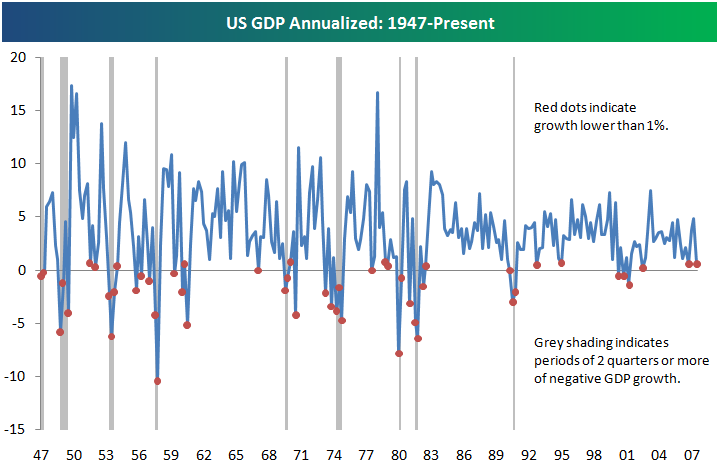
I have to be honest … I get sicker and sicker of “the new normal” each time I hear about it … even though I must admit that upon reflection I did find the recent article from McKinsey Quarterly’s Strategy Practice on “Navigating the New Normal” to be hilarious. For a while I couldn’t put my finger on why I couldn’t stand hearing about “the new normal”, but then it hit me. There’s no such thing as a new normal … just the old normal coming back after an extended 15 year hiatus. After all, if you think back to before 1995 and before the leading edge of the first tech boom, you see a slow, steady growth in the year-over year stock indices going back to 1975*1. And if you look at the annualized GDP data in the same time frame, you see that growth went up and down, usually between -7% and 7%, over time*2, but averaged out to slow, steady growth*3.

Not only does this mean, as the McKinsey Quarterly article pointed out, that (continual) market growth of 5% to 7% is a thing of the past, but that you have to go back to the good old days where your growth is going to be at the expense of your competitor’s loss. That means that you are going to have to buckle down and build better products, create better services, and offer them at a better price point than your competitors. In other words, the days of new markets and free growth are over.

And while I agree with the leading “strategists” that you are going to have to limit growth plans to “growth above market” and adapt to changing conditions on a quarterly basis, I am fed up about this bullshit about having to go to shorter and shorter planning cycles. That’s why the economy is in the gutter. No more long term thinking. No more research labs. No more support for long term research projects in academia (where it’s now “publish another paper, no matter how trivial, tomorrow or perish”). It’s one thing to be on short production cycles … as that lets you adapt to changing market conditions. But it’s another thing to not be planning beyond three years. It’s just crazy. We need to get back to the days where companies not only had five year plans, but ten year plans … and even longer term plans where innovation roadmaps were concerned. Until we do, I don’t see things getting much better. But in the meantime we’ll get lots of five page articles on discussions with “leading” Chief Strategy Officers who, in long winded diatribes, essentially tell us that they don’t know where things are going … which is exactly what you get when you stop planning for the future.

*1 Comparison of the Dow Jones Industrial Average, NASDAQ Composite, and S&P 500 after 1975

*2 Annualized US GDP Growth from 1947-Present

*3 US Gross Domestic Product 1947-Present

Share This on Linked In

Sustainability Took Centre Stage in 2009

I was glad to see a recent article on Industry Week last month that covered the recent study by McGraw-Hill construction, sponsored by Siemens (and available on the Siemens Building Technologies site), that found that three out of four firms viewed sustainability as consistent with their profit goals.

The study, which also found that:

  • 75% of firms expected green practices would reduce energy,
  • 70% of firms expected green practices would retain and attract customers,
  • 64% of firms expected green practices would provide market differentiation, and
  • 58% of firms expected green practices would serve the financial performance of the company

is dead on. Reduced energy consumption saves money. Market differentiation attracts more customers. More customers increases revenue. All of this adds up to more profit. Basically, what us bloggers have been telling you for years is true. Sustainability is more than just being green … it’s keeping your firm around for the long haul. For ideas on how to get started, check the SI sustainability archives or take a trip over to Tim Albinson’s 2Sustain.

After all, as per this recent Strategy+Business article, Green Is A Strategy. Look what Ecomagination did for GE … over $100 Million in cost savings to the bottom line and a portfolio of 80 new products and services that generate over $17 Billion in annual revenue. And with 80% of workers wanting to work for a company or organization that makes the environment a top priority and 67% of currently employed personnel planning to look for new opportunities when the economy picks up, your business could be in serious risk if you’re not green.

If you don’t know where to begin, the Strategy+Business article has five steps to get you started.

Share This on Linked In

Google may have ended voting on Project 10100 …

… but that doesn’t mean that you can’t change the world!

If you can come up with something that:

  • improves the Community
    and connects people, builds the neighbourhood, and protects unique cultures
  • increases individual Opportunity
    and lets people provide for themselves and their families
  • reduces Energy consumption
    and helps move the world toward safe, clean, and inexpensive energy
  • sustains the Environment
    and promotes a cleaner and more sustainable global ecosystem
  • improves Health
    and helps individuals lead longer and healthier lives
  • furthers Education
    and helps people get access and
  • ubiquitizes shelter
    and ensures everyone has a safe place to live

then, even without Project 10100, you too can change the world.

And if you’re not in it for the money, why not take part in the IEEE Humanitarian Technology Challenge (HTC)? The HTC is an innovative, collaborative endeavour that will develop and implement technological solutions to selected humanitarian challenges in developing countries. It’s mission is to create sustainable, scalable, and adaptable solutions that can be implemented locally within the environmental, cultural, structural, political, and socio-economic conditions that will

  • generate reliable electricity,
  • connect rural district health offices with central facilities, and
  • generate and tie individual ids to health records to provide potentially life-saving access to accurate health information for remote, mobile populations in underdeveloped nations.

Getting involved is easy. Just request access to the online collaborative platform or contact one of the leaders of the movement. For example, in Canada you could contact Alfredo Herrera (Ottawa) and in the US you could contact Narendra Mangra (Washington, DC). You can find more leaders on Linked-In or contact your local IEEE section to help you find someone closer to you.

Share This on Linked In

Are You the Perfect Twit?

Chances are, if you’re reading this blog daily, you’re not, but if you know someone that is, there’s a well-funded e-commerce company in New York that wants YOU!

Check out this Craiglist posting for a “Twitter Genius”! It’s a hoot and a holler!