
Monthly Archives: July 2010

Want To Speed Up? Slow Down!

I really enjoyed this recent article in the Harvard Business Review on “the acceleration trap” and how corporations often take on more than they can handle when faced with intense market pressures by increasing the number and speed of their activities, raising performance goals, shortening innovation cycles, and introducing new management technologies or organizational systems at a furious and frenetic pace until employee motivation is sapped, the company’s focus is scattered in various directions, and exhaustion and resignation blanket the company which enters a rapid downward spiral.

It happens more often than one might think. And even if it doesn’t bring a company down, it can bring down a department. The worst scenario is when a company, after waiting, waiting, waiting almost forever to upgrade antiquated and failing systems decides it is going to do a big-bang upgrade in record time and decides to go, go, go before anyone plans, outlines, or even thinks about what they are doing. (There’s a reason that at least 70% of technology initiatives fail to some degree. This is usually it.) That’s why sometimes the best way to speed up is to slow down, take a step back, figure out what’s important and needs to be done, develop a plan of action, and then attack it with zest, but not so much zealousness that all of the employees will burn out before it’s done and success is achieved. Otherwise, you might be the next FoxMeyer.
Share This on Linked In

Six Keys to a Sustainable Advantage

Supply & Demand Chain Executive recently ran a short piece on the “six keys to the sustainable supply chain advantage” by Dr. Lowell Yarusso and Ronald J. Sanderson (of The MPower Group) which was quite good. In brief, these six principles were:

  • Collaborate, Don’t Competebecause a true value-oriented supply chain consists of an extensive network of integrated suppliers, suppliers’ suppliers, internal supply chain participants and customers, all working together to maximize the value of the supply chain. This can’t be achieved without extensive collaboration.
  • Remember the Goalas many strategic sourcing/supply chain organizations tend to get overwhelmed by the task at hand and lose sight of the bigger picture. After all, cost reductions aren’t about objectives but improving competitiveness and functionality.
  • Recognize the Complex, Manage the SimpleThe supply chain is complex. That’s not going to change. The key to success is to simplify as many processes as possible so they can be easily managed and the risk of failure, due to unmanageable complexity, minimized.
  • Treat the Issue, Not the SymptomIf you track the right metrics, you’ll be able to identify the cause of poor performance and focus on correcting it. This is important because if you don’t correct the issue, the symptom will just keep reappearing.
  • Focus on Cost Drivers and Business ImpactsRemember, costs are symptoms; cost drivers are the cause. Cost drivers can be labor, demand, shortage of raw material supply, etc. Left unchecked, they can continue to rise. Tackled head-on, they can be contained.
  • Don’t Waste an At-batIf an idea is worth pursuing, it is worth pursuing to its full and natural conclusion. To make a significant impact on the business, strategic sourcing and supply chain professionals need to understand that, over the course of a season, the difference between “hall of fame” and “journeymen” hitters is largely that the hall-of-famer is driven to excel on every swing. They aren’t satisfied with batting .300. They drive for more. And that’s what’s needed to truly achieve supply chain success — a constant drive for more.

In short, the article serves as a good introductory guide on how to give your supply chain an sustainable advantage. For a deeper dive, I recommending diving into the full article on the “six keys to the sustainable supply chain advantage”.

Share This on Linked In

Savings for Nothing

To the tune of Money for Nothing by Dire Straints.

Now look at them cubers, that’s the way you do it …
You analyze spend on your PC
That ain’t working, that’s the way you do it
Savings for nothing and props for free

Now that ain’t working, that’s the way you do it
Lemme tell ya them guys ain’t dumb
Maybe get a blister on your index finger
Maybe get a blister on your thumb

We gotta install database software
Custom coded modules
We gotta move these EDI flat files
We gotta move these XML feeds

See the little yuppie in the polo and the loafers
Yeah buddy, that’s his own smile
That little yuppie got his own jet airplane
That little yuppie he’s a millionaire

We gotta install database software
Custom coded modules
We gotta move these EDI flat files
We gotta move these XML feeds

I shoulda learned ’bout analytics
I shoulda learned about spend maps
Look at that trophy, she got it stickin’ in the camera
Man we could have some fun

And he’s up there, what’s that? Hawaiian noises?
Sippin’ on the champagne like its an iced tea
That ain’t working, that’s the way you do it
Savings for nothing and props for free

We gotta install database software
Custom coded modules
We gotta move these EDI flat files
We gotta move these XML feeds

Now that ain’t working, that’s the way you do it
You analyze spend on your PC
That ain’t working, that’s the way you do it
Savings for nothing and props for free

Share This on Linked In

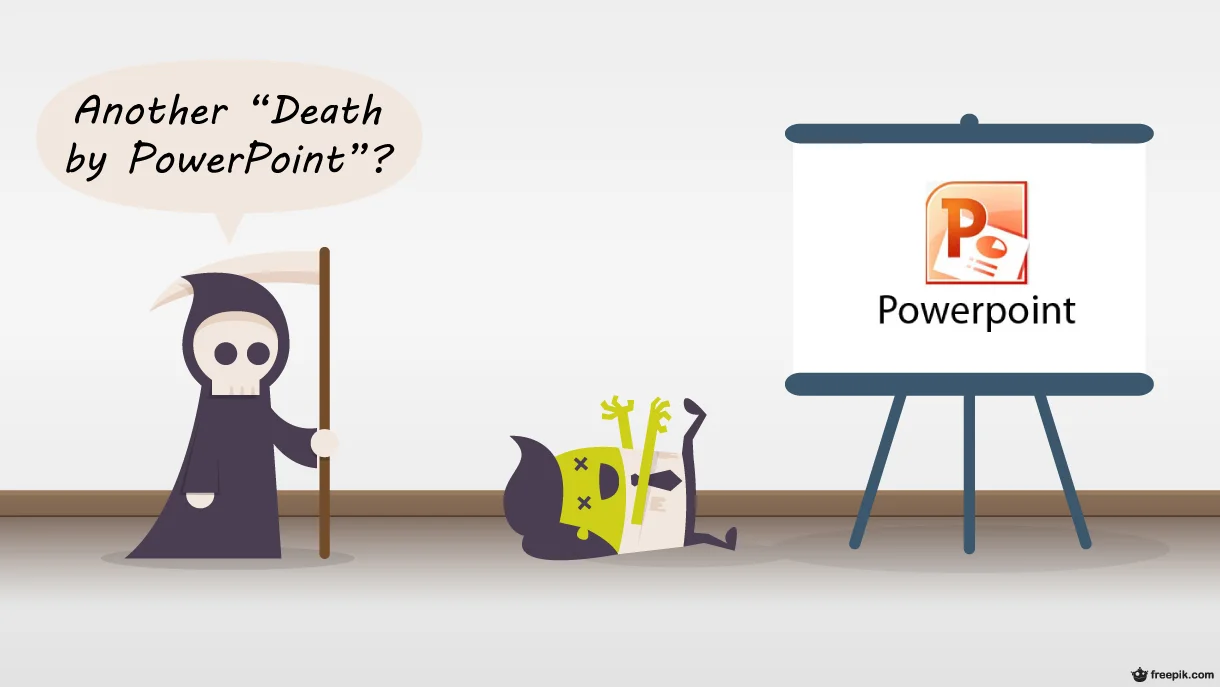
Death By Presentation

Death by PowerPoint

Don’t let it happen to you!

To avoid this fate, start with these simple tips offered up in a recent blog post over on the Harvard Business Review on “how to avoid death by presentation”:

  • Don’t Turn Presentations into Reportspresentations should summarize the key points of a report, not the other way around
  • Clarify the Purpose of a Presentationand get to the point quickly
  • Develop a Presentation Protocolslides to be distributed in advance; slide limit; etc.

Share This on Linked In

A Hitchhiker’s Guide to e-Procurement: Approvals, Part I

Mostly Harmless, Part IV

Previous Post 

Requisition challenges and best practices.

The approval process needs to vary depending on what is being ordered, who is doing the ordering, the budget(s) the order is being made against, and the approval limits of the requisitioner, her supervisor, and/or the budget managers. It can be as simple as an automatic approval if the requisition is for approved items from approved suppliers at contracted rates within the purchase limits of the requisitioner, to a multi-level approval process where the supervisor has to sign off because it’s above the spending limits of the buyer, where the budget manager has to sign off because it’s for IT equipment, where the department manager has to sign off because it’s an off-contract purchase, and where the CPO has to sign off because it’s over $10,000.

As a result, the e-Procurement system needs to not only allow for the creation, management, and tracking of spend against budgets, but also needs to support the definition of very flexible routing rules of varying priority that will not only insure that all parties sign off on a requisition before it is approved (and used to generate a purchase order that is sent off to a supplier), but that it is routed to the approvers in an appropriate order. In the example above, it should not reach the department manager until the supervisor and budget manager have signed off, and should definitely not reach the CPO until the department manager has signed off. The routing should be generated automatically upon creation based upon the appropriately ranked approval rules defined in the system (which will include an automatic routing to the supervisor for definition of the approval chain for any purchase order that is not appropriately covered by other rules).

The e-Procurement system will need to either maintain an up-to-date organizational chart, or integrate with the HR system that does. This way, general rules can be written in terms of supervisors, budget managers, and other organization roles. Otherwise, rules would have to be defined using individual users, which would make maintenance a nightmare.

When evaluating the approvals capability of an e-Procurement system, which might include budgeting support and rules management, one should keep in mind the associated challenges of the approvals process, keep an eye out for best practice support, and insure that the solution will deliver the intended benefits. These topics will be addressed in the next post.

Next Post: Approvals, Part II

Share This on Linked In