Category Archives: Market Intelligence

One of these things is not like the other — it’s the right choice!

Note the Sourcing Innovation Editorial Disclaimers and note this is a very opinionated rant!  Your mileage will vary!  (And not about any firm in particular.)

Three bids for that spend analytics project from the three leading Big X firms come in at 1 Million. One bid for that spend analytics project from a specialized niche consultancy you pulled out of the hat for bid diversity comes in at 250 Thousand. Which one is right?

Those of you who only partially paid attention to the education Sesame Street was trying to impart upon you when you were growing up will simply remember the “one of these things is not like the other” song and think that any of the bids from the Big X firm is right and the niche consultancy is wrong because it’s different, and therefore must be thrown out because it’s too low when, in fact, it’s just as likely that the three bids from the Big X firms that are wrong and the bid from the niche consultancy that was right.

Those of us who paid attention knew that Sesame Street was trying to show us how to detect underlying similarities so we could properly cluster objects for further analysis. What we should have learned is that the Big X bids were all the same, built on the same assumption, and can be compared equally. And that the outlier bid needed further investigation — a further investigation that can only be undertaken against an appropriately sized set of sample set of bids from other specialized niche consultancies to compare against. And without that sample set of bids, you can’t properly evaluate the lower bid, which, the doctor can tell you, is just as likely to be closer to correct than what could be wildly overpriced Big X bids.  (Newer firms often have newer tech and methods — and if these are the right methods and tech for your problem … )

As per our recent post, if you want to get analytics and AI right, most of these guys don’t have the breadth and depth of expertise they claim to have (as most don’t have the educational background to know just how broad, deep, and advanced AI and analytics can get, especially when you dig deep into the math and computer science and all of the variable models and strengths and weaknesses, and instead are trained on what is essentially marketing content from AI and analytics providers). In the group that sells you, there will be a leader who is a true expert (and worth his or her weight in platinum), a few handpicked lieutenants who are above average and run the projects, and a rafter of juniors straight out of private college with more training in how to dress, talk, and follow orders than training in actual analytics … and no guarantee they even have any real university level mathematics beyond basic analysis in operational research (and thus a knowledge of what analytics is and isn’t and can and can’t do).  And unless you know what you need, and why, you can’t judge the response.  (Furthermore, you can’t expect them to figure out your problem and goals with only partial information!)

While there was a time big analytics projects were (multi) million dollar projects, that was twenty years ago when Spend Analysis 1.0 was still hitting the market; when there were limited tools for data integration, mapping, cleansing, and enrichment; and when there weren’t a lot of statistics on average savings opportunities across internal and external spend categories. Now we have mature Spend Analysis 3.0 technologies (some taking steps towards spend analysis 4.0 technologies); advanced technologies for automatic data integration, mapping, cleansing, and even enrichment; deep databases on projects and results by vertical and industry size; extensive libraries for out-of-the-box analytics across categories and potential opportunities; and a whole toolkit for spend analysis that didn’t exist two decades ago. This new toolkit, built by best of breed vendors used, and sometimes [co-]owned by these best of breed niche consultancies (that don’t try to do everything, and definitely don’t pretend they can), allows modern spend analysis projects to be done ten times as efficiently and effectively, in the hands of a master — a master that isn’t necessarily on your project if you hire a Big X or Mid-Sized Consultancy without doing your homework, vetting the proposal, and vetting the people. [See when should you be using Big X.]

In contrast, a dedicated niche consultancy should have all these tools, and only have masters on the project who do these projects day in and day out. Compared to the bigger consultancies who don’t specialize in these projects, which will have a team of juniors using the manual playbook from the early 2000s, and one lieutenant to guide them. That’s often why sometimes their project bids are five times as much — and why you should be inviting multiple niche best-of-breed consultancies to bid on your project as well as multiple Big X consultancies (including those that are truly focusing on analytics and AI, and you can identify some of these by their recent acquisitions in the area) and be focusing in just as much on the six figure bids for the one that provides the best value, not just the seven figure Big X bids.  (And, FYI, if you invite enough Big X, you might find some come in at six figures and not seven because they have acquired the newer tech, took the time to understand your request, and figured out how they could get you the same value for less cost, leaving you funds for the follow on project where you should consider the Big X!)

(This is also the case for implementations. The Big X always have a rafter on the bench to assign to any project you give them, but there’s no guarantee any of them have ever implemented the system you chose before, or if they did, no guarantee they’ve ever connected it to the systems you need to connect to. You need specialists if you want a new system implemented as cost effectively as possible, especially if its a narrow focused specialist application and not a big enterprise application the Big X always implements. At the end of the day, even if you’re paying those specialists 500 or more an hour because getting a system up in 2 months at 40K is considerably better than a small team of juniors taking 4 months at 200 an hour and a total cost of 80K.  But again, mileage will vary — if the solution you select is a Big X partner, then the Big X will be best.  If it’s a solution they never heard of, you will need to evaluate multiple bids from multiple parties. )

Remember, where any group of vendors on the same page are concerned, All of us is as dumb as One of us!

Don’t fall for the Collectivism MindF6ck! that if multiple parties agree on something, that’s the right answer!  the doctor does NOT want to do say it again, but since a month still is not going by where he’s hearing about niche consultancies being thrown out for “being too cheap” or “obviously not understanding the problem” (which means the enterprise throwing them out is too uninformed and not recognizing that the Big X bids could just as likely the outliers because they aren’t inviting enough expert consultancies to the table), apparently he has to keep writing (and screaming) this truth. (the doctor isn’t saying that you can’t get a million dollars of value from some of these consultancies, just that you won’t by giving them a project they are not suited for;  again, see when should you use big X to identify when that million dollar project will generate a five million ROI — it’s people doing these projects at the end of the day, and where are those people?)

Remember, most of these firms got big in management, or accounting and tax, or marketing and sales consulting, not technology consulting. The only reason these big consultancies started offering these services is because of the amount of money flowing into technology, money which they want, but while the best of the best of the best in more traditional accounting, management, and marketing fields flocked to them, the best of the best in technology flocked to startups and c00l big tech firms  Now, some of these firms double downed, went and recruited those people, built small teams, learned, bought tech companies to expand the team, and now have great offerings in a number of areas.  But we have tens of thousands of tech companies for a reason, not everyone can build every type of technology, and not everyone can be an expert in every type of technology.  So while they will have expertise in some areas, they just can’t have expertise in all areas.  No one can.  Find the best provider for you.  Sometimes it will be Big X.  Sometimes Mid-Market.  Sometimes Niche.  It all depends on your problem at hand.)

And yes, sometimes the niche vendor will be wrong and woefully undersize the project or your needs.  But as per the above, if you don’t do give them a chance, and deep dive into their bid, how will you know?


Did you ever try eating a mitten? the doctor bets some of those clients did! (He feels you’re not all there if you think glorified reporting projects should still cost One Million Dollars by default and might actually try to eat your mittens! [Joking, but you get the point.]  Deep analytics projects that require the most advanced tech, especially AI tech, will cost a lot, but standard spend analysis, sales analysis, etc. where we have been iterating and improving on the technology for two decades should not.)

Be Wary of Top X Lists That Only Have ONE Specialist Vendor!

For every area of Source-to-Pay, including, but not limited to Sourcing, Supplier Management, Contract Management, Spend Analysis, e-Procurement, Invoice-to-Pay, Accounts Payable, Intake, Orchestration, and Spend Management, you can find a Top 10 vendor list. In fact, you can find multiple … just do a Google or Chat-J’ai Pété! search. However, if you compare them all side by side, you’re likely going to see the same vendors over and over again. Specifically, in all but one of the lists, you’re likely going to see the following vendors: SAP Ariba, Coupa, iValua, GEP, Jaggaer, and Oracle. In other words, you’re going to see the same six vendors over and over again.

And therein lies the problem. These are top suites. Suites may be best in breed in the one or two modules they started off with when they were startups, or the one or two startups they just acquired, but they are NOT best of breed across the board. Not even close. If you’re looking at a Top X Supplier Management list, you want a vendor that is best of breed in (at least one aspect of) Supplier Management. If you wanted a top suite, you’d look at a top suite list.

And it wouldn’t be so bad if you knew this, but you don’t. You’re looking for these lists because you are looking for a solution, don’t know what the options are, or where to find them. So when there’s only one specialist vendor on the list, and the list is on a major site like Supply Chain Digital or CIO, how is an average Procurement Professional supposed to find out what vendors even offer the type of solution they are looking for, let alone who the best vendors may be?

The answer is they don’t. And who does help? No one! The reality is that those suites are enterprise suites, all designed for, and going after, the same Fortune 500 / Global 3000. All are great baseline end-to-end solutions. But this also means they are not designed for the next 30,000 companies in the mid-market. That they don’t have end-to-end deep capability, and may not have specialized capability in the one-or-two modules the organization needs deep capability in due to the organization’s specific needs. If the organization is a utility, it needs deep contractor vetting (which is a specialized type of supplier compliance management), especially when those contractors send people to consumer sites and a safety violation could not only harm them, but also harm the consumer. If the organization is a financial institution, contracts need to be extensive and iron clad when it comes to risk, compliance, and security and a top of the line contract management solution is needed. If the organization does a lot of small purchases, it probably needs a best-of-breed catalog management solution with easy search and request so the average organizational buyer can request it. If you examine each of these requirements, none of those suites due specialized contractor vetting. Only one has a best of breed CLM, and only one other has a partnership with a best of breed CLM (and while they’ll tell you otherwise, remember that the doctor was a Spend Matters Analyst, designed ALL of the original Source-to-Contract Solution Map evaluations [which are still the deepest technical evaluations in the analyst space], as well as led the development of the common stack and infrastructure sections across all of the Maps and knows with authority what the “best” solutions are in each of these categories when you go broad and deep technically*). With respect to catalog management, half of these suites do it quite well, but with regards to organizational roll-out and tail-spend capture, most don’t get good adoption and that’s why you have intake/orchestration specialists (like Zip, Oro, and Tonkean) providing easy to use, consumer friendly, natural language interfaces to the organizational users beyond Procurement (and sitting on top of these suites).

In other words, these lists are junk, and besides presumably keeping the advertisers happy, they offer no value to anyone. In fact, they are so junk that, if they are not clearly labelled as advertorials (because that’s what they effectively are), they could be in violation of Competition Acts (introduced to bring transparency into journalism and “influencing”) in some states and countries if it wasn’t for the inclusion of exactly one best-of-breed vendor on the list who clearly wasn’t paying the publication anything (because they are small and definitely couldn’t afford the advertising rates).

In short, if half of a “Best Of” list for a Procurement module is suites, it’s junk and you should completely ignore it, and the publication should do better (or not do it at all).

And while the doctor can’t point you to any Top X lists that are suite/advertiser free (as he’s never found any), what he can do is point you to non-exclusionary vendor lists that you can start from to do your own research.

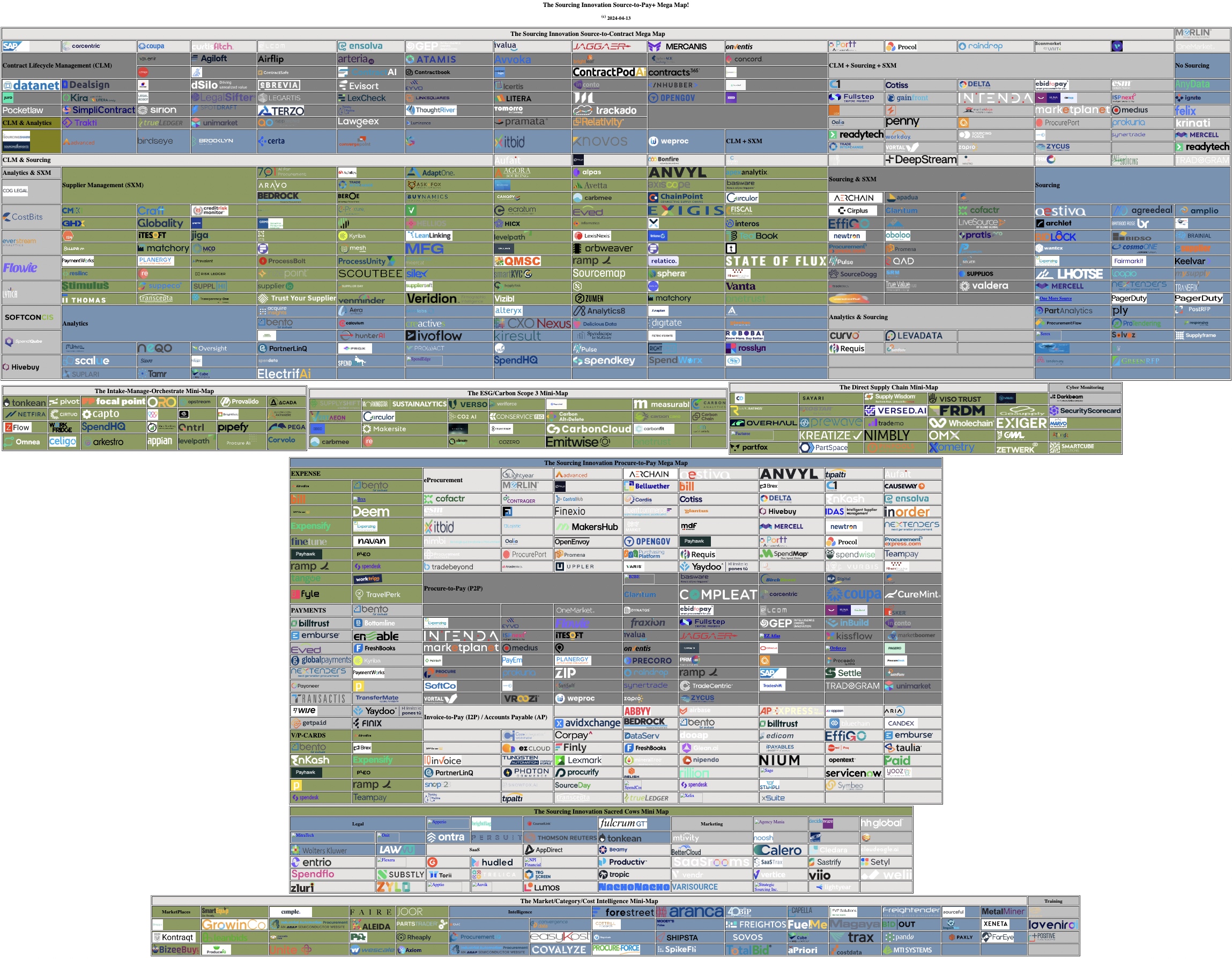
ProcurementSoftware.site has an open directory of a large number of Procurement software companies organized across 20 categories and the Spend Matters Vendor Directory has an open directory of vendors across 26 categories. And while neither of their category definitions or segmentations is perfect, they’re pretty close and a great start (and infinitely better than useless suite-filled Top X lists).

Also, the doctor regularly posts easy access lists of vendors when he does a(n update of a) summary of an area, and so far has listed hundreds and hundreds of vendors across the main areas of S2P in these posts (with almost 100 vendors addressing some area of Supplier Management, over 80 of which ARE NOT SUITES — which means this recent Top 10: SRM Providers list on Supply Chain Digital was very, very, sad when it had 6 suites: Ariba, Coupa, GEP, iValua, Jaggaer, and Oracle; 2 Supply Chain ERPs: Blue Yonder and Epicor [well, 4 actually as SAP and Oracle are ERPs, but at least they have specialist Procurement suites]; 1 trade network (which isn’t actually SRM by the way); and EXACTLY ONE best of breed SRM solution: Vizibl. FYI: SI’s list of over 100 SXM platforms has over 20 SRM specialists … just sayin’.)

For easy consumption, here are:
75+ Sourcing Vendors
90+ Supplier Management Vendors
80+ Contract Management Vendors
40+ Spend Analysis Vendors
70+ e-Procurement Vendors
75+ Invoice-to-Pay/Accounts Payable Vendors
20+ Intake/Orchestrate Vendors
10+, 5+, and 20+ Legal, Marketing, and SaaS Management Vendors
55+ Supply Chain Risk Vendors

And if you’re wondering why the doctor doesn’t do Top X lists, it’s twofold. One, in no area are there exactly 10 best vendors, so it’s a disservice to you to leave vendors out or add vendors in just to make a round number. Two, and most importantly, the top X vendors are predicated on the specific functionality you are looking for and the ability of the vendor to plug into your software ecosystem. For example, in Supplier Management, there are over a dozen different areas of focus. the doctor‘s coverage included 10 major areas of functionality, of which “R”elationship was just one, and while a large number of vendors “do” relationship, there are a number of different definitions as to what that is (and what functionality must be included). So, without a good definition accompanied by an ecosystem definition, there’s 40-ish vendors that may or may not be on that list. Every module has 3 to 10 major functionalities it has to support, and then sub-functionalities you may want. Without that context, no one can provide you a Top 10. (But if you engage an advisor who knows all those vendors at a high level, and provide your requirements, that person can help you get to a relevant short-list quickly so that you are making meaningful comparisons at decision time.)

* the doctor also knows that you don’t always need the absolute best, that sometimes the 80% solution [compared to the absolute best] is more than enough for most organizations, and that’s why a suite is often the right starting point for a large enterprise; especially if the enterprise augments the suite with one or two specific best-of-breed applications for specific use cases, as needed; but that’s your decision, not the suite, and not an uniformed third party hiding potential solutions from you

Commenting on The Prophet‘s 2024 Procurement / Supply Chain HR Advice

Note the Sourcing Innovation Editorial Disclaimers and note this is a very opinionated rant!  Your mileage will vary!  (And not about any firm in particular.)

Don’t be Afraid of Going “In-House” If you Have Tech Expertise

In this recent LinkedIn article, The Prophet notes that, in the past, he’s always recommended a stint in consulting given the presentation and analytical skills it builds where consulting can also imply “outsourcing” or “managed services”. But for 2024 he think[s] the time is right to consider going “in-house” if you’re debating a career change in procurement or supply chain and you have technology skills.

the doctor fully agrees, with a mild caveat. Specifically, “in-house” must also be capable of being interpreted to include new-age niche service providers that, as The Prophet himself pointed out in his 9th Prediction that “SaaS Management Solutions Start to Eat Services Procurement Tech“, we’re going to see new categories of blended consulting/service providers that offer not only consulting but power engagements with in house (SaaS) tech that blends tech, data, and automation in new ways to provide enhanced service packages to clients based on service fees, data fees, platform fees, and consulting fees, depending on the engagement. These plays will need the above above average talent to bring it all together, and could prove to be the most fruitful jobs this talent can get both in terms of compensation (especially if they get a small piece of the company) and job satisfaction (solving problems in less time with more value than any Big X did before).

The Prophet also notes that many consulting orgs are still on hiring freezes or cutbacks and a bunch I know aren’t raising salaries this year and that if you are an expert “grinder” versus someone with deep commercial/sales or product knowledge, you might be better valued in a company in 2024. the doctor agrees.

Moreover, the doctor believes that this will be the year that Big X Consultancies will, in tech, finally be hit with the triple whammy of:

  1. a market unable to afford their (sometimes ridiculously) high rates
    especially relative to the average service they provide (as the market has to accept what we’ve known since The Limits to Growth was published in 1972)
  2. an exacerbated brain drain
    as the companies who let talent slip in favour of DEI quotas recruit good talent back in house (which is easy when talent who went to consultancies sees their salaries freeze & their careers stall)
  3. a dose of reality as the smarter companies see what some of us analysts* have seen for years that when it comes to modern tech or industry leading service offerings, at consultancies that have under-invested in tech, you have one group leader who is stellar (and worth whatever the firm charges), two or three handpicked recruits that are above average (and worth double or triple their market value because you can’t get that talent easy), and then thirty to forty average bench warmers fresh out of school who aren’t capable of doing anything original due to lack of real world experience and can only follow the playbook written years ago by the group leader and only updated sparingly as the handpicked recruits have time.

Why?  Because the best consultancies, mid-market and Big X alike, will do something about it  (and already are — either acquiring companies to get pools of talent, focusing more on training the talent they have, or forcing team leaders to do more mentorship of the junior staff to raise them up), and bring the same value to tech that they bring to other areas.  (See when should you use Big X?)

If you don’t believe the doctor when he says that the big consultancies are much shorter on the above average tech talent they claim to provide you, then ask yourself this:

How are Big X and Mid-Sized consultancies supposed to hire talent during tech booms when some tech companies will pay 250K+ for an intermediate developer (which is twice the average average salary in some well educated markets, and at least 2/3 more than the average salary#) and 500K+ for a superstar?

When the VC and PE money flows, startups, which are cool and an opportunity to get rich if you ride the next unicorn, are more attractive than starting at the bottom rung of a consultancy. Thus, in these times, especially when the consultancies need bodies for all the implementation projects (because when the economy is pumped up by tech, a lot of companies buy tech), they hire what they can get — which is not the above average talent (of which there isn’t even enough for all the tech companies when you look at the paltry number of STEM graduates each year, the number of those who are actually qualified [which is less and less every year, not only do you have the double whammy of severe grade inflation and below par DEI-agenda admissions that The Prophet pointed out, but also overworked Professors who are forced to grade on a curve] and then calculate the number above average). Some of the “talent” graduating is so bad that you’re lucky if they understand the concept of a boundary condition when coding or calibrating when installing a piece of hardware [but fortunately they don’t end up, or stay in, tech very long — it’s easy to weed these individuals better suited for other careers out fast]. (Remember, the doctor used to be a Professor, keeps in contact with Professors, and the situation gets worse and worse each year. It’s all about maximizing dollars — from out-of-province/state students who’ll pay more, international students who’ll pay way more, and then hitting those quotes for massive DEI-based subsidies. It’s not about admitting, training, and turning out the best and the brightest. Only the rich and the rainbow.)

Now, the doctor should again point out that he’s not totally bashing the Big X and Mid-Sized consultancies — in traditional (management/operational/finance/strategy) consulting domains, many of them are great — and way better than an average company  In fact, he has a whole article on when should you use Big X?. But in tech, you’re often lucky if they’re average.  (Some are way above average, having recently acquired specialist vendors and consultancies in tech, analytics, and/or AI that instantly gave them a pool of world leading experts, while others have more or less ignored modern areas of tech until the AI hype reached full steam and are playing catch up.)  And when it comes to advanced tech, if you’re trying to find a true leader to take on your project, and you don’t know what you’re looking for, your odds are about equal to snake eyes when you roll the bones. (Your cost will be too high and your odds of generating a real return too low unless you first do your homework. You can’t throw an incomplete project request over the wall and hope for a good return from anyone!  This means identifying your needs in detail, reviewing the proposals in detail, and vetting the talent that is proposed.)

* even if many analysts can’t speak the truth because their firm’s success hinges on the success of the vendors who pay for their research, which in turn hinges on the success of the consulting partners they use for implementations …
# even though these same vendors will then wonder why they go bankrupt or have to do massive layoffs in two years

A Truly Great Article on Transforming Legacy Procurement

If you’re a new occasional reader, you might think that one of the doctor‘s primary goals is to just rip big analyst firms and publications apart when they publish ridiculous results (based on ridiculous surveys) or ill-conceived articles with little to no good Procurement content (if we’re lucky), or wrong content (if we’re not) that, as far as the doctor is concerned, would have been just as good if they unleashed an intern with no knowledge of procurement on Chat-GPT (and you all know what the doctor thinks of that!).

However, that’s just because, as Procurement is hitting the limelight (as a result of all the supply chain disasters we’ve been facing that they have been expected to deal with), coverage has increased significantly (to capitalize on the hot topic), and most of it is, frankly, NOT that good. However, every now and again there is a truly tremendous article published under the radar, and when the doctor finds one of those, he’s very happy to bring your attention to it. Especially when it’s written by a practitioner who obviously gets it.

In her article on From Tactical to Strategic: Transforming Legacy Procurement, the author reminds us that the majority of large scale transformations fail, that a major challenge for older companies is that they have no comprehensive view into global spend, that e-Procurement systems offer many fixes, but also that if they are not optimized for your specific business needs, you could be missing out on opportunities for better supplier partnerships and cost leadership.

This does not mean that you should build your own (overly) customized system, or insist that the systems support your current processes (before determining if those processes are better than the processes supported out-of-the-box by the new systems that have been developed based on typical best practices of the industries the vendor serves), but that the solution has to be appropriate to your industry and support some customization where you need it for specific products, services, or processes that make your business unique (but only those — don’t reinvent the wheel already there where you’re the same as everyone else).

The author then goes on to outline a three-phase approach to identifying, selecting, implementing, and, most importantly, maximizing adoption of the platform — which is an ultimate key to success.

the doctor highly recommends you read this article on going From Tactical to Strategic: Transforming Legacy Procurement.

Fraud and Waste are Not the Same Thing — And You Cannot Overcome them Equally

A recent article in BusinessDailyAfrica on how firms can overcome fraud and wastage in technology procurement had some good advice, but it missed some key points, especially since you can’t treat fraud and wastage equally if you want to truly combat fraud and wastage in real time.

The article notes that when it comes to the adoption of new technologies, organizations allocate substantial budgets that provide fertile ground for funds to be siphoned through fraud, which is sort of true, but usually what happens is a plethora of change orders and upsells at multiples of what the organization should be paying, which is not fraud when the vendor delivers, but severe wastage.

A bigger concern is, as the article notes, manipulation of procurement processes encompasses practices such as bid rigging or collusion with service providers, kickbacks and bribery, false invoicing, misrepresenting specifications and capabilities of products and services, channelling payments through shell companies solely to facilitate bribery, conflict of interest, and disguising procurements to bypass processes, which has nothing to do with the tech budget, and which happens whether or not the company implements new tech or not, whether the decisions are ill-considered or not, whether the decisions are rushed or not, etc.

The reality is this: if a company has a lot of money and fraudsters believe it, or its processes, can be exploited for fraud, they’ll try. And while adequate planning, centralization of tech decisions, robust implementation of strategies, and controls can curb fraud and wastage, that’s not always enough.

The only way to minimize and prevent fraud is

  1. identify each type of fraud attempt that your organization is likely to get hit with
  2. for each type of fraud,
    1. identify processes that can be exploited, and change them to minimize exploitation
    2. implement specialized technology or algorithms to look for it and alert people to the potential — in real time (before money changes hands)
    3. educate your people on what valid payment requests look like, what typical fraud looks like, and when to ask questions and/or escalate it up the chain (possibly all the way to the CFO if necessary)
    4. anytime a fraud slips through, besides trying to immediately stop-payment, immediately do a post-mortem to figure out the root cause and update the process, technology, or detection methodology; fraudsters are always upping their game, so you need to always be upping yours

And when the doctor says you have to identify and target each type of fraud (scheme/scam) separately, he means it. There’s no one-size-fits-all for fraud, but there are technologies, techniques, and targeted theorem tabulations that can rather reliably progressively prevent frequent frauds.

Nor is it as simple as just throwing a bunch of analytics at the problem, as this recent article that purports to prevent procurement fraud with analytics that was published as a think tank article in SupplyChainBrain (which, as you can guess, really upset the doctor when think tank articles in Supply Chain Brain should be the best of the best and this was barely acceptable). Apparently the doctor will have to include Procurement fraud in his list of topics for his Source-to-Pay+ series because the state of information being provided to you is, for the most part, sorry and sad.

But waste is entirely different. As we alluded above, that typically takes the following forms:

  • frequent change orders during implementation, usually billed at excessively high day rates as they have to “divert resources” or “work overtime”
  • unnecessary customizations or real-time integrations that are an extensive amount of work (and cost) when out-of-the-box or daily flat-file synchs are more than sufficient
  • extensive “process evaluation” or “process transformation” processes that are well beyond what you need to eat up consulting hours
  • extensive “best practice” education when your practices are good enough for now and/or those best practices are already encoded in the system and just following the default process gives you the same education
  • additional seats or licenses you really don’t need (but you are convinced somehow that you do) (which don’t get used and just sit on the v-shelf)
  • etc.

Basically, you go in for a penny, and they take you on a joyride that costs a pound. They deliver the minimum at each step of the way so you can’t technically accuse them of fraud, but they end up making sleazy used car salesmen look good!