
Monthly Archives: January 2010

BravoSolution Collaboratively Optimizes Its Way onto the doctor’s Short List

As many of you know, there are not many vendors out there that (claim to) offer strategic sourcing decision optimization, and fewer still that meet the doctor‘s basic requirements for a strategic sourcing decision optimization platform. Up until a few days ago, I could only certify six such solutions, though I suspected BravoSolution, especially with its recent acquisition of VerticalNet, made the grade as I knew both were close. However, with the recent addition of the infamous Paul Martyn (formerly of CombineNet fame) as VP Marketing, BravoSolution has been reaching out to analysts and bloggers alike and I received the demo I needed to certify BravoSolution (and it’s Collaborative Sourcing platform) as one of the doctor‘s Optimization Sourcing Samurai.

I’ll keep this post fairly short since, by now, you all know the minimum requirements for a strategic sourcing decision optimization (SSDO) solution, and thus what the BravoSolution Collaborative Optimization platform offers by definition, which are:

  1. solid mathematical foundations,
  2. true cost modelling,
  3. sophisticated constraint analysis, and
    • capacity
    • basic allocation
    • risk mitigation allocation
    • qualitative
  4. what-if capability.

What I will point out is the following:

  • They have one of the easiest-to-use constraint definition UIs
    Not only is it wizard-driven, but they have their constraint categories broken down into four primary categories and 15 sub-categories. In addition, their capacity switches and supplier and lane filters make it really easy to define capacity constraints and supplier exclusions.
  • Their switches make it incredibly easy to construct scenarios from varied data sets.
    They have four types of scenario switches:

    1. Functional
      which let you determine whether or not you want to include bundles (to allow you to compare bids with and without bundles), volume discounts, and capacity constraints
    2. Price Component
      which allow you to select your baseline scenario data and whether or not to include (projected) fuel surcharges
    3. Demand Component
      which lets you switch between different historical and forecast volumes
    4. Filters
      which act similar to other providers’ attributes and allow you to determine whether or not you want to include suppliers, groups, carriers etc. and (automatically) define constraints that would exclude new suppliers, intermodal carriers, or suppliers without a valid contract status or force the inclusion of WMOB suppliers, etc.
  • They have a very extensive library of built in reports
    Not only do they have full-featured comparison reports (like any good SSDO vendor), award detail reports, carrier reports, but they have reports by business unit, geography, bid attribute, lane, incumbent, and scenario detail. The last report makes it easy to determine the differences between two scenarios (which is necessary to understand the cost differential) and their award reports include cost differentials that allow a negotiator to tell a supplier how much their prices would have to decrease in order to get an award.
  • They have a very extensive help library.
    The help library has information tailored to each screen, each constraint, and each option and includes a discussion of the possible ramifications of each constraint and option on the model as a whole.
Share This on Linked In

It’s the Year of the Tiger … and China is Going to ROAR!

In 2008, according to the World Bank, China had a GDP of approximately 4.326 Trillion. Given that China projected growth of 8% in 2009, that puts them at about 4.672 Trillion for 2009. Continuing this trend, as China is projecting similar growth for 2010, that puts them at a GDP of about 5.046 Trillion this year. Meanwhile, Japan, which clocked in at 4.909 Trillion in 2008, just downgraded its projected growth to 1.3% for 2009, putting it at 4.973 Trillion for the year. As its economic outlook is not looking up, holding steady, this puts Japan at an estimated GDP of 5.023 Trillion for 2010. What does this mean? This will likely be the year that the Tiger ROARS and China becomes the 2nd largest producer of GDP in the world.

So what should you do besides learn Mandarin, if you haven’t already? (You can even start for free at sites like Chinese-Tools.com.) Good Question! While I still adamantly believe that you should not be importing goods from China that you can produce closer to home — as there’s nothing lean about an 8,000 mile supply chain — that doesn’t mean that you shouldn’t be producing in China for the Chinese market. Or that you shouldn’t be tapping the collective knowledge of the almost two million geniuses that live in the country.

But where do you start with the world’s fastest-growing economy? I’m not sure, but a recent article from Knowledge@Wharton on “The Road to China” that interviewed Harbir Singh, Saikat Chaudhuri, and Lawton Burns on their recent trips to China provided some fresh insights that are worth a second thought.

The economy is barreling ahead in high gear in major cities like Shanghai and Beijing which have literally transformed over the last decade. They have a strong infrastructure, a very strong manufacturing-based economy (as they are the manufacturing hub of the world), and are investing a lot of money to set up firms and an ecosystem to foster innovation. They’re trying very hard to move up the global value chain very fast. Plus, a lot of overseas Chinese are now returning to China — junior people as well as senior people.

However, they’re still a big country with a huge population which collectively has many different types of people with varied interests. As a result, where China is concerned, it’s still about managing diversity. It’s about meeting the aspirations of those people and managing the differences, as much as its promoting some uniformity in a standard of living.

In other words, you probably have to start by diving in head first because there’s so much happening, so fast, that it’s hard to really wrap your head around it all unless you’re immersed in it. But check out the article. Although it’s five pages, it is quite interesting.

Share This on Linked In

Is it Time for a New Renaissance in the Supply Chain?

The Renaissance was a cultural movement that encompassed a resurgence of learning based on classical sources and a gradual, but widespread, educational reform. It was also known for the humanist method of study, which focussed on the study of grammar, rhetoric, moral philosophy, poetry, and history by Latin and Greek literary authors, the development of techniques to render perspective and light in a natural way, and a scientific revolution that began with the likes of Leonardo da Vinci who intermixed art and science in remarkable ways.

After reading a recent article on “Supply Chain 2010” in the Supply Chain Management Review which noted that a “Renaissance” education is needed, I’m wondering if it’s not high time we brought a new renaissance to supply chain. I’m not saying we should dig out the dusty Latin and Greek texts (after all, how many of us could read them? I know a few Greek roots and could probably refresh myself on grade school Latin if I had to but beyond that …), just that we should look back a few decades to when growth was slow and steady, the market didn’t change overnight, and crashes didn’t come faster than we could log them. The Old Normal Is Coming Back, and it wouldn’t be a bad idea if we knew how to deal with it … especially those of us who weren’t working in the real world 20 years ago.

We have a rapidly expanding discipline. Sourcing, Procurement, Contract Management, Global Trade Management, Compliance Management, Green, Sustainability, Logistics Management, 3PLs, Asset Management, Supply Chain Finance, Inventory Management, Warehouse Management, Demand Driven Forecasting, Marketplaces, Supply Market Insight, Warranty and Returns Management, Service Management, IP Management, Talent Management, Supplier Information Management, Supplier Performance Management, Negotiation Management, and dozens of other self-contained disciplines that are impacting every aspect of the supply chain. In addition to having deep expertise in one of these areas to differentiate yourself and offer value above and beyond your peers (to ensure you keep your job in these lean and mean times), you also have to be reasonably well versed in each of these other areas to understand your role, where it fits in your organization’s supply chain(s), and where you fit on the cross functional teams. You literally have to be a jack of all trades and master of one.

We have technology platforms proliferating even more rapidly on a wide array of deployment options that leave even experienced IT pros dizzy. Traditional installed, single-instance ASP, multi-tenant SaaS, single-tenant Cloud, multi-tenant Cloud, Virtual Beowulf Clusters, and so on.

And it’s finally being recognized that not only is Supply Chain the core of the business, with the ability to contribute much more to the bottom line in a slow-growth (or flat) economy than sales and marketing ever will (as every dollar saved is equal to between 5 and 20 dollars of additional revenue as far as the bottom line is concerned), but an opportunity for revenue generation. Robert Rudzki (Beat the Odds: Avoid Corporate Death and Build a Resilient Enterprise) and David Jacoby (Guide to Supply Chain Management: How Getting it Right Boosts Corporate Performance) have written entire books about how the supply chain can boost your revenue and corporate performance.

And that’s just the tip of the iceberg. The experts are realizing that Supply Chain Process is Art and Science, that Collaboration Innovation is required for success, that we’re in for energy and water shortages if we don’t revolutionize our supply chains, that the 106 steps discrete steps to global trade are only going to multiply as more and more environmental and security regulations come into play (as we try to figure out how to truly trade across global boundaries), and that inefficiencies are costing the global supply chain hundreds of Billions of dollars each year.

When you try to achieve a coherence, you realize that we need a way to render global supply chain perspectives in comprehensible ways, a more humanist approach that links the man with the machine — which is extremely unlikely to acquire the true intelligence we have in our lifetimes, that integrates the morals of sustainability and responsibility into everything we do, that uncovers the poetry of an optimized supply chain, that outlines a philosophy for how an ideal supply chain should flow, and that scientifically revolutionizes how we produce and consume throughout the chain. And if that’s not a Modern Renaissance, I don’t know what is!

Share This on Linked In

New and Upcoming Events from the #1 Supply Chain Resource Site

The Sourcing Innovation Resource Site, always immediately accessible from the link under the “Free Resources” section of the sidebar, continues to add new content on a weekly, and often daily, basis — and it will continue to do so.

The following is a short selection of upcoming webinars and events that you might want to check out in the coming weeks:

Date & Time Webcast
2010-Jan-12

11:00 GMT-08:00/AKDT/PST

Oracle & Deloitte IFRS Manufacturing & Distribution Webcast
Sponsor: Oracle
2010-Jan-12

11:00 GMT-05:00/CDT/EST

IT Spending in 2010 and Beyond
Sponsor: Gartner
2010-Jan-13

11:00 GMT-05:00/CDT/EST

Don’t Train – Make an Investment and Expect a Return
Sponsor: ISM ADR School for Supply Management
2010-Jan-13

11:00 GMT-05:00/CDT/EST

Taking Responsibility for E-Waste Recycling
Sponsor: Global Sourcing Council
2010-Jan-13

8:00 GMT-08:00/AKDT/PST

Outsourcing in CEE. Country Overview. Ukraine
Sponsor: Ukrainian Hi-Tech Initiaitve
2010-Jan-13

10:00 GMT-08:00/AKDT/PST

Separation of Duties for Security and Regulatory Compliance
Sponsor: Oracle
2010-Jan-13

9:00 GMT-05:00/CDT/EST

Does BI equal Better Decision Making?
Sponsor: Gartner
2010-Jan-13

8:00 GMT-05:00/CDT/EST

Hardball Negotiation Tactics
Sponsor: Gartner
2010-Jan-14

14:00 GMT-05:00/CDT/EST

A Better Option For Managing Cash Flow
Sponsor: The Receivables Exchange

Dates Conference Sponsor
2010-Feb-1 to
2010-Feb-2
Gartner Business Intelligence Summit
London, England, UK (Europe)
Gartner
2010-Feb-1 to
2010-Feb-2
Supply Chain Forecasting & Planning Conference: Europe
London, England, UK (Europe)
IBF
2010-Feb-2 to
2010-Feb-4
Logicon 2010
Brussels, Brussels, Belgium (Europe)
WBR
2010-Feb-2 to
2010-Feb-5
Supply Chain Analytics
Atlanta, Georgia, USA (North-America)
Georgia Technology Institute
2010-Feb-3 to
2010-Feb-3
Procurecon CPO Roundtables
London, England, UK (Europe)
Buying team, Efficio
2010-Feb-4 to
2010-Feb-5
Innovation
Cambridge, Ontario, Canada (North-America)
APICS Ontario Grand Valley
2010-Feb-8 to
2010-Feb-10
4th Annual Shared Services & Outsourcing Summit 2010
London, England, UK (Europe)
SSON
2010-Feb-8 to
2010-Feb-10
RLA Conference & Expo
Las Vegas, Nevada, USA (North-America)
Reverse Logistics Association
2010-Feb-8 to
2010-Feb-11
ARC World Industry Forum: Where Industry Leaders Meet to Solve Their Most Challenging Issues
Orlando, Florida, USA (North-America)
ARC Advisory Group

They are all readily searchable from the comprehensive Site-Search page. So don’t forget to review the resource site on a weekly basis. You just might find what you didn’t even know you were looking for!

And continue to keep a sharp eye out for new additions!

There is NO New Normal … Just the Old Normal Coming Back

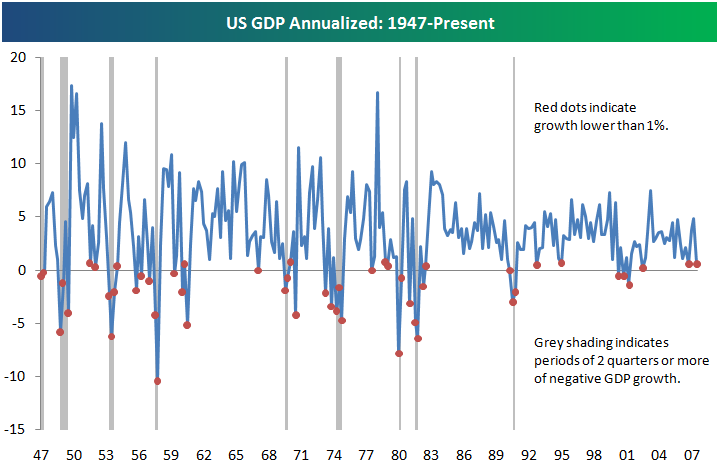
I have to be honest … I get sicker and sicker of “the new normal” each time I hear about it … even though I must admit that upon reflection I did find the recent article from McKinsey Quarterly’s Strategy Practice on “Navigating the New Normal” to be hilarious. For a while I couldn’t put my finger on why I couldn’t stand hearing about “the new normal”, but then it hit me. There’s no such thing as a new normal … just the old normal coming back after an extended 15 year hiatus. After all, if you think back to before 1995 and before the leading edge of the first tech boom, you see a slow, steady growth in the year-over year stock indices going back to 1975*1. And if you look at the annualized GDP data in the same time frame, you see that growth went up and down, usually between -7% and 7%, over time*2, but averaged out to slow, steady growth*3.

Not only does this mean, as the McKinsey Quarterly article pointed out, that (continual) market growth of 5% to 7% is a thing of the past, but that you have to go back to the good old days where your growth is going to be at the expense of your competitor’s loss. That means that you are going to have to buckle down and build better products, create better services, and offer them at a better price point than your competitors. In other words, the days of new markets and free growth are over.

And while I agree with the leading “strategists” that you are going to have to limit growth plans to “growth above market” and adapt to changing conditions on a quarterly basis, I am fed up about this bullshit about having to go to shorter and shorter planning cycles. That’s why the economy is in the gutter. No more long term thinking. No more research labs. No more support for long term research projects in academia (where it’s now “publish another paper, no matter how trivial, tomorrow or perish”). It’s one thing to be on short production cycles … as that lets you adapt to changing market conditions. But it’s another thing to not be planning beyond three years. It’s just crazy. We need to get back to the days where companies not only had five year plans, but ten year plans … and even longer term plans where innovation roadmaps were concerned. Until we do, I don’t see things getting much better. But in the meantime we’ll get lots of five page articles on discussions with “leading” Chief Strategy Officers who, in long winded diatribes, essentially tell us that they don’t know where things are going … which is exactly what you get when you stop planning for the future.

*1 Comparison of the Dow Jones Industrial Average, NASDAQ Composite, and S&P 500 after 1975

*2 Annualized US GDP Growth from 1947-Present

*3 US Gross Domestic Product 1947-Present

Share This on Linked In