It’s a Wild Wild West, and (Gen-) AI won’t tame it!

In this linked post, Jon the Revelator shares his thoughts about “supply chain orchestration”, which is, in his words, the latest incarnation of “agent-based modelling within a dynamic Metaprise” (probably because no one understood what a Metaprise was, no one in their right mind would want to live in a Metaverse, and orchestration just sounds cool). After all, the technical definition of “a synchronized [versus sequential] architecture (private hub) that simultaneously links or incorporates the unique operating attributes of all transactional stakeholders on a real-world, real-time basis” is pretty close to what orchestration does, which today is supposed to link all the systems the organization uses to capture the unique operating attributes of the different transactional stakeholders.

Jon also notes that stakeholder input is required to lay a solid foundation, and that orchestration cannot forget the people aspect, as people are responsible for Procurement. This is where most systems fail today. They don’t focus on usability, stakeholder connectivity, or end user enablement. The process is important, as is automation capability, but it’s not about AI (and definitely not Gen-AI which is just Artificial Idiocy), but Augmented Intelligence where the system automates the tactical and not only allows the user to focus on the strategic, but provides enhanced intelligence to enable strategic analysis. Machines are great at the repeated error-free calculations required for thunking, but they are definitely not great at strategic thinking.

As a result, while software can be a tool to tame the wild west of Procurement, it will only be if it is the right software tool in the hands of an old Pro who knows when to grab the reins and when to grab the Colt 1860. And only an old pro will understand what to look for in a reliable tool, because, unlike the new generations, we don’t fall for “the new hotness”. (Check the comments.)

the doctor dislikes logo maps! So why did he create one?

To demonstrate how, to date, they have all been completely useless, with some to the point of being actually harmful, but now that the gauntlet has been cast, he expects the next version of at least one of these maps to only be mostly useless (and maybe even only moderately useless) and mostly harmless. It’s the same reason he developed the initial versions of Solution Map*, because he found all of the big analyst firm maps mostly useless, and completely useless for tech selection.

(On the tech map front, how can you compare the technical capabilities of a solution where the axis are each on subjective classifications such as “strength and “strategy” or “execution” and “vision”, and, furthermore, where each of these nebulous concepts is made up of half a dozen subjective ratings meshed into one. While not perfect, at least Solution Map gave you an apples-to-apples pure objective technology rating (as each question had a defined rating scale based on technical maturity) against an unbiased pure customer opinion. So you at least knew whether or not

  1. the vendor actually offers a readily available solution of that type
  2. how it compares to the market average of vendors with actual available solutions of that type)

Thus, if you insisted on using logo maps, he at least wanted to make sure there was at least some redeeming qualities.  However, as he has already stated, his map is mostly useless and while a few flaws were corrected on release, some are inherently not addressable.  The problem with these maps in general is that, in addition to all the weaknesses the doctor addressed in his release post, namely:

  • Some vendors/solutions no longer existed as of release date (which was addressed)
  • Many of the categories are meaningless and not actual solution modules (which he corrected, but this means the fit varies across vendors in a category)
  • Vendor logos were not clickable, and not even footnoted when all you got was some strange symbol that looks like it should be carved on a 3000 year old ruin (which is the primary improvement, all logos are clickable and take you to the vendor site as of the release date).

4. They are nowhere near complete.
Most of these maps are in the 100 to 150 logo range. As the doctor has clearly demonstrated that’s only 1/7 to 1/10 of the number of vendors in the core space. Furthermore, even though the doctor does a full database update at least annually, he will guarantee that not even his map is close to complete. While he’d wager he has 90% of the vendors actively selling in North America and Western Europe in the core Source-to-Pay buckets, that percentage goes down as you venture out into the periphery. Plus, in some areas, like ESG/Carbon, he tracks only those focussed on carbon/scope 3 accounting with supplier management / sourcing integration capability, and ignores the remaining ESG/Sustainability/Climate vendors, of which there is likely 10 times as many right now (although we’ll see a lot get swallowed up or die off as the space matures). Most of the supply chain risk vendors are missing unless they offer core supplier management capabilities, or integrate with supplier management modules, as well. And so on.

5. The landscape changes daily.
the doctor did a full database review last year when he did his 39 steps … err … 39 clues … err … 39 part Source-to-Pay+ series, and since then, over half a dozen vendors/offerings are completely gone and over a dozen acquired and swallowed into larger vendors. One, acquired in 2022 that was still offered as a standalone solution late March disappeared by the final link checks that began on April 13. So, while these maps are distributed by their creators for months, and sometimes a year, they are only valid as of the last date where the creator actually re-verified every single vendor.

6. The vendors are only comparable at the baseline, IF they are comparable at all.
If no two (2) vendors are created equal, imagine how different twenty (20) are, or one hundred (100)! If you refer back to our previously referenced 39 part Source-to-Pay+ series,

  • sourcing vendors break down into RFX, Auction, optimization and may/not contain (best-practice) templates or category expertise
  • contract management generally breaks down into negotiation support, (post-signing) lifecycle (execution) management and tracking, and analytics
  • spend analysis is similar, but differs on DIY vs. services led, load/classification support vs. self load/(re)class, out of the box report templates, autonomous analysis and opportunity identification, etc.
  • supplier management was broken down into the 10-segment CORNED QUIP mash, which expressly excluded DEI, because most application thereof is definitely NOT equitable (as the biggest promoters clearly never looked up what the words actually mean in a dictionary)
  • eProcurement, while it revolves around a PO (and, hopefully, a no PO, no pay policy), may or may not have punchout/internal/managed catalog support, may or may not support receiving, may or may not support price tiers and discounts, etc.
  • I2P, while it revolves around the invoice, it may or may not support anything beyond internal PO flip or XML, may or may not support m-way match, may or may not integrate with a payment system, etc.
  • and the same variation exists across every other category

This is assuming that the creator actually understood what every vendor offered and classified according to what the vendor’s product actually did vs. what language the vendor chose to use to describe their product.

7. Even all the vendors with comparable solutions are NOT relevant for you.

When you are considering a vendor, at the very least you have to consider

  • the verticals/industries their solution was designed on, and designed for
  • the organizational size they were developed for

and a host of other considerations based on your industry, your organizational size, and the hole you are trying to fill.

This is why so many Source-to-Pay+ selection projects end up not (fully) delivering and why most big consultancies just keep recommending the same-old same-old five (5) (big) vendors regardless of what your needs are, because they don’t know any different and at least those vendors will be around tomorrow. And this leads into a bigger discussion of why these logo maps, like most analyst maps, are NOT appropriate for transformation projects. Which we’ll take up in our next article / rant.
Secure Download the PDF!  (or, use HTTP) [HTML]
(5.3M; Note that the Free Adobe Reader might choke on it; Preview on Mac or a Pro PDF application on Windows will work just fine)

* and the doctor would like to make it very clear he had NOTHING to do with the current interface and presentation of Solution Map; it’s likely many of the questions are still his, but to be valuable, SolutionMap has to be properly scored and the ratings properly compared and applied relative to a number of factors not explicitly captured in the map

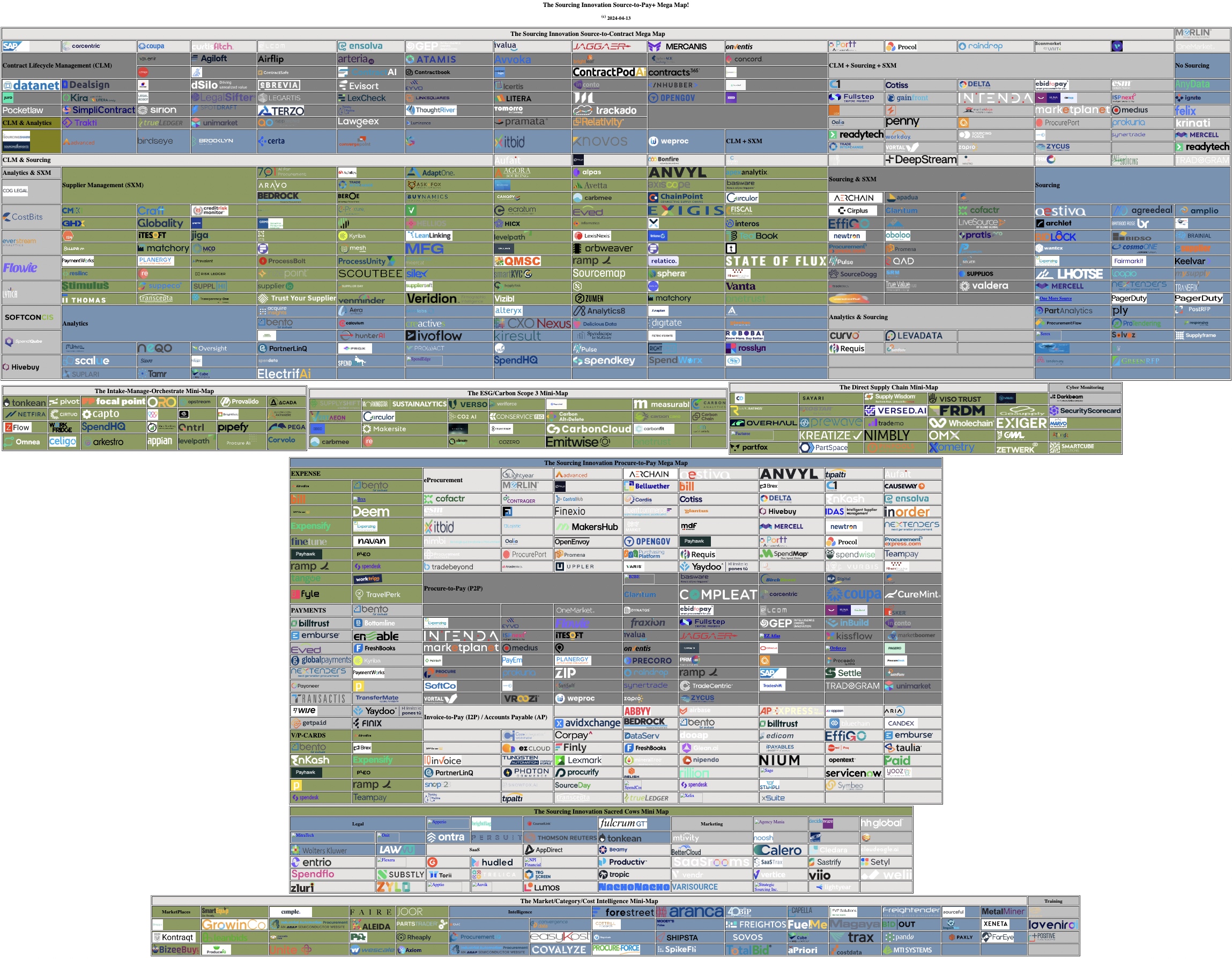
The Sourcing Innovation Source-to-Pay+ Mega Map!

Now slightly less useless than every other logo map that clogs your feeds!

1. Every vendor verified to still be operating as of 4 days ago!
Compare that to the maps that often have vendors / solutions that haven’t been in business / operating as a standalone entity in months on the day of release! (Or “best-of” lists that sometimes have vendors that haven’t existed in 4 years! the doctor has seen both — this year!)

2. Every vendor logo is clickable!
the doctor doesn’t know about you, but he finds it incredibly useless when all you get is a strange symbol with no explanation or a font so small that you would need an electron microscope to read it. So, to fix that, every logo is clickable so you can go to the site and at least figure out who the vendor is.

3. Every vendor is mapped to the closest standard category/categories!
Furthermore, every category has the standard definitions used by Sourcing Innovation and Spend Matters!
the doctor can’t make sense of random categories like “specialists” or “collaborative” or “innovative“, despises when maps follow this new age analyst/consultancy award trend and give you labels you just can’t use, and gets red in the face when two very distinct categories (like e-Sourcing and Marketplaces or Expenses and AP are merged into one). Now, the doctor will also readily admit that this means that not all vendors in a category are necessarily comparable on an apples-to-apples basis, but that was never the case anyway as most solutions in a category break down into subcategories and, for example, in Supplier Management (SXM) alone, you have a CORNED QUIP mash of solutions that could be focused on just a small subset of the (at least) ten different (primary) capabilities. (See the link on the sidebar that takes you to a post that indexes 90+ Supplier Management vendors across 10 key capabilities.)

Secure Download the PDF!  (or, use HTTP) [HTML]
(5.3M; Note that the Free Adobe Reader might choke on it; Preview on Mac or a Pro PDF application on Windows will work just fine)

You Need a Plan to Mitigate Supply Chain Risks. But You Also Need a Platform.

A recent article over on Supply & Demand Chain Executive on Navigating a Supply Chain Management Toolkit noted that with a plan in place, organizations can quickly respond to any changes and help mitigate any supply chain risks.

Which is true, but how much of the risk they can mitigate is the question.

The article, which is very good and definitely worth reading (so check out the link), noted that problems arose as a result of COVID and disruptions since because many organizations use just-in-time inventory management (which we’ve already noted should have ended by now along with seasonality). The article also noted that the problems were often exacerbated by the fact that order processes were often not documented effectively and, in general, most organizations don’t spend the time and resources to really manage their supply chain. All of this is correct, as is the observation that these challenges can be alleviated with wholly embracing the tried-and-true methods for effective supply chain management because effective processes, measurements and accountability are … key to a supply chain that works for an organization.

But, on their own, not the key. Today, you also need a platform that enables the organization to:

  • quickly detect a risk event has occurred
  • quickly analyze the impact
  • quickly initiate any pre-defined mitigation plan
  • quickly implement new decisions and processes where the mitigation plan isn’t sufficient and doesn’t exist
  • monitor the impact of the risk event and the response in near real time

Otherwise, your process could be too slow, your measurements inaccessible and/or unrecorded, and your accountability (under audit) non existent.

For example, the article indicates you should start by getting a better grip on inventory management (which is correct, no product, no business for most companies), and that involves a self-assessment, forecast accuracy review, and inventory segmentation. All correct. But that doesn’t help you when all of a sudden there’s a fire in the factory, a strike at the port, or a strait/border closing. What do you do then?

It also tells you that you should focus on better supplier relations, which is also extremely important, and focus on vetting suppliers before you onboard them and then measuring them and computing the total cost of ownership of keeping them, which is also very important as suppliers should improve over time and costs should not inch up faster than inflation. It also mentions the importance of proper strategic sourcing (matrices) to get the right products from the right suppliers. Another definite. But fails to tell you what you do when all of a sudden a key supplier can’t deliver or becomes unavailable.

The answer here is you use all of your good relationships and data to immediately identify the next best supplier. If you were splitting award, you try to shift to the other supplier (if they can handle the volume — if you were doing an 80/20 split and the 80% supplier suddenly became unavailable indefinitely, the 20% might not be able to support you, or at least not for very long, and you will have to add a new supplier to the mix. If you were doing proper sourcing, and proper supplier vetting before including them in an event, then you already have potential suppliers — the runners up from your last event. A good platform will let you immediately identify them and immediately start another sourcing event to onboard a new supplier as fast as possible.

If you have a good logistics (sourcing) platform, and your primary carrier / route becomes unavailable, you may be able to identify another carrier / route that will get you the products on time, or at least be able to accelerate an order from a secondary source of supply while you wait for the first source through a lengthier route.

The point is, while you need great processes, measurements (to indicate if something is taking too long, such as an order acknowledgement or a delivery, which can be a sign of a potential risk event materializing), and accountability (to show you made efforts to detect and mitigate risks in a reasonable time frame), you can’t measure, execute processes, or provide unquestionable audit trails of accountability without a proper platform. Never forget that. (And for help, you can see our Source-to-Pay series which helps you to identify where to start with your acquisitions and what vendors you might need to look at.)

And again, remember to read the article on Navigating a Supply Chain Management Toolkit as it will help you understand the basic processes you need to put in place.

4 Smart Technologies Modernizing Sourcing Strategy — Not Just Doctor Approved!

IBM recently published a great article on 4 smart technologies modernizing sourcing strategies that was great for two reasons. One, they are all technologies that will greatly improve your sourcing. We’ll explain why.

Automation

Business Process Automation (BPA, or RPA — Robotic Process Automation) can optimize sourcing workflows as well as procurement workflows. With good categorization, demand forecasting, inventory management, price intelligence, templates, strategies, situational analysis (that qualitatively and quantitatively define when a strategy should be applied), and workflow, you can automate sourcing just as much as you can automate Procurement. You can eliminate all of the tactical and focus solely on the strategic analysis and decision making.

Blockchain

If you need to record information in a manner that can be publicly accessed and verified, such as to ensure that records for traceability can be independently verified, or to publicly record ownership, blockchain is a great technology as its ultra secure. In Sourcing and Procurement, it can be used to track orders, payments, accounts, and more across global supply chains and multiple private and public parties.

Analytics

In addition to providing an organization with deep insights into their spend and (process level) performance, analytics engines and their “big data brains” provide real-time sourcing flexibility and visibility to enhance order management, inventory management, and logistics management. With proper intelligence, sourcing teams can understand and act on changes in the increasingly complex supply chain — as they happen.

AI

When deep data and analytics are paired with AI, the deep insights can improve forecasts, help identify risk, and provide suggestions for management.

And this brings us to the next great aspect of the article. Not once did it mention Gen-AI. Not once. As the doctor has been stating over and over, the classic analytics, optimization and machine learning you have been ignoring for almost two decades will do wonders for your supply chain. (Blockchain is not always necessary, but will help in the right situation.)