
Category Archives: Sustainability

Myth-busting 2025 2015 Procurement Predictions and Trends! Part 5

Introduction

In our first instalment, we noted that the ambitious started pumping out 2025 prediction and trend articles in late November / early December, wanting to be ahead of the pack, even though there is rarely much value in these articles. First of all, and we say this with 25 years of experience in this space, the more they proclaim things will change … Secondly, the predictions all revolve around the same topics we’ve been talking about for almost two decades. In fact, if you dug up a Procurement predictions article for 2015, there’s a good chance 9 of the top 10 topic areas would be the same. (And see the links in our first article for two “future” series with about 3 dozen trends that are more or less as relevant now as they were then.)

In our last instalment, we continued our review of the 10 core predictions (and variants) that came out of our initial review of 71 “predictions” and “trends” across the first eight articles we found, in an effort to demonstrate that most of these aren’t ground-shattering, new, or, if they actually are, not going to happen because the more they proclaim things will change …

In this instalment, we’re again continuing to work our way up the list from the bottom to the top and continuing with “sustainability”.

Sustainability

There were 10 predictions across the eight articles which basically revolved around “ESG” with some sideline focus on the need for “collaboration” and “balance (against profit)”. This is yet another topic that is overhyped and needs to be addressed, but, as with our last two articles, we will start by listing all of the individual predictions:

  • ESG Metrics will Increase In Importance for Procurement
  • Focus on ESG Factors
  • Increased Focus on Sustainability
  • Increased Focus on Sustainability
  • Struggle to Balance ESG Goals with Profit
  • Supplier Collaboration will become Key for Achieving Sustainable Procurement
  • Sustainability and ESG
  • Sustainability and ESG Compliance
  • Sustainability and Ethical Sourcing
  • Sustainable Procurement Practices

Has there been a year where sustainability hasn’t made the list? SI remembers running a cross-blog series on sustainability 17 years ago back in 2008! And there was just as much hullaballoo then as there is now. Nothing has changed, and as long as the first world doesn’t agree on the importance of sustainability and ESG goals (with Europe taking one stance and the USA about to take another), nothing ever will.

Sustainability is as important as ever, considering that

  • some critical raw materials, such as rare earths, are getting scarcer by the day
  • it’s getting hotter and hotter every year, with 2024 another record year for the books
  • with natural disasters increasing year-over-year, crop destruction and food shortages are becoming more common
  • not being sustainable is about to be costly in Europe, which will levy massive fines to try and prop up their struggling economy
  • being sustainable is about to become costly in the USA as the incoming administration abandons all sustainability regulations, while implementing tariffs that are going to drive up costs more than sustainability ever will
  • the last two will be at odds, so organizations will be pursuing different, localized strategies

However, it is not new, just front-and-center as it is every year. The primary reasons may change year-to-year, but the cycle stays the same. Sustainability remains on the important items list, with the importance ultimately dictated by the regulations in place.

What Should Happen? (But Won’t!)

Organizations should stop looking at sustainability as a cost to be addressed only to the event necessary, but as a strategic business advantage. This is because:

  • sustainable organizations minimize energy use …
    and with energy costs rising every year, investments in energy efficiency will pay multiples in the long run
  • sustainable organizations maximize use of renewables …
    and minimize dependence on materials in limited, dwindling, supply (which only get more expensive every year)
  • sustainable organizations optimize processes to minimize waste …
    which maximizes the value of every dollar spent
  • etc.

Sustainability isn’t just keeping the carbon and GHGs down, its optimizing operations to reduce costs (and carbon) in the long run. But as long as it’s seen as a cost, organizations will never achieve value from sustainability, which only exists in the supply chain.

That’s four down. Six to go.
Supply Disruption Has Been The Top Procurement Risk For At Least the Past 15 Years

… and it’s too bad it took the worst global pandemic in 100 years, two wars, exacerbated natural disasters (including one of the worst global wildfire years on record), and Panamanian droughts for Procurement leaders to realize this. (Basically, the fact that a Gartner survey finally confirmed this should not come as a shock!)

When you go back to basics (i.e. the business 101 that it seems most business leaders have been skipping for the last couple of decades), there are two truths that all businesses are subject to:

  1. Profit = Revenue – Expenses, which makes the CRO and the CPO the two most important people in the business, and if market conditions prevent revenue from increasing, the CPO becomes the most important
  2. Business that sell product need to make or acquire product to sell. This requires supply and people.

This says that, when you abstract it high enough, your two three primary risks are:

  • supply (no supply, no product; no product, no sales; no sales, no capital)
  • talent (the skilled resources to acquire/make the product economically and run the company)
  • capital (you need money for supply, talent, and operations)

And when you dive in, you see that supply disruption is far and above any other risk because:

  • today’s supply chains are global and require multiple forms of limited transportation
  • with thousands of suppliers in dozens of countries and regions (across 4, 5, and sometimes even more tiers)
  • which are all exposed to the economic, environmental, geopolitical, and societal risks in the locales in which they operate
  • which means you are exposed to all of the economic, environmental, geopolitical, and societal risks in which they operate!

Thus, if your extended supply chain spans 30 or 40 countries, then you are exposed to every risk of those 30 or 40 countries at all times!

Given the drastic increase in multiple

  • economic,
  • geopolitical,
  • societal, and
  • environmental

risks over the past two decades, as well as the increase in cyberattacks, which makes the weakest unknown supplier in your supply chain your weakest link (if a hack into their system provides a backdoor into their buyer one tier up the chain, which then provides a backdoor into their buyer one tier up, until the hackers trace their way back to you through a chain of back doors).

Given that, right now, multiple risks in multiple risk categories are materializing every day on this planet, at a rate that exacerbates annually, we are at the point where no company is going to even go a year without a risk event impacting their supply. (This doesn’t mean they won’t get it, just that it will be late or cost more, and either could cause substantial loss.)

So if you’re not sourcing and procuring with mitigation strategies in mind at all time, start now. Multi-tier visibility is no longer enough. Advance warning is no longer enough if you are not ready to act with another option.

There are Many Key Elements of Sustainable Procurement Strategy — But Three Fundamental Elements that Must Be Present

A recent article over on Material Handling & Logistics on Key Elements of Sustainable Procurement Strategy outlined for key strategies for sustainable procurement that were on point:

  • A Holistic Approach
  • Data Integration
  • Pay it Forward
  • Stakeholder Engagement

But meaningless if you don’t have the basics in place:

  • trained talent
  • well defined processes
  • solution-oriented systems

Trained Talent

All of the above, and all of the other key elements of a strategic procurement strategy not listed, require talent to execute. Talent that is appropriately educated, experienced, and trained on all of the key elements appropriate to your organization. With respect to the above:

  • talent needs to define the right holistic approach
  • talent needs to identify the critical data, formats, and integration strategy — and make sure it is done effectively
  • only talent can handle delicate supplier relationships to make sure it is truly paid forward
  • shareholders need to be engaged effectively, and that requires real talent

Well Defined Processes

Statements, directions, and mandates don’t accomplish anything. Neither do people without an appropriately designed and detailed plan — which goes well beyond we’re going to engage supplier S or buy product P. Procurement success rates are high when there are well thought out and appropriately defined processes that can be followed by all those involved in a project or process, and generally low otherwise. Moreover, without well defined processes:

  • there is no holistic approach, it’s just a buzz phrase
  • data integration is just a one time pull into a system or push into a warehouse, and it gets outdated faster than fashion on Melmac
  • it takes more than smooth talk to pay it forward, it takes processes that ensure knowledge is transferred to, effort is minimized for, and real collaboration takes place with suppliers — it takes processes to make sure nothing critical is overlooked that could hamper the organization’s goals
  • while talent is the most critical to stakeholder engagement, good processes are critical to ensuring requirements and data is efficiently collected and retained (as a stakeholder should never have to make the same request or provide the same input twice) and no concern is overlooked

Solution Oriented Platforms

Sustainable Procurement ultimately relies on appropriately trained talent executing well designed processes with the help of platforms that help them do the jobs they need to do on a daily basis. Platforms that automate the tasks and solve the problems the organization has, not platforms that do nothing but act as fancy middleware or slap roll-the-bones AI-assisted conversational interfaces on top of software that never worked in the first place. Sustainable Procurement requires that the procurement department be able to get stuff done. That will rarely be AI, or spend orchestration, or the buzzword of the day.

  • orchestration may sound like it supports a holistic approach, but all those systems do is tie systems together that actually do the work through a common interface, which, in its attempt to homogenize everything, often weakens the solutions for the individuals that need to use them the most; a holistic approach is about getting things done with systems that get things done
  • you can’t integrate data without the right platforms that collect, process, and normalize the right data the right way
  • it’s a lot easier to pay it forward when you have the right platforms that support the processes and the people who need to pay it forward
  • it’s easier to manage stakeholder engagement on systems designed to support the stakeholders in question, in contrast to one-size-fits-all (but serves no one) “orchestration” systems

In other words, if you truly want sustainable procurement, start with making sure the foundations are in order. The rest will follow in a straight-forward manner once you have the basics right.

How Do You Say Bye-Bye to DEI Without Customers and Suppliers Going Bye-Bye

DEI is going a lot of blowback. Much of it deservedly so since

  • many initiatives are led by people, who’ve never read a dictionary, that confused “opportunity” with “outcome” (and they’re not the same thing at all),
  • many initiatives are led by people who are misusing DEI to discriminate against unrecognized groups (specifically, religious minorities, white candidates, etc.), and
  • it was so bad in some jurisdictions that it is triggering legal responses (not just board and investor responses).

But ripping it out without a plan or even a thought about the blowback is not a good idea.

First of all,

  • a properly defined initiative is NOT illegal, or even immoral,
  • not all are being used to illegally discriminate against religious minorities or non-minorities, and
  • education can help ensure that a well-defined program is tweaked to be perfectly in alignment with federal and state laws with respect to equal opportunity.

Secondly, just because you’re doing it wrong, doesn’t mean everyone is. As pointed out in this recent opinion article on Supply Chain Dive on how Harley-Davidson’s DEI rollback is a procurement mistake, Harley Davidson’s removal of their support for supplier diversity could be seen as going too far.

And it could be. Ripping out or killing a program that doesn’t work, and then publicly stating that you’re instead going to focus on complying with all state and federal equal opportunity legislation, especially if that’s what customers want is definitely a good thing. (If you’re not convinced, read Jason Busch’s article on why Harley Davidson Dumping Supplier Diversity is more-or-less a good thing.

But you want supplier diversity to the extent there are diverse suppliers that can support your business. It may be your right to buy from who you want, when you want, where you want, and how you want, but if it upsets your supplier base, that’s a problem. Especially if your best suppliers walk away, or, even worse, walk away and sue you. Just like you need happy customers, you need happy suppliers. Plus, a good policy encourages diversity, it doesn’t mandate it when one supplier is inferior to another.

Moreover, even if the DEI program is not working, killing it too fast can also result in customer blowback who might think that you are not about equal opportunity and diversity. It’s a tricky situation, and any action needs to be well thought out, including any potential blowback and how you respond to it in a matter that dispels it before it snowballs.

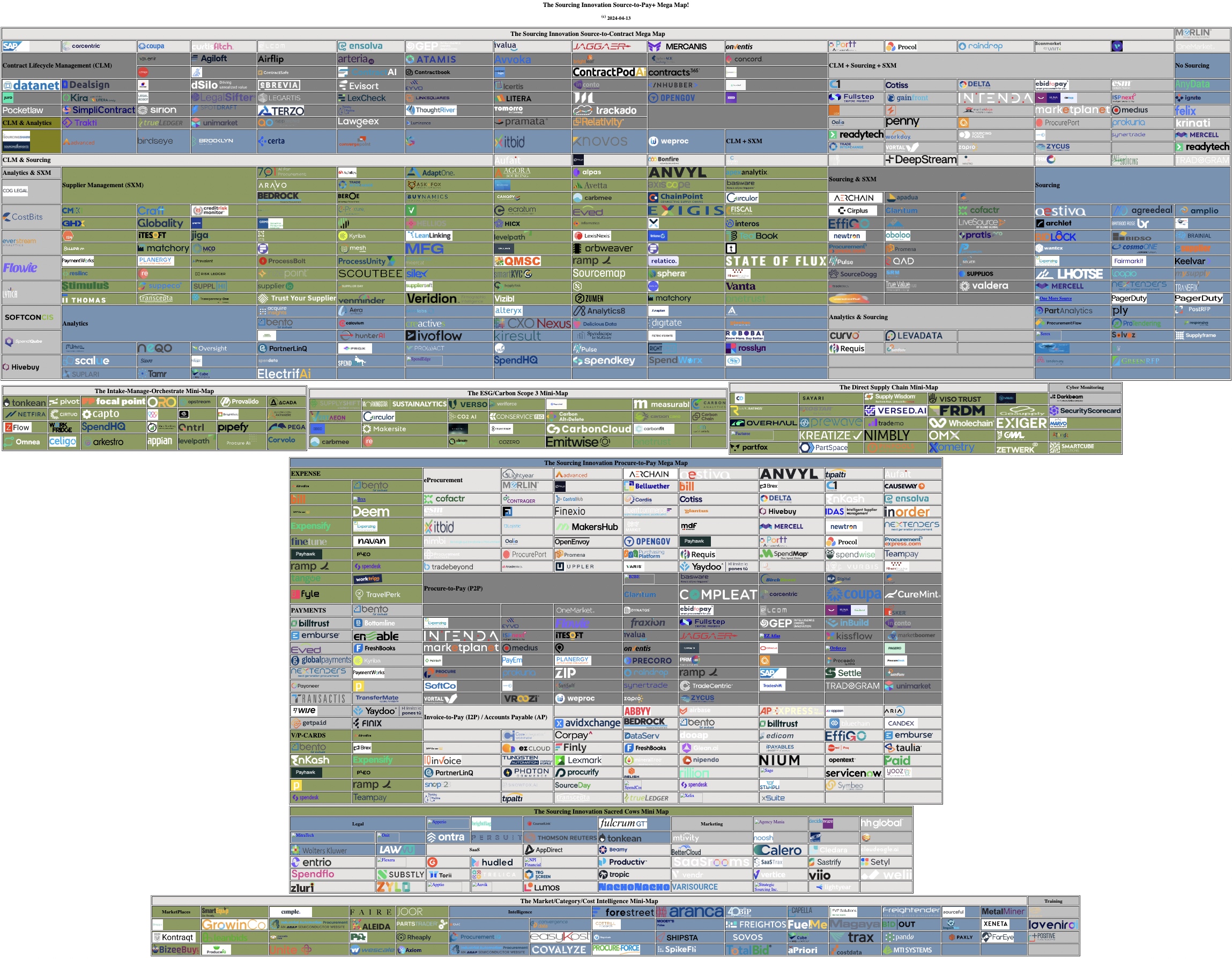
The Sourcing Innovation Source-to-Pay+ Mega Map!

Now slightly less useless than every other logo map that clogs your feeds!

1. Every vendor verified to still be operating as of 4 days ago!
Compare that to the maps that often have vendors / solutions that haven’t been in business / operating as a standalone entity in months on the day of release! (Or “best-of” lists that sometimes have vendors that haven’t existed in 4 years! the doctor has seen both — this year!)

2. Every vendor logo is clickable!
the doctor doesn’t know about you, but he finds it incredibly useless when all you get is a strange symbol with no explanation or a font so small that you would need an electron microscope to read it. So, to fix that, every logo is clickable so you can go to the site and at least figure out who the vendor is.

3. Every vendor is mapped to the closest standard category/categories!
Furthermore, every category has the standard definitions used by Sourcing Innovation and Spend Matters!
the doctor can’t make sense of random categories like “specialists” or “collaborative” or “innovative“, despises when maps follow this new age analyst/consultancy award trend and give you labels you just can’t use, and gets red in the face when two very distinct categories (like e-Sourcing and Marketplaces or Expenses and AP are merged into one). Now, the doctor will also readily admit that this means that not all vendors in a category are necessarily comparable on an apples-to-apples basis, but that was never the case anyway as most solutions in a category break down into subcategories and, for example, in Supplier Management (SXM) alone, you have a CORNED QUIP mash of solutions that could be focused on just a small subset of the (at least) ten different (primary) capabilities. (See the link on the sidebar that takes you to a post that indexes 90+ Supplier Management vendors across 10 key capabilities.)

Secure Download the PDF!  (or, use HTTP) [HTML]
(5.3M; Note that the Free Adobe Reader might choke on it; Preview on Mac or a Pro PDF application on Windows will work just fine)