Category Archives: contract management

Stop Wasting Your Time With Contract Management

The Mandarin (Yes, The Mandarin) recently posted a great article on why you should stop wasting your time with contract management

As the author clearly states, every department, state and federal, in which I have worked has a set of policies and directives on contracting and contract management. Almost every contract has a contract management plan. Yet we continue to get it badly wrong.

He quotes a recent review of Home Affairs which got a shellacking about their utter inability to reasonably prepare for the end of a contract (as well as other Procurement issues). It’s as he says, when it comes to preparation for contract termination, which should be part of a well formed contract management plan, it’s almost always “too little, too late”.

Contract Management isn’t working, and more importantly, neither are contract management platforms. (Making a colleague of mine who poo-poo’d them almost two decades ago as not worth your time, because they didn’t do any more than what a high schooler could do with some scripting and an access database, a visionary genius.)

So why do we get it so wrong? The author starts off by saying we think about contracts the wrong way, which we do (and there’ll be more on that later), especially since many approach it as a matter of performance and punishment since the contractor or vendor just needs to do what they promised and whatever performance or punishment framework included in the contract will encourage the contractor or vendor to deliver on time.

And, at the end of the day, most organizations just see it as a reporting and control framework, driven by compliance. When, as the author points out, it is supposed to be about outcomes, and, even more importantly, as the author points out, it should be a tool for managing the value chain.

The author then recommends that you fix things by:

  • owning the business outcomes
  • understanding and measuring mutual obligations
  • measuring, reporting, and managing the entire business, not just the odd contract
  • making what’s required visible and clear
  • not treating relationship management and contracting as mutually exclusive
  • using performance measures you understand

Which is all good advice, but not going to fix the fundamental problems. The fundamental problem is that it’s not contract management, it’s project fulfillment (even if you are just buying stuff).

This means that before you can do a contract you have to:

  • first develop a detailed project plan including requirements, desired outcomes, and timelines
  • identify what sub-plan you want to farm out to one (or more) vendor(s, but that requires a lot more planning and possibly subcontracting)
  • create the contract schedule with this plan as well as milestones, reporting requirements, and mutual obligations
  • decide what performance incentives or penalties you want to include to speed up performance and/or prevent late deliveries/completion
  • decide what matters (most) to you and what you are going to require around vendor geography, personnel, sustainability, etc. requirements
  • evaluate the risk and define appropriate mitigation (out) clauses
  • hand it off to legal to complete the Ts & Cs
  • then do a Procurement event
  • then complete it in negotiation, pushing the plan into your project management system once counter-signed

It’s project and relationship management at the end of the day, the rest is just document management, making CMS something that you can do with a high school student and an Access database, since its not where the contract is or how its indexed, but how it’s accessed and used on a daily basis, which should be through the project management system.

And that’s why Project Assurance is so critically important.

Don’t know what that is? Read my original and current series on Project Assurance:

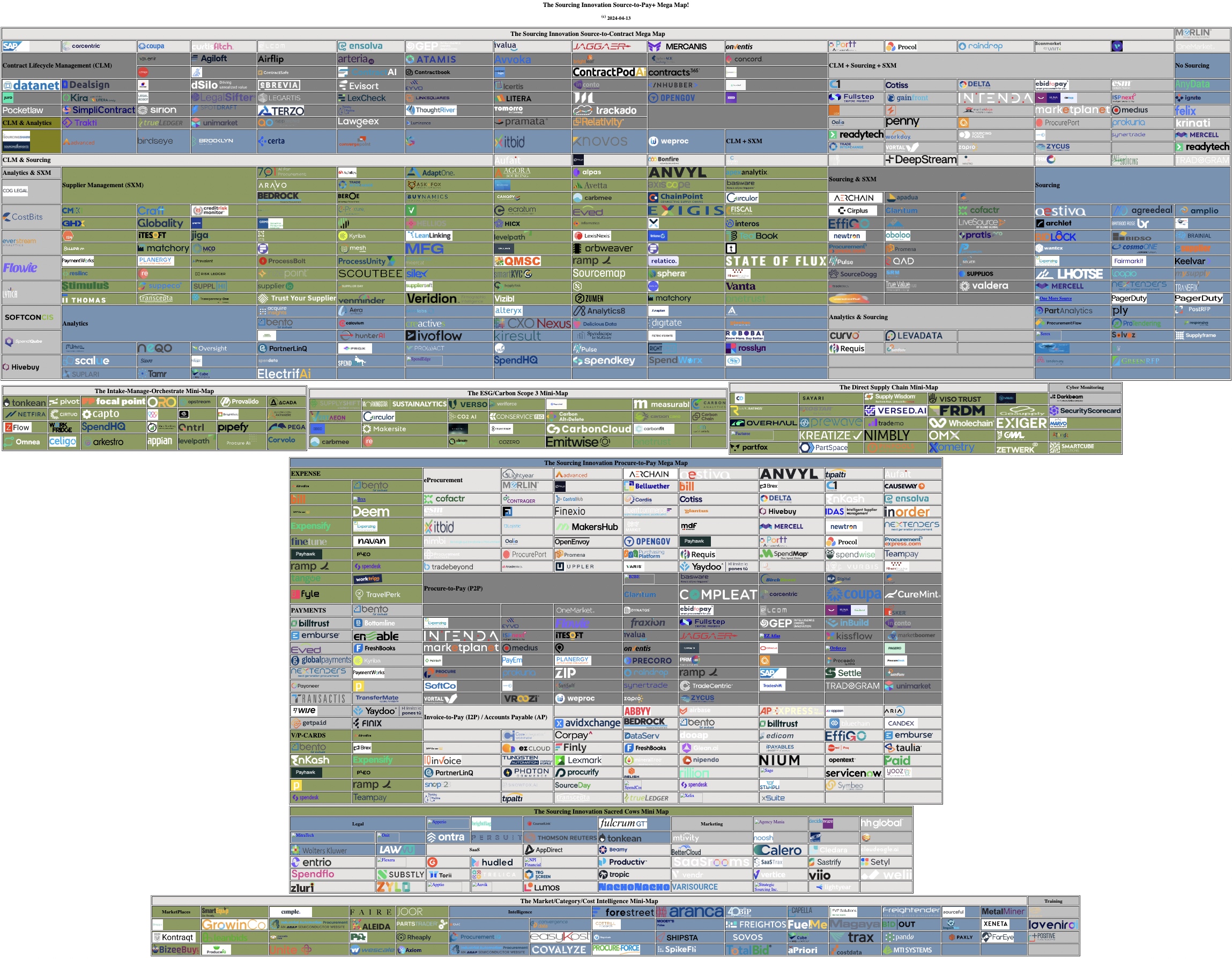
The Sourcing Innovation Source-to-Pay+ Mega Map!

Now slightly less useless than every other logo map that clogs your feeds!

1. Every vendor verified to still be operating as of 4 days ago!
Compare that to the maps that often have vendors / solutions that haven’t been in business / operating as a standalone entity in months on the day of release! (Or “best-of” lists that sometimes have vendors that haven’t existed in 4 years! the doctor has seen both — this year!)

2. Every vendor logo is clickable!
the doctor doesn’t know about you, but he finds it incredibly useless when all you get is a strange symbol with no explanation or a font so small that you would need an electron microscope to read it. So, to fix that, every logo is clickable so you can go to the site and at least figure out who the vendor is.

3. Every vendor is mapped to the closest standard category/categories!
Furthermore, every category has the standard definitions used by Sourcing Innovation and Spend Matters!
the doctor can’t make sense of random categories like “specialists” or “collaborative” or “innovative“, despises when maps follow this new age analyst/consultancy award trend and give you labels you just can’t use, and gets red in the face when two very distinct categories (like e-Sourcing and Marketplaces or Expenses and AP are merged into one). Now, the doctor will also readily admit that this means that not all vendors in a category are necessarily comparable on an apples-to-apples basis, but that was never the case anyway as most solutions in a category break down into subcategories and, for example, in Supplier Management (SXM) alone, you have a CORNED QUIP mash of solutions that could be focused on just a small subset of the (at least) ten different (primary) capabilities. (See the link on the sidebar that takes you to a post that indexes 90+ Supplier Management vendors across 10 key capabilities.)

Secure Download the PDF!  (or, use HTTP) [HTML]
(5.3M; Note that the Free Adobe Reader might choke on it; Preview on Mac or a Pro PDF application on Windows will work just fine)

Three Critical Elements of a Good Procurement Contract

We’ve been seeing quite a few articles lately popping up randomly on LinkedIn, Procurement searches, newsletters, etc. around Procurement Contracting, and, as you’ve probably guessed, we’ve noticed that most of them aren’t great. Not to say they’re bad, they’re not, but usually they’re finely focussed on core clauses that should be in there to keep the lawyers happy, using standard templates for consistency, making sure you have Force Majeure or appropriate risk management clauses (which are important, but miss the point), or on particular specifications or appendices you need for services contracts, etc. Few are good across the board, and most miss the key points.

So, today, we’re going to overview key elements of a good procurement contract, be it for goods or services, that all buyers should be aware of. This is not intended to be a complete list, as every category is different, every company is different, and every scenario is different and no single generic checklist will cover everything that is needed, but one can distill a list of common requirements that will always be required regardless of the category, geography, company, or situation at hand. Logically speaking, these requirements will always be necessary, but may not always be sufficient.

1) As Dick Locke will tell you over and over again, if you want them to be good, then all of your contracts should be written in Plain English, not convoluted legalese, and should be comprehensible by someone with a high school education. Not all buyers will have a University education, or even a College education, and even if they do, it may not have been in English and/or English may not be their first language.

2) A good contract answers the 6Ws: who, what, when, where, why, and how.

a) what are the goods and services the organization is contracting for

b) who is the intended recipient of the goods or services (not just the company) who will be using the goods or services and signing off that they are fit for use

c) where are they needed (plant, warehouse, office, etc.) as this determines where they need to be delivered

d) why are they being used over another good or service, as this determines key features or functions or specifications that the organization needs to ensure are maintained

e) when are they needed, as this specifies delivery schedules that need to be met

f) how are the goods or services going to be used as this dictates what specifications must be met or certifications that must be possessed (and explicitly referenced in the contract)

3) A good contract addresses the actionable risk mitigations that are to be adhered to by both parties to minimize the chances of a risk event significantly impacting or disrupting the business, even if it’s just timely notifications of an event happening or not happening.

Shift happens, and then sh!t happens. It’s reality. Blaming someone doesn’t fix it. Nor does having an out when the supplier doesn’t deliver on time, because chances are, you still need the goods or services, by a certain time, or your business is going to end up in the sh!tter when you can’t deliver to your customers because you won’t get paid (best case), and might get sued (worst case). And even including a legal clause on damages that allows damages to be passed through is rather useless, because, chances are, your supplier is living order to order and couldn’t afford to pay your legal fees and/or any judgement against you, which still leaves you on the hook.

Furthermore, any Force Majeure that you include in your customer contracts won’t protect you if you didn’t make all reasonable efforts and/or only you were affected while your competitors served their customers with similar products and services just fine without interruption.

You need to understand not only what can go wrong, and if there’s anything the supplier can do to prevent it or deal with it when it does, but also how long it will take you to find another source of supply if the supplier can’t deliver and make sure you have enough notice to do so if that is the only option available to you.

For example, if you need a custom manufactured product where it takes a new supplier ten weeks to upgrade a production line because it takes six to eight weeks to get the equipment, install it, and then test it; and it would take you two weeks to go to the next best supplier, get a contract, and get started, then you need three months lead time if your current supplier can’t deliver. In this situation, you need your supplier to let you know of any potential delays as soon as they get foreknowledge, and then let you know as soon as they won’t be able to manufacturer. This means that you might need to specify in the contract that, as soon as one of the supplier’s key tier suppliers is a week late on notifying the supplier of a shipment, they notify you that they may not be receiving a critical part or raw material on time and may not be starting your production on time. This allows you to determine whether or not this could be a risky situation and whether or not you want follow up.

You’d also want a notification if production didn’t start within a certain period of time from the expected production date, as that will dictate a late shipment. And so on.

Same for services. If you need a consultant or contractor with a certain industry certification, and the supplier only has three, and all three on tied up on a contract where it is determined they won’t be finished by the due date and cannot be redeployed on the date they were initially promised to you, you want to know the day the service provider knows they will not be able to allocate those contractors or consultants to you, especially if you can’t wait to start your project. Then you can figure out how many resources you really need to start, and use the risk mitigation clauses to go find someone else from another provider.

Again, this is not everything a contract needs, but requirements that must be met by every contract.

The 39 Steps … err … The 39 Clues … err … The 39 Part Series to Help You Figure Out Where to Start with Source-to-Pay

Figuring out where to start is not easy, and often never where the majority of vendors or consultants say you should start. They’ll have great reasons for their recommendations, which will typically be true, but they will be the subset of reasons that most benefits them (as it will sell their solution), and not necessarily the subset of reasons that most benefits you now. While you will likely need every module there is in the long run, you can often only start with one or two, and you need to focus on what’s the greatest ROI now to prove the investment and help you acquire funds to get more capability later, when you are ready for it. But figuring out how much you can handle, what the greatest needs are, and the necessary starting points aren’t easy, and that’s why SI dove into this topic, with arguments and explanations and module overviews, both broader and deeper than any analyst firm or blogger has done before. Enjoy!

Introductory Posts:
Part 1: Where Do You Start?
Part 2: Where Should You Start?
Part 3: You Start with …
Part 4: e-Procurement, and Here’s Why.

e-Procurement
Part 5: Defining an e-Procurement Baseline
Part 6: There are Barriers to Selecting an e-Procurement Solution (and they are not what you think)
Part 7: Over 70 e-Procurement Companies to Check Out

Interlude 1
Part 8: What Comes Next?

Spend Analysis
Part 9: Time for Spend Analysis
Part 10: What Do You Need for A Spend Analysis Baseline, I
Part 11: What Do You Need for A Spend Analysis Baseline, II
Part 12: Over 40 Spend Analysis Vendors to Check Out

Interlude 2
Part 13: But I Can’t Touch the Sacred Cows!
(including Over 20 SaaS, 10 Legal, and 5 Marketing Spend Management / Analysis Companies to Check Out)
Part 14: Do Not Stop At Spend Analysis!

Supplier Management
Part 15: Supplier Management is a CORNED QUIP Mash
Part 16: Supplier Management A-Side
Part 17: Supplier Management B-Side
Part 18: Supplier Management C-Side
Part 19: Supplier Management D-Side
Part 20: Over 90 Supplier Management Companies to Check Out

Contract Management
Part 21: Time for Contract Management
Part 22: Contract Management is a NAG: Let’s Start with Negotiation
Part 23: Contract Management is a NAG: Let’s Continue with [Contract]Analytics
Part 24: Contract Management is a NAG: Let’s End with [Contract] Governance
Part 25: Over 80 Contract Management Vendors to Check Out

e-Sourcing
Part 26: Time for e-Sourcing
Part 27: Breaking Down the ORA of Sourcing Starting With RFX
Part 28: Breaking Down the ORA of Sourcing Continuing with e-Auctions
Part 29: Breaking Down the ORA of Sourcing Ending with [Strategic Sourcing Decision] Optimization
Part 30: Over 75 e-Sourcing Vendors to Check Out!

Invoice-to-Pay (I2P):
Part 31: Time for Invoice-to-Pay
Part 32: Breaking Down the Invoice-to-Pay Core
Part 33: Over 75 Invoice-to-Pay Companies to Check Out

Orchestration:
Part 34: How Do I Orchestrate Everything?
Part 35: Do I Intake, Manage, or Orchestrate?
Part 36: Over 20 Intake, [Procurement] [Project] Management, and/or Orchestration Companies to Check Out
Part 37: Investigating Intake By Diving In to the Details
Part 38: Prettying Up the Project with Procurement Project Management
Part 39: Deobfuscating the Orchestration and Fitting it All Together

Source-to-Pay+ is Extensive (P25) … And Contract Management Very Extensive … So Here Are 80 Contract Management Companies to Check Out!

And now the post you’ve all been waiting for! A partial, starting, list of 80 contract management companies that may (or may not) meet some, or many, of the core baseline capabilities we outlined in the last three parts of this series (Part 22, Part 23, and Part 24) as we discussed the Negotiation, Analysis, and Governance sides of Contract Management today. (For those of you who skipped these posts, please note that we define a Contract Analysis solution as one which supports the syntactic, semantic and numeric [spend] analysis of the contracts and that we do NOT include a vendor that focusses [just] on numeric [spend] analysis of the contracts.)

As with our lists of e-Procurement Companies (in Part 7), Spend Analysis Companies (in Part 12), Sacred Cow Companies that do, or support, customized “spend” analysis on Marketing, Legal, and SaaS (in Part 13), and Supplier Management Companies (in Part 20), we must again give our disclaimer that this list is in no-way complete (as no analyst is aware of every company), is only valid as of the date of posting (as companies sometimes go out of business and acquisitions happen all of the time in our space), and does NOT include any document management companies (that could store contracts) in our expository on how Contract Management can be a NAG.

Furthermore, as we’ve said before, not all vendors are equal, and we’d venture to say NONE of the following are equal. The companies below are of all sizes (very small to very large, relative to vendor sizes in our space), cover the baseline differently (in terms of percentage of features offered, the various degrees of depth in the feature implementations, and differing levels of customization for a vertical), offer different additional features, have different types of service offerings (backed up by different expertise), focus on different company sizes, and focus on different technology ecosystems (such as plugging into other platforms/ecosystems, serving as the core platform for certain functions or data, offering a plug-and-play module for a larger ecosystem, focussing on the dominant technology ecosystem(s) in one or more verticals), etc.

Do your research, and reach out to an expert for help if you need it in compiling a starting short list of relevant, comparable, vendors for your organization and its specific needs. For many of these vendors, good starting points might be found in the Sourcing Innovation archives, Spend Matters Pro, and Gartner Cool Vendor write-ups if any of these sources has a write-up on the vendor.

Finally, a second reminder that inclusion on this list DOES NOT imply Sourcing Innovation is recommending the vendor.

Company LinkedIn
Employees
HQ (State)
Country
Negotiation Analytics Governance
Aavenir 69 Plano, Texas N G
Advanced 2680 United Kingdom G
Agiloft 259 California, USA A G
AnyData Solutions 10 United Kingdom A G
Atamis 40 United Kingdom G
Aufait 114 India G
Bonfire 87 Ontario, Canada G
BrightLeaf 65 Massachusetts, USA A
Brooklyn Solutions 23 United Kingdom G
Cloudia 40 Finland G
Cobblestone Software 131 New Jersey, USA A G
Concord 71 California, USA N G
Conga 1571 Colorado, USA N G
Contract Hound 37 New York, USA G
ContractLogix 32 Massachusetts, USA N G
ContractPodAI 294 United Kingdom N A G
Contract Safe 18 California, USA G
Contracts Wise 2 United Kingdom G
Contracts 365 19 Massachusetts, USA G
Corcentric 588 New Jersey, USA G
Coupa 3674 California, USA N G
datanet 2 Colorado, USA G
Deep Stream 25 United Kingdom G
Delta eSourcing ?? United Kingdom G
DocuSign 7538 San Francisco, USA N A G
ebidToPay ?? Bavaria G
eBrevia (DFIN) 23 New York, USA A
Elcom 18 United Kingdom G
ElectrifAI 132 New Jersey, USA A
Eyvo 24 California, USA G
Evisort 234 California, USA N A G
FullStep 128 Spain G
GateKeeper 103 Illinois, USA G
GEP 4650 New Jersey, USA N G
iCertis 2263 Washington, USA N A G
Ignite Procurement 60 Sweden G
Inconto 9 Netherlands G
Intenda 111 South Africa G
Ion Wave 22 Missouri, USA G
ISPnext 59 Netherlands G
Ivalua 849 Ivalua N G
Jaggaer 1266 North Carolina, USA N A G
Juro 125 United Kingdom N G
Kira Systems 48 Ontario, Canada A
Legal Robot ?? California, United States A
Legal Sifter 31 Pennsylvania, USA A
LGX Corporation ?? North Carolina, USA G
Litera 1104 Illinois, USA A
Malbek 89 New Jersey, United States N G
Market Dojo (Esker) 34 United Kingdom G
MarketPlanet 72 Poland G
Medius 562 Sweden G
Merlin Sourcing 29 Germany G
Oalia 22 France G
Onventis 129 Germany G
OpenGov 603 California, USA N G
ParleyPro 16 California, USA N G
Outlaw 7 New York, USA G
Penny Software 35 Saudi Arabia G
Proactis 557 United Kingdom G
ProcurePort 8 Indianapolis, USA G
ProcureWare (Bentley Systems) 4830 Pennsylvania, USA G
Prokuria 8 Romania G
Raindrop 27 Raindrop G
Ready Contracts 243 Australia G
SafeSourcing 10 Arizona, USA G
SAP (Ariba) 2963 California, USA G
ScanMarket Symfact (Unit4) 60 Denmark G
ScoutRFP 44 California, USA G
SirionLabs 918 California, USA N A G
Sourcing Force 4 Ontario, Canada G
Sourcing Insights 9 Indiana, USA G
SupplyOn 239 Germany N G
Synertrade 180 Germany G
Trade Interchange 27 United Kingdom G
Trakiti 12 United Kingdom N G
Unimarket 77 New Zealand G
Vortal 188 Portugal G
Zycus 1464 New Jersey, USA A G

Come back for Part 26 as we continue our discussion of Source-to-Pay.